Geoscience
الرياح تُثير السحاب
السياق العلمي
دورة الماء في الغلاف الجوي
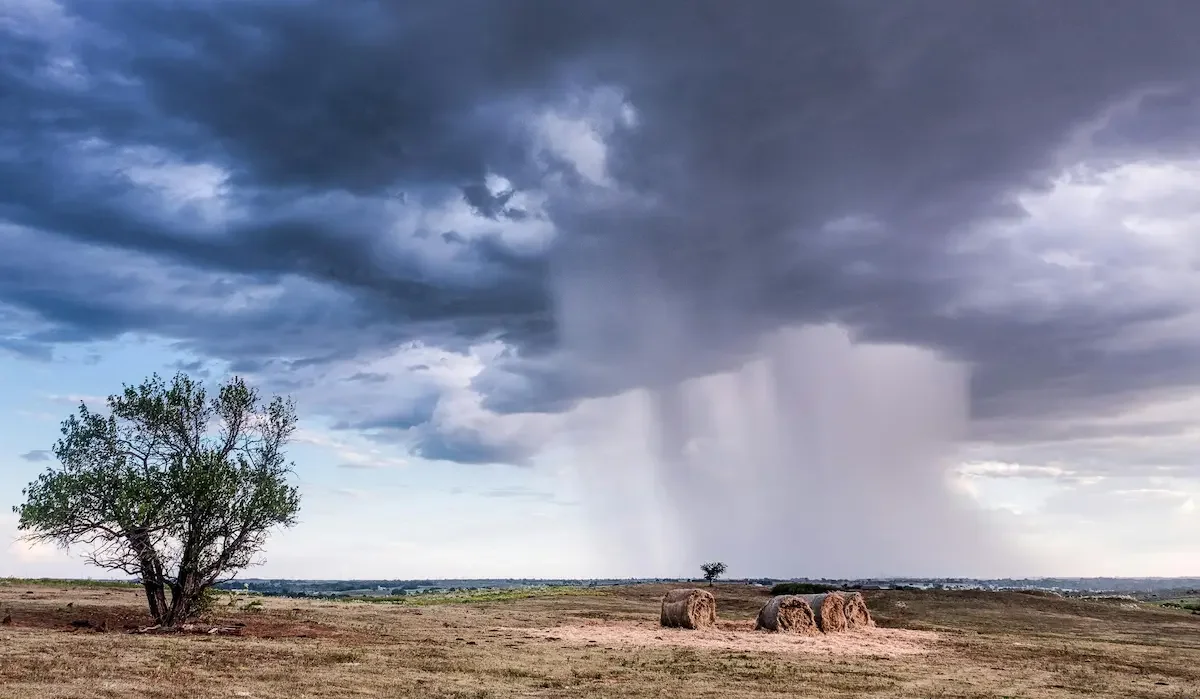
A rainstorm does not begin as a cloud drifting across the horizon. It begins as a vertical engine driven entirely by the wind. For centuries, people viewed clouds as passive reservoirs carried along by horizontal breezes. In 1841, American meteorologist James Pollard Espy overturned that idea in The Philosophy of Storms. Espy proved that clouds are manufactured on the spot by upward motion. When surface winds collide, they have nowhere to go but up. As this air ascends, atmospheric pressure drops, forcing the air to expand and cool. The moment it hits the dew point, invisible moisture condenses onto airborne particles. The wind does not import a pre-existing cloud; its vertical rush conjures the cloud into existence.
Once this buoyant column of moist air rises, prevailing winds aloft take over, stretching and laying out the condensing mass across the sky into broad sheets and towering anvils. Yet even an expansive cloud canopy cannot produce rain on its own. Its microscopic droplets are so light that rising air currents keep them suspended.
To turn this floating canopy into rainfall, the engine shifts to an internal microphysical phase. In 1911, German geophysicist Alfred Wegener discovered the trigger, later confirmed in the 1930s by Tor Bergeron and Walter Findeisen. High inside the cold reaches of the cloud shield, ice crystals and supercooled water droplets mix in delicate disequilibrium. Because ice binds moisture more tightly than liquid water, the ice crystals siphon vapor away from neighboring droplets. Within minutes, these crystals swell into heavy particles, turning the cloud into an active, water-bearing system.
This sudden buildup of weight triggers the final stage of the machine. In 1958, meteorologist Joanne Simpson showed that tropical weather systems are driven by powerful localized updrafts and downdrafts. Simpson’s research through the 1980s and 1990s proved that as heavy moisture begins to fall, a storm never unloads as a single, uniform ceiling. Instead, internal downdrafts tear the expansive cloud canopy apart, fracturing the unified mass into distinct, localized convective cells. The rain bursts forth directly from inside these broken fragments. From the initial ground-level updraft to the final localized downpour, wind acts as the working mechanism at every step—building the cloud, spreading it across the sky, arming its cold core, and breaking it into pieces that deliver rain.
السياق القرآني
اللَّهُ الَّذِي يُرْسِلُ الرِّيَاحَ فَتُثِيرُ سَحَابًا فَيَبْسُطُهُ فِي السَّمَاءِ كَيْفَ يَشَاءُ وَيَجْعَلُهُ كِسَفًا فَتَرَى الْوَدْقَ يَخْرُجُ مِنْ خِلَالِهِ فَإِذَا أَصَابَ بِهِ مَن يَشَاءُ مِنْ عِبَادِهِ إِذَا هُمْ يَسْتَبْشِرُونَ
— القرآن 30:48
This verse begins by placing the wind at the very start of the sequence: Yursilu al-riyāḥ (He sends the winds), followed immediately by fa-tuthīru saḥāban (and they stir up a cloud). The verb athāra denotes agitating, rousing, or lifting into motion. The early authority Ibn ʿAbbās (d. 687) explained that the winds do not merely encounter an existing cloud; they churn and elevate vapors until a cloud takes form. Linguist Al-Zamakhsharī (d. 1144) noted in Al-Kashshāf that the wind acts as the active cause, lifting air upward so that the cloud is the direct result of that ascent. Fakhr al-Dīn al-Rāzī (d. 1210) observed that placing ithāra before the mention of the cloud establishes the wind upstream in the causal order. The cloud is not something the wind merely moves; it is what the wind’s upward motion brings into being.
The sequence unfolds with fa-yabsuṭuhū fī al-samāʾ (and He spreads it across the sky). Derived from the root for laying out or unrolling, the verb describes broad spatial expansion rather than transit from one place to another. Commentator Al-Qurṭubī (d. 1273) observed that the cloud is drawn out across the sky like an expansive fabric kayfa yashāʾ (however He wills), emphasizing that its growth stretches freely across the overhead expanse.
Then comes a deliberate structural shift: wa-yajʿaluhū kisafan (and He makes it fragments). The word kisaf refers to pieces broken off from a unified whole, like shards breaking from a single vessel. The expansive cloud cover, having first spread wide, does not release rain as one unbroken sheet. Instead, it is partitioned into distinct, smaller segments.
From within these segments, the final event takes place: fa-tarā al-wadqa yakhruju min khilālihi (so you see the rain emerge from within it). Commentator Al-Bayḍāwī (d. 1286) highlighted the prepositional phrase min khilālihi—the rain is generated inside the broken pieces, emerging directly from their interior rather than falling from an external source above them.
المقال السابق
Next Post
الخط الزمني المرجعي
600 CE
1000 CE
1500 CE
2000 CE
Quran verse 30:48
615 CE–632 CE
Outlines the sequential lifecycle of rainstorms, from wind-driven cloud generation and broad expansion to structural fragmentation and internal precipitation release
687 CE
Ibn ʿAbbās explains that the winds do not merely encounter floating clouds but actively churn and elevate atmospheric vapors until a cloud takes form
Ibn ʿAbbās (d. 687), recorded in classical tafsīr traditions
1144 CE
Al-Zamakhsharī identifies the wind as the active cause of condensation, observing that lifted air is the very substance from which the cloud forms
Al-Zamakhsharī (d. 1144), Al-Kashshāf ʿan Ḥaqāʾiq Ghawāmiḍ al-Tanzīl
1210 CE
Fakhr al-Dīn al-Rāzī analyzes the causal syntax of the verse, demonstrating that placing ithāra before the cloud establishes the wind upstream of cloud creation
Fakhr al-Dīn al-Rāzī (d. 1210), Mafātīḥ al-Ghayb (Tafsīr al-Kabīr)
1273 CE
Al-Qurṭubī defines yabsuṭuhū as broad spatial expansion across the sky rather than lateral travel, likening the spreading cloud to an unrolled fabric
Al-Qurṭubī (d. 1273), Al-Jāmiʿ li-Aḥkām al-Qurʾān
1286 CE
Al-Bayḍāwī highlights the phrasing min khilālihi, explaining that precipitation is generated within the cloud’s broken fragments rather than descending from an outside source
Al-Bayḍāwī (d. 1286), Anwār al-Tanzīl wa-Asrār al-Taʾwīl
1841 CE
James Espy publishes The Philosophy of Storms, proving that clouds are formed by converging winds and rising air rather than carried in from elsewhere
James Pollard Espy, The Philosophy of Storms (1841)
1911 CE
Alfred Wegener identifies the microphysical disequilibrium between supercooled droplets and ice crystals, laying the basis for cold-cloud rain
Alfred Wegener, Thermodynamik der Atmosphäre (1911)
1938 CE
Tor Bergeron and Walter Findeisen confirm the Wegener–Bergeron–Findeisen process, showing how ice crystals siphon vapor from neighboring droplets to produce heavy rain
Tor Bergeron, On the Physics of Cloud and Precipitation (1935); Walter Findeisen, Meteorologische Zeitschrift (1938)
1958 CE
Joanne Simpson discovers tropical hot towers and characterizes convective organization, showing that cloud shields fracture into localized rain cells rather than discharging uniformly
Riehl & Simpson (1958); Simpson et al., NASA TRMM convective studies (1988–1998)
وجه الارتباط
The Quranic sequence traces a deliberate, unbroken progression: winds stir up moisture, spread it across the sky, fracture the cloud canopy into fragments, and release rain from deep within those pieces. Modern meteorology mirrors this exact lifecycle. A storm does not fall as a uniform sheet; it requires dynamic wind-driven updrafts to trigger condensation, prevailing winds to expand the canopy, and internal downdrafts to break the mass into convective cells that generate downpours.
روابط ذات صلة

Springs from the Earth
Spring Water, Soil Enrichment, and the Diversity of Arid-Land Agriculture
Geoscience