The Inheritance Puzzle
Mark as readKhwarazm (Uzbekistan) → House of Wisdom, Baghdad
Obligation → InventionOverview
Islamic inheritance rules required dividing estates into exact fractional shares across family heirs, debts, and bequests. Resolving these intricate claims demanded an exact, systematic system, prompting scholars to turn a sacred legal duty into a universal science of calculation.
Legal roots
Scriptural rules assigned strict shares—halves, thirds, eighths—that frequently overlapped with debts and legacy gifts. Standard arithmetic proved clumsy and error-prone, creating a need for an exact mathematical method to guarantee legal fairness.
The breakthrough
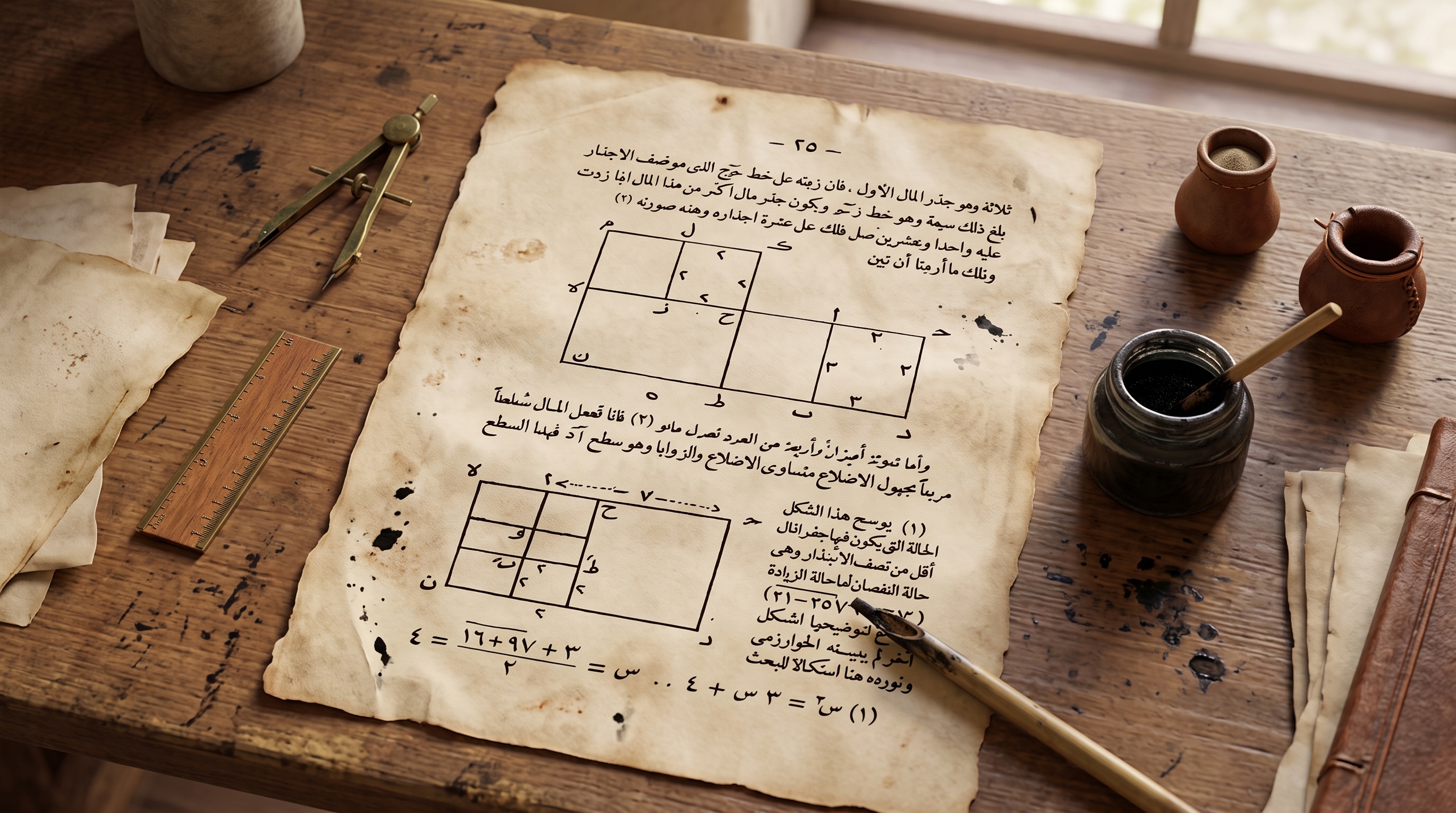
In Baghdad, al-Khwarizmi formulated algebra (al-jabr) specifically to resolve these inheritance distributions. By balancing equations to find unknown quantities, he transformed practical estate disputes into an entirely new mathematical discipline.
Civic impact
Algebra quickly moved beyond legal courts into everyday public works. Engineers and surveyors used these equations for canal excavation, land assessment, and commerce, turning a legal tool into the universal foundation of modern calculation.
Sources
- Qurʾān 4:11–14
- al-Khwārizmī, Al-Kitāb al-mukhtaṣar fī ḥisāb al-jabr wal-muqābala (c. 820 CE)
- Fibonacci, Liber Abaci (1202 CE)
- Statuto dell’Arte del Cambio di Firenze (1299 CE)
- Gandz, S., “The Algebra of Inheritance,” Osiris (1938)
- Menninger, K., Number Words and Number Symbols (1969)
- Berggren, J. L., Episodes in the Mathematics of Medieval Islam (1986)
- Rashed, R., Al-Khwārizmī: The Beginnings of Algebra (2009)
- Burnett, C., Numerals and Arithmetic in the Middle Ages (2010)
- Devlin, K., The Man of Numbers (2011)