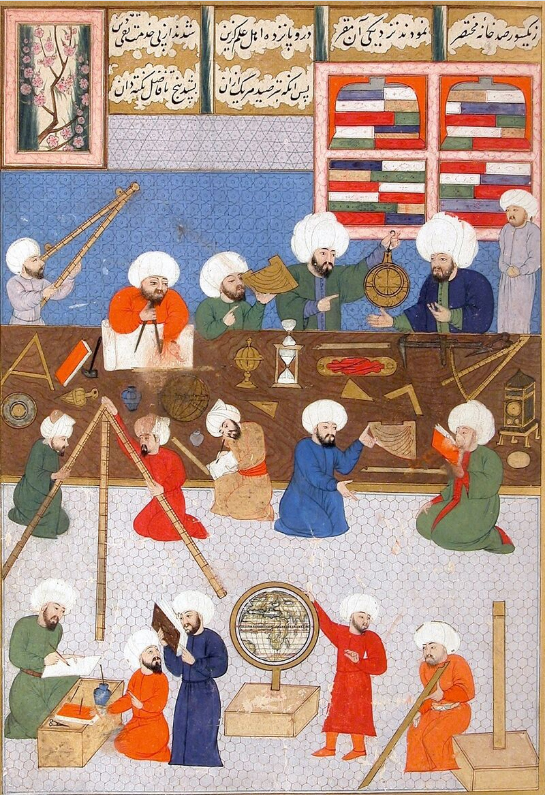
The Astronomers of the Mosques
Mark as readHarran (Türkiye) → Maragha (Iran) → Samarkand (Uzbekistan) → Cairo & Damascus
Worship obligation → Precision scienceOverview
Five daily prayers follow the sun’s shadow angle, and the qibla must be found from any city on the globe — solving both demands spherical trigonometry. That worship obligation turned every mosque into a mathematics problem and produced the best astronomy on Earth.
Science as salaried work
From the 13th century, great mosques employed muwaqqits — professional timekeeper-astronomers — making astronomy an institutional career across Egypt and Syria.
Tables Copernicus quoted
Al-Baṭṭānī of Harran (d. 929) took geometrical models that had travelled by translation from Greece, rebuilt them into observation-driven astronomy Ptolemy never attempted, measured the solar year to within minutes, and was cited by name in Copernicus’ De Revolutionibus (1543).
Precision unmatched for 150 years
Ulugh Beg’s Samarkand observatory (1420s) charted over 1,000 stars with accuracy Europe matched only under Tycho Brahe around 1580.
Sources
- al-Baṭṭānī, az-Zīj aṣ-Ṣābi’ (c. 900)
- Copernicus, De Revolutionibus III (1543) — cites al-Baṭṭānī by name
- Ulugh Beg, Zij-i Sultani (c. 1437)