Geoscience
الرياح اللواقح
السياق العلمي
نقل حبوب اللقاح والغبار المعدني بالرياح
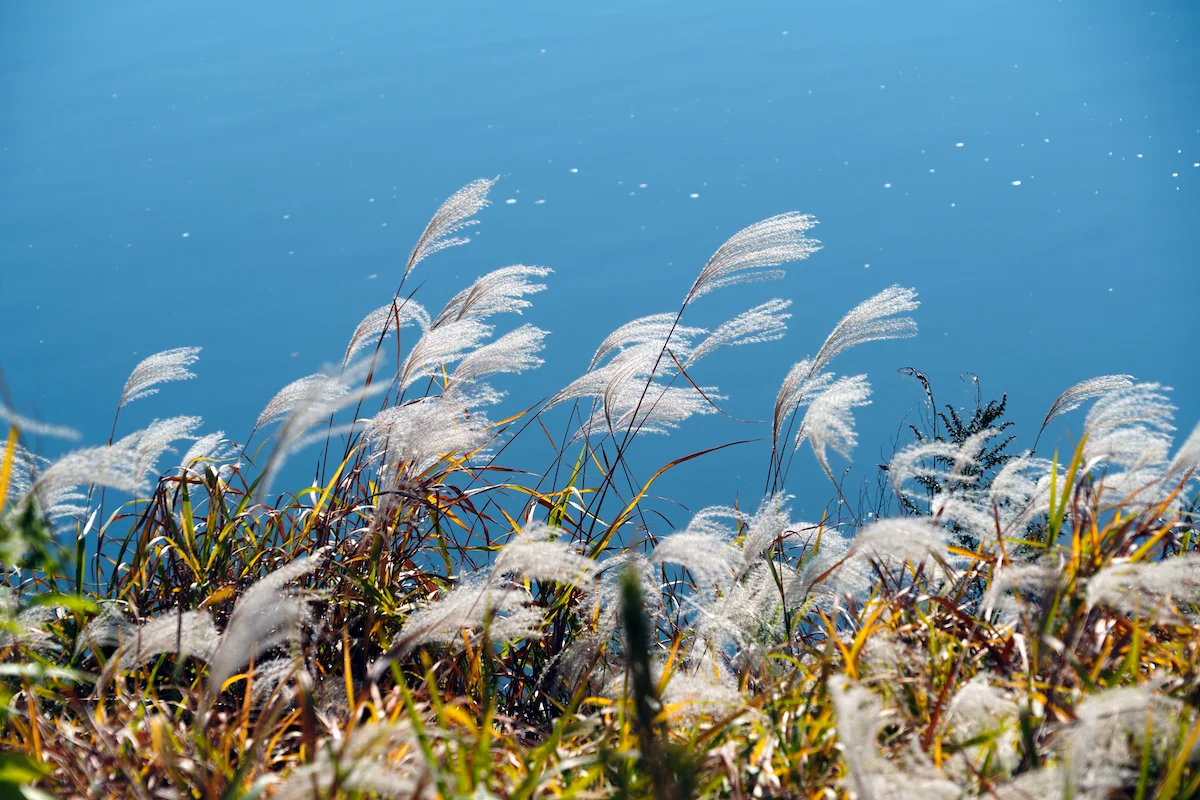
Historically, pollination research focused almost entirely on the showy side of biology: bees, birds, and insects lured by sweet nectar and bright petals. Wind was often treated as a clumsy, wasteful alternative—a blunt numbers game that tossed pollen into the air and hoped for the best. That view changed in 1966 when botanists Knut Faegri and Leendert van der Pijl published The Principles of Pollination Ecology. They showed that wind pollination, or anemophily, is actually a precise aerodynamic strategy. It is, in fact, the primary reproductive engine behind the world’s vast grasslands, conifer canopies, and staple cereal grains.
On the ground, this airborne handoff runs on a tight schedule. A wheat plant, for instance, opens its flowering window for only a few days each growing season. It spends no energy growing colorful petals or producing scent. Instead, it dumps millions of microscopic pollen grains straight into passing breezes. Local drafts lift and scatter the grains across the field; Pollen grains that land on a receptive neighbor fertilize the plant and set seed. If the air stays completely dead during those few days, the window closes, the pollen settles into the dirt, and the crop yields nothing.
The atmosphere runs the same transport system over open water, but on an intercontinental scale. Every year, trade winds scoop up roughly 180 million tonnes of fine mineral dust from the Sahara Desert and haul it thousands of miles across the Atlantic Ocean. In the 1970s, atmospheric chemist Joseph Prospero set up a monitoring station on the island of Barbados, analyzing the airborne haze until he proved its mineral makeup matched Saharan soil.
In 1988, oceanographer John Martin demonstrated why that airborne soil matters to global biology. Through his "Iron Hypothesis," Martin showed that vast expanses of the open ocean are packed with primary nutrients like nitrogen and phosphorus, yet remain strangely barren because they lack bioavailable iron. Saharan dust is rich in iron oxide. When wind deposits this dust over iron-starved waters, it acts like fertilizer, sparking explosive blooms of single-celled phytoplankton. These microscopic algae feed the entire marine food web and generate a massive share of the planet's oxygen.
From a grain of pollen drifting across a farm to millions of tonnes of desert dust feeding the sea, the atmosphere is never just moving air. It functions as a working carrier, lifting essential chemical and biological cargo in one region and depositing it where life needs it next.
السياق القرآني
وَأَرْسَلْنَا الرِّيَاحَ لَوَاقِحَ فَأَنزَلْنَا مِنَ السَّمَاءِ مَاءً فَأَسْقَيْنَاكُمُوهُ وَمَا أَنتُمْ لَهُ بِخَازِنِينَ
— القرآن 15:22
The core of this verse rests on a single, evocative word: lawāqiḥ (fertilizing or impregnating). In classical Arabic, the root comes directly from the vocabulary of animal husbandry and plant cultivation to describe the transfer of generative seed to produce new life. By describing the winds as lawāqiḥ the text treats moving air not as passive drift or indifferent weather, but as an active courier. The wind is dispatched with a specific task, to lift the essential catalysts of growth from donor to recipient and carry them across the land.
Early interpreters focused directly on this physical role. The Prophet’s companion Ibn Abbas (d. 687) explained that the winds act as literal conveyors operating with two distinct roles, they sweep across branches to pollinate blossoms, while simultaneously churning atmospheric moisture until clouds swell with rain. Preserving these early reports, Al-Tabari (d. 923) emphasized that the wind is named directly for what it bears. Its identity in the text is defined entirely by its cargo, moving air whose purposeful work is to distribute vital materials that trigger new growth across the land.
Al-Razi (d. 1210) expanded this observation into an overarching principle of planetary provision. He noted that lawāqiḥ is not confined to a single plant or a solitary field. Rather, it frames the entire atmosphere as an open distribution system. Air currents sweep up vital elements where they originate in abundance and carry them across distant skies, sustaining territories that cannot produce those resources on their own. For Al-Razi, the wind serves as an active bridge of mutual sustenance, ensuring the earth functions as an interconnected whole rather than isolated fragments.
The verse completes the picture by linking this airborne transport directly to rainfall: the fertilizing winds are sent first, and water descends after. Al-Qurtubi (d. 1273) observed that this sequence describes a unified, two-stage system. The wind initiates the biological cycle by delivering the spark of life, and the falling rain follows to nourish and sustain it. The two events share a single grammatical frame because they operate as one unbroken continuum in the natural order.
المقال السابق
Next Post
الخط الزمني المرجعي
600 CE
1000 CE
1500 CE
2000 CE
Quran verse 15:22
615 CE–632 CE
Identifies the winds as active fertilizing agents (lawāqiḥ) dispatched to transport the essential catalysts of life and initiate rain
687 CE
Ibn ʿAbbās explains that the winds act as physical conveyors, cross-pollinating trees so they set fruit and churning clouds to produce rain
Ibn ʿAbbās (d. 687), recorded in Jāmiʿ al-Bayān
923 CE
Al-Ṭabarī establishes that the wind is named directly for its cargo, functioning as an active carrier of the materials needed to initiate life
Al-Ṭabarī (d. 923), Jāmiʿ al-Bayān ʿan Taʾwīl Āy al-Qurʾān
1210 CE
Fakhr al-Dīn al-Rāzī frames the atmosphere as an open distribution system, transporting vital elements across regions in an ongoing cycle of mutual provision
Fakhr al-Dīn al-Rāzī (d. 1210), Mafātīḥ al-Ghayb (Tafsīr al-Kabīr)
1273 CE
Al-Qurṭubī explains that the verse outlines a unified two-stage system: the wind initiates growth by delivering the spark of life, and falling rain follows to nourish it
Al-Qurṭubī (d. 1273), Al-Jāmiʿ li-Aḥkām al-Qurʾān
1966 CE
Knut Faegri and Leendert van der Pijl publish The Principles of Pollination Ecology, establishing wind pollination as a precise, essential aerodynamic strategy
Knut Faegri & Leendert van der Pijl, The Principles of Pollination Ecology (1966)
1970 CE
Joseph Prospero establishes aerosol monitoring stations in the Caribbean, chemically proving that transatlantic dust plumes originate from Saharan soil
Joseph M. Prospero, Earth and Planetary Science Letters (1970)
1988 CE
John Martin formulates the Iron Hypothesis, showing that atmospheric transport of iron-bearing mineral dust is the primary catalyst for open-ocean phytoplankton blooms
John H. Martin, Paleoceanography (1988)
وجه الارتباط
The Quranic use of lawāqiḥ (impregnating/fertilising) identifies moving air as an active carrier defined by the generative cargo it transports across the earth. Modern ecology and oceanography confirm this physical mechanism at every scale: local breezes carry microscopic pollen across flowering croplands, while transatlantic trade winds haul millions of tonnes of mineral dust to fertilize iron-limited oceans. Where the Quran describes the wind's structural role as an instrument of planetary provision, science describes precise aerodynamic and chemical pathways that sustain life across distant ecosystems.
روابط ذات صلة
Springs from the Earth
Spring Water, Soil Enrichment, and the Diversity of Arid-Land Agriculture
Geoscience