Astroscience
Constructed With Strength
Scientific Context
Dynamics of Universal Expansion
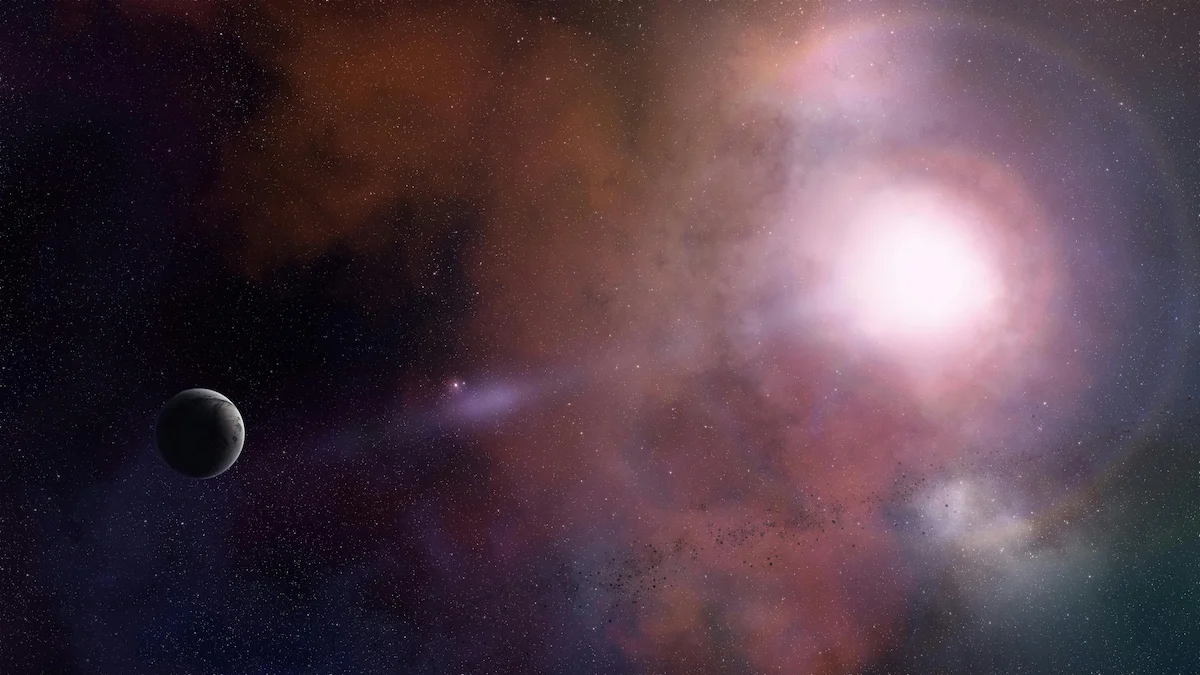
In 1929, the American astronomer Edwin Hubble made one of the most consequential discoveries in the history of science. By analyzing the light from distant galaxies using the 100-inch Hooker telescope at Mount Wilson Observatory, he found that nearly every galaxy was moving away from our own. Hubble determined this by observing cosmological redshift—a phenomenon where the fabric of space stretches the wavelength of traveling light, shifting it toward the red end of the spectrum. More importantly, he observed that the farther away a galaxy was, the more its light was stretched, meaning it was receding faster. This relationship, now known as Hubble's Law, demonstrated that the universe is not static, but actively expanding. The implication was staggering: if the universe is growing larger now, it must have been smaller in the past.
The discovery of cosmic expansion was rooted in the theoretical framework of Albert Einstein's general relativity, published in 1915. When Einstein first formulated his field equations, the mathematics naturally pointed to a dynamic, moving universe. To force the equations to depict the static universe accepted at the time, Einstein inserted a "cosmological constant"—a decision he later called the greatest blunder of his life. In the 1920s, a Russian mathematician named Alexander Friedmann and a Belgian physicist named Georges Lemaître independently solved Einstein’s original equations, proving mathematically that the universe must be either expanding or contracting. Lemaître took this a step further, proposing that an expanding universe implied a definitive beginning: a primordial atom from which all matter, energy, space, and time originated. This became the foundation of the Big Bang theory.
Modern cosmology has refined this picture considerably. In 1998, two independent teams of astronomers studied distant Type Ia supernovae—exploding white dwarf stars that burn with such consistent, predictable luminosity that astronomers use them as cosmic "standard candles" to measure vast distances. The data yielded a shocking result: the expansion of the universe is not slowing down under the weight of its own gravity, as physicists had long assumed. Instead, it is accelerating. This acceleration is driven by dark energy, a mysterious force comprising roughly 68 percent of the total energy density of the universe. Measurements from the Planck satellite and the James Webb Space Telescope continue to confirm that the fabric of space itself is continuously stretching—carrying galaxies along with it—at an ever-increasing rate.
Islamic Context
وَالسَّمَاءَ بَنَيْنَاهَا بِأَيْدٍ وَإِنَّا لَمُوسِعُونَ
And the heaven We constructed with strength, and indeed, We are its expander.
— Quran 51:47
The verse describes the architecture of the cosmos by placing two verbs in a highly deliberate sequence: banaynāhā ("We constructed it") and la-mūsiʿūn ("We are its expander").
The linguistic precision here is extraordinary. The first word, banaynāhā, describes a completed past act. The second word, mūsiʿūn, is the active participle of the verb awsaʿa (to widen, expand, or extend). In classical Arabic grammar, an active participle does not denote a finished event; it dictates a continuous, ongoing, and active state. Furthermore, the prefix la- acts as an intensifier, emphasizing the certainty and magnitude of this continuous action. The grammar strictly translates to: "We are continuously expanding it."
For centuries, this strict literal grammar presented a conceptual puzzle for classical Quranic scholars. Because a dynamic, expanding universe was not imagined prior to the 20th century, foundational interpreters like al-Tabari (d. 923) and al-Qurtubi (d. 1273) leaned away from a literal physical expansion. Instead, they interpreted the active participle metaphorically, suggesting it meant "We possess expansive power and abundance." or "We made it vastly expansive." They recognized the grammar of expansiveness, but lacked the framework to understand it as an ongoing physical mechanism.
In the 20th century, the advent of modern cosmology offered a new lens through which to approach this verse, adding to rather than overriding classical interpretations. As astrophysics began to reveal a dynamic universe, early pioneers of modern scientific interpretation, such as the Egyptian scholar Tantawi Jawhari (d. 1940) in the 1920s and 30s, observed that these new discoveries aligned beautifully with the verse's demanding grammar.
Building on this foundation, prominent later scholars like Metwali Al-Shaarawy (d. 1998) explicitly connected the text to modern astrophysical consensus. Al-Shaarawy argued that the active participle mūsiʿūn operates as a literal description of a physically and continuously stretching universe, pointing to the immense, growing distances between galaxies as direct confirmation of the text's mechanical description. While maintaining that classical interpretations of immense divine power remain entirely valid, scholars like Al-Shaarawy recognized that the text demonstrates how the Quran continues to unfold, yielding new layers of physical reality as human observation expands.
Prev Post
Next Post
Reference Timeline
600 CE
1000 CE
1500 CE
2000 CE
Quran verse 51:47
615 CE–621 CE
Surat Adh-Dhariyat describes the heavens as being continuously expanded by God "and indeed, We are its expander."
923 CE
al-Tabari leans away from a literal physical expansion, interpreting the active participle metaphorically as 'We possess expansive power and abundance'
Al-Tabari, Jami' al-bayan (d. 923)
1273 CE
al-Qurtubi also interprets the grammar of expansiveness metaphorically, recognizing the grammar but lacking the modern framework of an ongoing physical mechanism
Al-Qurtubi, Tafsir al-Qurtubi (d. 1273)
1915 CE
Albert Einstein formulates the field equations of general relativity, whose mathematics naturally point to a dynamic, moving universe
Albert Einstein, General Relativity (1915)
1927 CE
Alexander Friedmann and Georges Lemaître independently solve Einstein's equations to prove a dynamic universe; Lemaître proposes a definitive beginning
Alexander Friedmann (1922) and Georges Lemaître (1927)
1929 CE
Edwin Hubble observes cosmological redshift, establishing Hubble's Law and definitively proving that the universe is actively expanding
Edwin Hubble, Mount Wilson Observatory (1929)
1935 CE
Egyptian scholar Tantawi Jawhari observes that new discoveries of a dynamic universe align beautifully with the verse's strict grammar of continuous expansion
Tantawi Jawhari, Al-Jawahir fi Tafsir al-Qur'an (d. 1940)
1998 CE
Sheikh Metwali Al-Shaarawy explicitly connects the active participle 'mūsiʿūn' to modern astrophysical consensus, arguing it describes a literal, continuously expanding universe
Sheikh Metwali Al-Shaarawy (d. 1998)
1998 CE
Two independent astronomical teams discover that the expansion of the universe is not slowing down, but accelerating due to dark energy
Supernova Cosmology Project & High-Z Supernova Search Team (1998)
The Connection
The linguistic construction of this verse describes the cosmos with a word that means ongoing, continuous expansion. For over a millennium, classical scholars understood this as an expression of divine power and the vastness of creation. Yet, the precise grammar of the verse described a physical expansion that human beings could not actually observe until 1929. With Hubble's observations and the discovery of dark energy, modern cosmology revealed that the literal phrasing of the Arabic aligns remarkably with the physical universe itself. The heavens are not merely vast; they are being continuously expanded.
Related Connections