Astroscience
Burst Apart
Scientific Context
From Singularity to Cosmos
Prior to the twentieth century, Western cosmology held that the universe was a static, unchanging expanse with no definitive beginning and no end. When astronomers first observed that galaxies were moving apart, the implication that the universe had once been much smaller faced immense resistance. Throughout the 1940s, physicists championed the Steady State model, proposing that the universe continuously generated new matter to fill the expanding gaps, preserving an eternal, unbroken timeline. But the empirical record ultimately pointed to a different architecture: the universe had an absolute physical beginning.
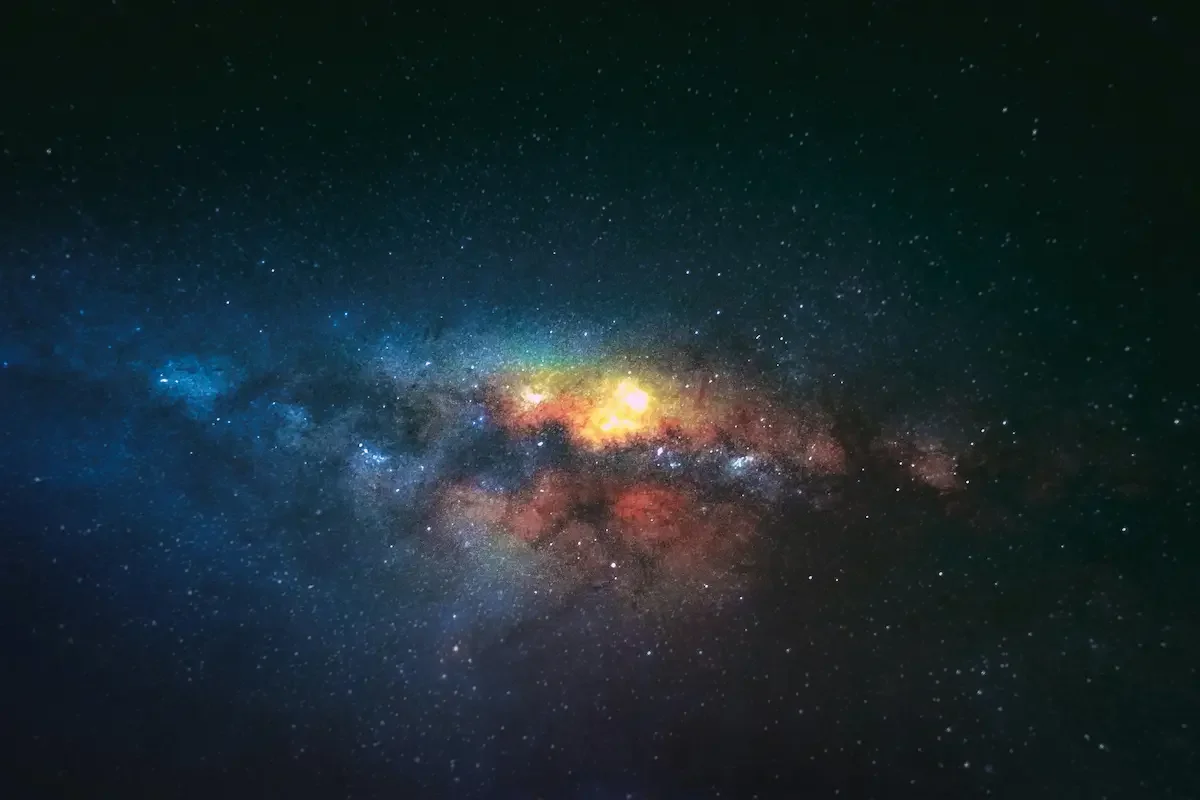
The origin of the cosmos was not an explosion that occurred within empty space, but the rapid, outward expansion of space itself. At its earliest measurable fraction of a second, the universe contained no separate parts. Every trace of matter, energy, and physical dimension was compressed into a singularity—a single, undifferentiated state of extreme heat and density. In this environment, distinct particles and individual elements could not exist, and fundamental forces were entirely merged. It was a completely indivisible physical state.
From that singular point, the universe expanded rapidly. As the fabric of space stretched, the immense internal heat cooled, forcing the previously undifferentiated energy to separate. This separation established the first distinct physical structures. Fundamental particles precipitated out of the heat, followed by simple atoms of hydrogen and helium, which eventually aggregated into the first galaxies. The architecture of the cosmos transitioned directly from absolute compression into vast, separated domains.
This mechanical sequence was confirmed through direct observation. In 1929 Edwin Hubble measured that distant galaxies recede from Earth faster than nearby ones, establishing the mechanics of the expansion. Decades later, in 1965, Arno Penzias and Robert Wilson at Bell Labs detected the thermal residue of that compressed, initial state: a uniform microwave radiation arriving from every direction in the sky. This cosmic microwave background is the oldest light in the universe, released when the cosmos finally cooled enough for distinct atoms to form. Mapped in extraordinary detail by modern satellites, this ancient light provides the definitive physical record of how a singular, dense point separated into the structured cosmos we observe today.
Islamic Context
أَوَلَمْ يَرَ الَّذِينَ كَفَرُوا أَنَّ السَّمَاوَاتِ وَالْأَرْضَ كَانَتَا رَتْقًا فَفَتَقْنَاهُمَا وَجَعَلْنَا مِنَ الْمَاءِ كُلَّ شَيْءٍ حَيٍّ أَفَلَا يُؤْمِنُونَ
Do they not see, those who repudiate, that the heavens and the earth were stitched together, and We burst them apart and We made from water every living thing? So then, will they not have faith?
— Quran 21:30
This verse is built on a precise pair of structural opposites. Ratq (to stitch closed, to seal shut, to be integrated) describes the original state: a single, undifferentiated whole. In this state, the heavens and the earth are locked together in absolute physical unity. Fatq (to split open, to cleave apart) describes the transformation. In classical Arabic, the two are exact antonyms and the choice of fatq rather than a softer term like farq (to divide) signals that this is not a gentle sorting of material. It is the violent, literal reversal of the original unity. The verse presents a complete sequence: a sealed whole, and the explosive opening of it.
The verse opens with a challenge: "Do those who repudiate not see?" The Arabic verb raʾā carries both physical sight and intellectual perception. Ibn ʿAbbās (d. 687) read ratq and fatq as a literal, physical event. He maintained that the heavens and the earth were originally fused as a single, indivisible mass of matter before God violently separated them into distinct domains. The grammar of the verse reinforces the finality of this rupture. The verb forms kānatā (they were) followed by fafataqnāhumā (and We burst them apart) place this explosive event entirely in the past. The prefix fa- attached to the second verb signals a direct, immediate consequence. It describes a sudden, completed act of creation fundamentally distinct from the present, separated state of the natural order.
Fakhr al-Din al-Razi (d. 1210) approached this physical transition as definitive proof against an eternal universe. He argued that the shift from a continuous, joined mass to a separated architecture proves the physical world is subject to structural change. Because the natural order underwent a fundamental alteration, from absolute unity to division, it could not be static or infinite in its past. For al-Razi, the physical rupture described by fatq established an absolute beginning.
Writing a few decades later, Al-Qurtubi (d. 1273) observed that because no human was present to witness this absolute beginning, the "seeing" demanded by the verse's opening question is ru'yat al-qalb—the seeing of the intellect. The verse challenges the listener to look at the vast, separated architecture of the present world and deduce the original, compressed state that preceded it. It asks the intellect to recognize that the distinct layers of reality were not always apart.
All Posts
Next Post
Reference Timeline
600 CE
1000 CE
1500 CE
2000 CE
Quran verse 21:30
615 CE–621 CE
Surat al-Anbiyaa vividly describes the separation of the universe: "the heavens and the earth were stitched together, and We burst them apart"
687 CE
Ibn Abbas maintains the heavens and earth were stuck together as a single indivisible mass before God violently separated them
Ibn Abbas (d. c. 687), as recorded by al-Tabari and al-Qurtubi
923 CE
al-Tabari records his concurring opinion that the heavens and earth were a single indivisible mass before God separated them
Al-Tabari, Jami' al-bayan 'an ta'wil ay al-Qur'an (d. 923)
1210 CE
Al-Razi concludes that the shift from a continuous joined mass to a differentiated universe is proof that it could not be eternal and must have had a definitive beginning
Mafatih al-Ghayb: Al-Razi (d. 1210)
1272 CE
al-Qurtubi observes that because no human witnessed the origin of the cosmos, the verse demands ru'yat al-qalb (the seeing of the intellect) to deduce the original compressed state
Al-Qurtubi, Tafsir al-Qurtubi (d. 1273)
1929 CE
Hubble observes that distant galaxies recede faster than nearby ones — the universe is expanding
Edwin Hubble, Proceedings of the National Academy of Sciences (1929)
1965 CE
Cosmic microwave background detected — the smoking-gun confirmation of a hot, dense, earlier state of the universe
Penzias & Wilson, Bell Labs (1965)
The Connection
The Quran describes a universe that began as a single, indivisible mass before undergoing a direct, structural separation. The modern cosmological framework, established over the last century of observation, traces the cosmos back to an undifferentiated singularity that rapidly expanded into distinct structures. The linguistic architecture of the verse perfectly mirrors the mechanical sequence of the physical record, and both paradigms reject an eternal, unchanging universe in favor of a definitive, explosive beginning defined by the move from absolute unity to separation.
Related Connections