Astroscience
Wrapping the Night
Scientific Context
The Spherical Envelopment of Day and Night
The idea of a spherical Earth is not new. As early as the late 6th century BCE, the Pythagorean school theorized that the world was a globe, though their reasoning was based entirely on the belief that a sphere is the most perfect geometric shape. It was not until Aristotle (c. 330 BCE) that this geometry was proven through direct observation, most notably by documenting the continuously curved shadow the planet casts on the moon during lunar eclipses. While this proof became an accepted fact among educated classes during the Middle Ages, it was not until the 16th century—following the first physical global circumnavigations—that it was broadly accepted by the general public.
Yet long before ships sailed around the world, the mechanical operation of day and night served as the ultimate test for any cosmological model. If the Earth were a flat plane, the transition between light and darkness would be inherently problematic. A sun setting below a flat global horizon would plunge the entire world into darkness simultaneously, while a localized sun circling above would create a warped, elliptical boundary of light that fails to match empirical observation.
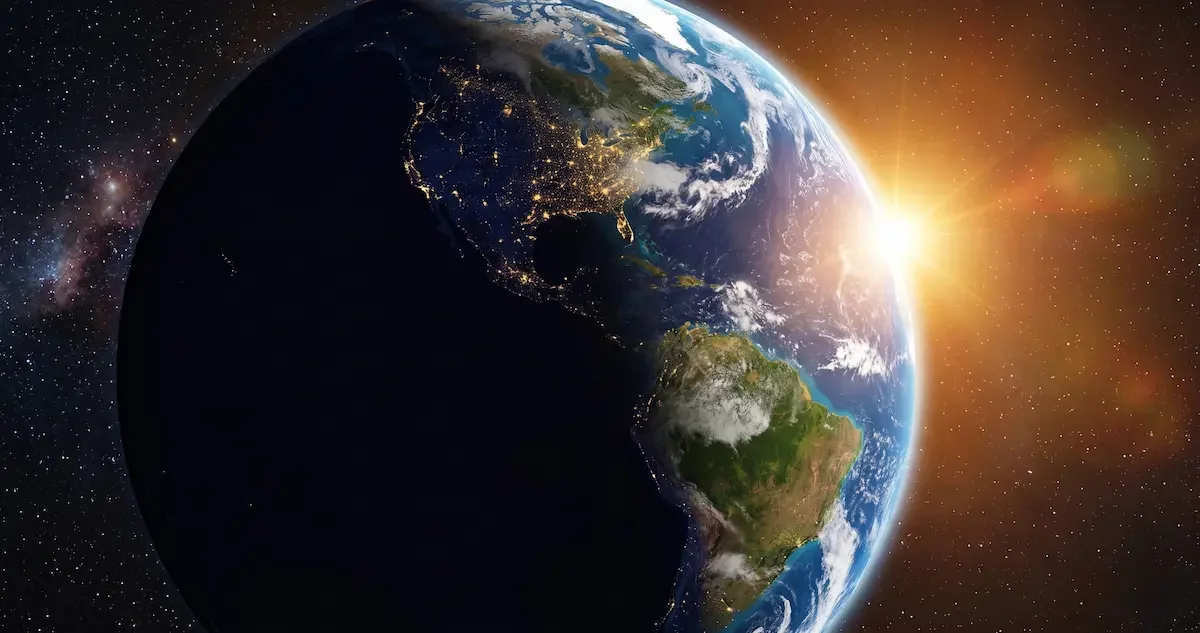
The physical reality of day and night, a continuous, progressive envelopment, is mathematically impossible on a flat surface. It is the direct consequence of a rotating sphere. Sunlight illuminates exactly one hemisphere at any given moment, while the opposite hemisphere remains in its own shadow. As the Earth turns, as demonstrated by Léon Foucault’s pendulum in 1851, the boundary between them, the terminator line, sweeps continuously across the surface.
Because the Earth is a globe, this terminator acts as a progressive gradient rather than a harsh, instantaneous switch. Light literally wraps around the physical curvature of the planet. From the perspective of someone standing on the ground, darkness does not simply "fall" from the sky; it winds around the globe, overtaking the landscape layer by layer. This geometric deduction was finally confirmed through direct external observation in 1946, when a camera aboard a modified V-2 rocket captured the first photograph of Earth from space. The image revealed exactly what the mechanics demanded: the continuous, simultaneous coiling of light and darkness—a highly specific phenomenon that absolutely requires a three-dimensional, rounded volume to exist.
Islamic Context
خَلَقَ السَّمَاوَاتِ وَالْأَرْضَ بِالْحَقِّ يُكَوِّرُ اللَّيْلَ عَلَى النَّهَارِ وَيُكَوِّرُ النَّهَارَ عَلَى اللَّيْلِ وَسَخَّرَ الشَّمْسَ وَالْقَمَرَ كُلٌّ يَجْرِي لِأَجَلٍ مُسَمًّى أَلَا هُوَ الْعَزِيزُ الْغَفَّارُ
He created the heavens and earth in truth. He wraps the night over the day and wraps the day over the night and has subjected the sun and the moon, each running for a specified term. Is He not the Most Esteemed, the Most Forgiving?
— Quran 39:5
The relationship between day and night in this verse is described with the verb yukawwiru which refers to the physical act of winding or coiling something around a circular form. Its most common historical application was takwir al-imamah—the process of wrapping a turban around a person's head, where cloth is wound in successive, overlapping layers around a spherical surface. The word yukawwiru carries strict geometric implications. Because one cannot coil or wrap a garment around a flat sheet in the manner described, the action inherently necessitates a three-dimensional, spherical base.
By the 10th century, the scholar Abu al-Husayn Ibn al-Munadi (d. 947) had documented a unanimous consensus (ijma) among Islamic theologians and astronomers that the Earth is a sphere. However, Ibn Hazm (d. 1064) was the first major scholar to explicitly cite the mechanics of this verse as definitive textual proof of that geometry (kurawiyyat al-ard). He anchored his argument on the precise linguistics of takwir, observing that the verb dictates a continuous, simultaneous process rather than a flat, sequential replacement. Because this wrapping is perpetual, he argued, as night envelops one side of the physical form, day must simultaneously wind around the opposite side.
To address the question "If the Earth is a sphere, why does it appear flat to the human eye?" later scholars built upon this foundation. Fakhr al-Din al-Razi (d. 1210) explicitly affirmed the spherical model, but explained that the Earth's immense scale prevents a human observer on the ground from physically perceiving the curvature. Because any localized line of sight across a massive sphere appears practically flat, human intuition of a flat world is merely a localized illusion of scale, one that does not contradict the planetary reality.
Together, these classical readings demonstrate how early scholars approached the text's mechanical descriptions. For them, the verse did not merely state that day and night alternate; it provided the exact geometric framework, progressive layering around a curved mass, that makes the progression of light and darkness physically possible.
Prev Post
Next Post
Reference Timeline
500 BCE
1 CE
600 CE
1000 CE
1500 CE
2000 CE
Quran verse 39:5
615 CE–622 CE
500 BCE
The Pythagorean school theorizes that the world is a globe, based entirely on the philosophical belief that a sphere is the most perfect geometric shape
Pythagorean School (Late 6th Century BCE)
330 BCE
Aristotle proves the spherical geometry of the Earth through direct observation, documenting the continuously curved shadow the planet casts on the moon during lunar eclipses
Aristotle (c. 330 BCE)
947 CE
Abu al-Husayn Ibn al-Munadi documents a unanimous consensus (ijma) among Islamic theologians and astronomers that the Earth is a sphere
Abu al-Husayn Ibn al-Munadi (d. 947)
1064 CE
Ibn Hazm explicitly cites the mechanics of the verb 'yukawwiru' as definitive textual proof of the Earth's spherical geometry, arguing it dictates a continuous, simultaneous wrapping
Ibn Hazm (d. 1064)
1210 CE
Fakhr al-Din al-Razi explicitly affirms the spherical model, explaining that the Earth's immense scale creates a localized illusion of flatness that does not contradict planetary reality
Fakhr al-Din al-Razi (d. 1210)
1522 CE
The spherical Earth becomes broadly accepted in the West by the general public following the completion of the first physical global circumnavigations
16th Century Expeditions (1522)
1851 CE
Léon Foucault demonstrates the rotation of the Earth with a pendulum, showing the mechanical action that drives the terminator line continuously across the surface
Léon Foucault (1851)
1946 CE
A camera aboard a modified V-2 rocket captures the first photograph of Earth from space, directly confirming the geometric deduction of a three-dimensional, rounded volume
V-2 Rocket Observation (1946)
The Connection
The verb yukawwiru describes wrapping or coiling—a process that requires a curved surface. On a rotating sphere, the terminator sweeps across the surface continuously, enveloping landscapes in stages rather than switching instantaneously. The Quran's choice of this specific verb, rather than alternatives meaning insertion or coverage, aligns with the observable reality of how day and night transition on a curved, rotating world.
Related Connections