Astroscience
When the Heaven was Smoke
Scientific Context
The Opaque Architecture of the Early Universe
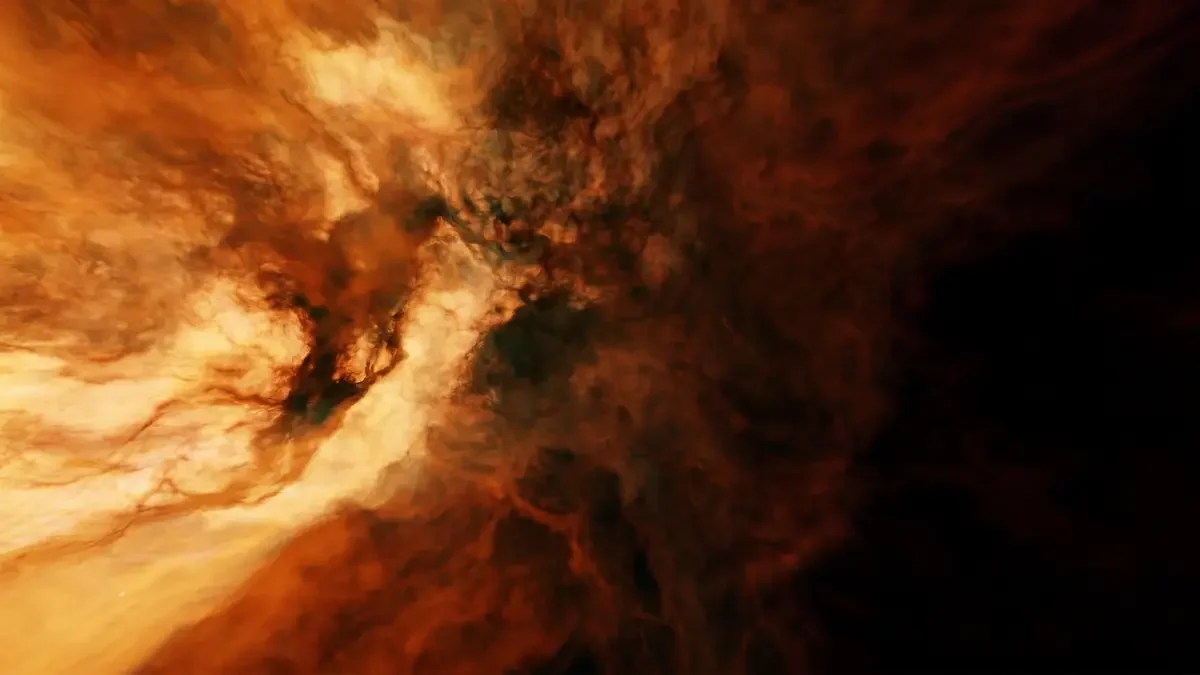
Before the first stars ignited, the universe was not an empty expanse waiting to be filled. It was an aggressively impenetrable, superheated fog. In the immediate aftermath of the Big Bang, the cosmos was a dense plasma of protons, neutrons, electrons, and photons. Because the heat was so intense—exceeding temperatures of 3,000 Kelvin—electrons could not bind to nuclei. Instead, they roamed free, colliding with photons in a continuous process called Thomson scattering. This meant that light could not travel freely. Every photon was almost instantly scattered or absorbed by the surrounding particles, bouncing endlessly in a tightly packed environment. The early universe was not dark, but it was visually completely opaque, shrouded in a glowing, diffuse haze.
The physical composition of this primordial soup is now detailed with extreme precision. In 1964, physicists Arno Penzias and Robert Wilson inadvertently detected the cosmic microwave background—the fading, universal afterglow of this exact era. Decades later, missions like the European Space Agency's Planck satellite mapped this radiation in high resolution across the entire sky. The data confirms that for roughly 380,000 years, the universe was filled with a hot, formless, highly agitated medium. It was a turbulent, particulate gas comprised of roughly seventy-five percent hydrogen and twenty-five percent helium, suspended in a bath of intense radiation. No distinct structures existed, only a pervasive, physical fog expanding uniformly across space.
This formless state was the required precursor to the ordered cosmos. As the universe expanded and cooled, a fundamental mechanical shift occurred. The temperature eventually dropped enough for the free electrons to finally bind with nuclei, forming the first neutral atoms in an event known as recombination. With the electrons suddenly locked away, the endless scattering ceased. Light decoupled from matter and streamed freely across the void, rendering the universe transparent for the first time. The opaque, gaseous medium then began to condense under the influence of gravity, collapsing over hundreds of millions of years into the highly structured universe of stars and galaxies observed today.
Islamic Context
ثُمَّ اسْتَوَىٰ إِلَى السَّمَاءِ وَهِيَ دُخَانٌ فَقَالَ لَهَا وَلِلْأَرْضِ ائْتِيَا طَوْعًا أَوْ كَرْهًا قَالَتَا أَتَيْنَا طَائِعِينَ
Then He directed Himself to the heaven while it was smoke, and said to it and to the earth, "Come, willingly or unwillingly." They said, "We come willingly."
— Quran 41:11
In detailing the stages of creation, Surah Fussilat does not describe the original sky as an empty expanse. The text explicitly anchors the early state of the heavens not to a void, but to a highly specific, physical substance that precedes the established order of the world. It refuses the idea of a universe built out of sheer emptiness.
The vocabulary chosen for this early state is dukhān. In classical Arabic, the word denotes a visible, opaque vapor—a mixture of particles suspended in a gaseous medium that obscures vision and physically fills the space it occupies. It is neither a solid mass nor a transparent emptiness. The early interpreter, Ibn Abbas (d. 687), understood this description literally, viewing the original heaven as a primitive, rising, vaporous mass that filled the space before the sky was distinctly formed. Building on this, the classical commentator Al-Tabari (d. 923) noted that the text deliberately names a state of matter that is formless, unsolidified, and visually impenetrable. The verse presents the early heaven as a pervasive, physical haze.
This smoky state is fundamentally temporary, existing as a raw material waiting for an organizing command. Ibn Kathir (d. 1373) observes that the verse explicitly situates this formless vapor prior to the structural ordering of the cosmos. The heaven is addressed while it is still dukhān, and it is commanded to take form and submit to a physical architecture. The response—"We come willingly"—signals the sudden transition from an unformed, turbulent cloud into an obedient, structured system. The architecture of the verse moves from an initial, turbid, particulate state directly into the establishment of a compliant, ordered universe. The text treats the heaven not as something built instantly out of nothing, but as something structurally organized out of a pervasive, opaque gas.
Prev Post
Next Post
The Connection
The Quran describes the early heaven as dukhān (smoke)—a formless, particulate laden, visually impenetrable, gaseous vapor that preceded the ordered cosmos. Over the past several decades of observing the cosmic microwave background, the cosmological record has come to describe the early universe as a hot, opaque plasma—a dense, particulate fog that filled all of space before condensing into stars and galaxies. The two descriptions are manifestly similar; the initial universe was a pervasive, unformed haze waiting to be structured into clarity.
Related Connections