Physics
Iron Sent Down
Scientific Context
The Stellar Origin of Iron
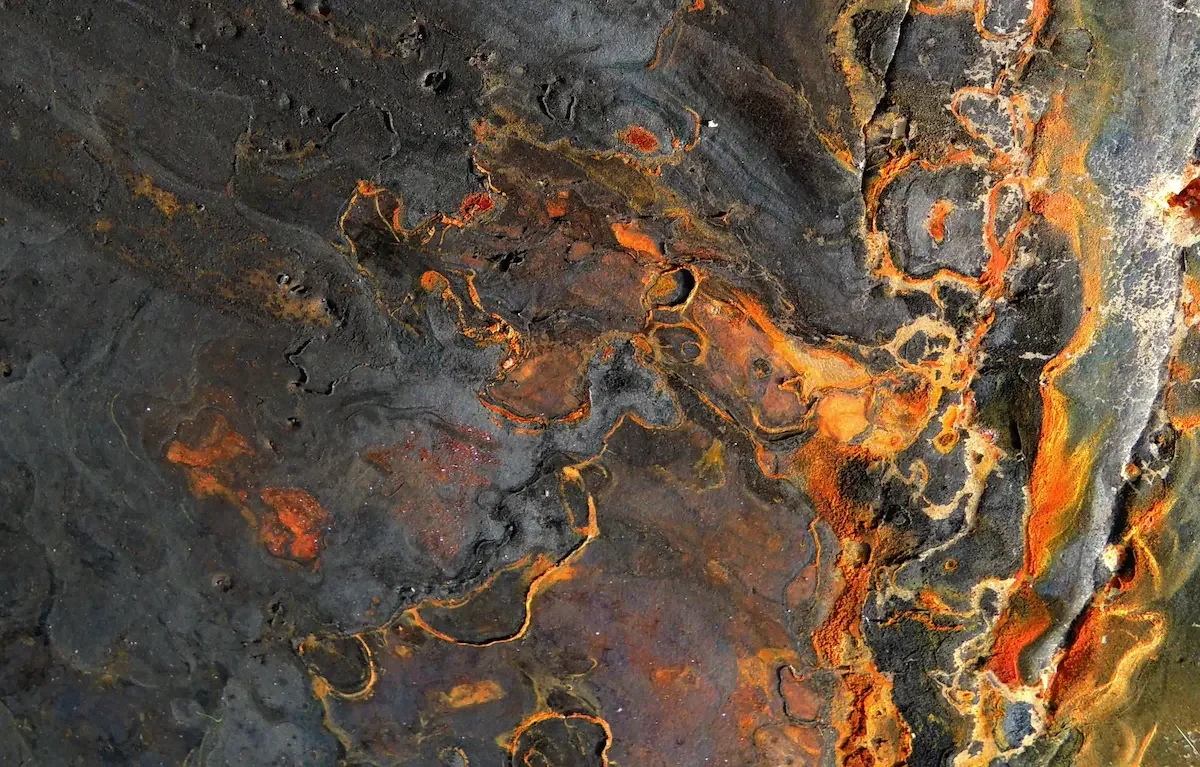
Iron makes up roughly a third of the Earth's mass. It forms the planet's molten core, drives its magnetic field, and runs through the crust in vast veins of ore. Yet the planet cannot produce a single atom of it. Every trace of iron on Earth was forged in the cores of massive stars and scattered across space long before the solar system formed.
A star spends the majority of its lifecycle converting hydrogen into helium. As primary fuels are exhausted, the core contracts and reaches the thermal threshold required to fuse heavier elements: carbon, neon, oxygen, and finally silicon. The mechanical architecture of this process was formalized in 1957. In a foundational publication known as the B²FH paper, physicists Margaret Burbidge, Geoffrey Burbidge, William Fowler, and Fred Hoyle documented the complete sequence of stellar nucleosynthesis. They demonstrated that iron represents the absolute structural limit of this sequence. Because the iron-56 isotope possesses the highest binding energy per nucleon, further fusion cannot yield an energy surplus. The core simply accumulates an inert mass of iron and nickel. At this stage, the outward thermal pressure that sustains the star gives way. Iron cannot be consumed as fuel; it is the terminal ash of stellar combustion.
The resulting structural collapse triggers a Type II supernova. The implosion generates a shock wave that ejects the star’s outer layers, scattering the heavy elements it spent millions of years synthesizing into interstellar space. Building on the 1957 consensus, W. David Arnett and his colleagues at the University of Arizona later demonstrated that this explosive phase itself serves as the principal mechanism for producing additional iron-group elements. The remnants of these explosions provide the material baseline for new stars, planets, and eventually biological life.
The clearest empirical confirmation of this mechanism occurred in February 1987, when Supernova 1987A flared in the Large Magellanic Cloud. Over the following years, observatories in Chile and at NASA identified the spectral signatures of iron, cobalt, and other freshly synthesized heavy elements in the fading remnant, matching the theoretical models of stellar nucleosynthesis point for point. Analyses of ancient meteorites date the formation of the Earth's iron core to roughly 4.5 billion years ago, occurring only after generations of massive stars had already lived, collapsed, and seeded the early solar system. Iron remains the heaviest element a star can build in its core, the most tightly bound nucleus in the periodic table, and the principal mass at the planet's center.
Islamic Context
لَقَدۡ أَرۡسَلۡنَا رُسُلَنَا بِٱلۡبَيِّنَٰتِ وَأَنزَلۡنَا مَعَهُمُ ٱلۡكِتِٰبَ وَٱلۡمِيزَٰنَ لِيَقُومَ ٱلنَّاسُ بِٱلۡقِسۡطِ وَأَنزَلۡنَا ٱلۡحَدِيدَ فِيهِ بَأۡسٞ شَدِيدٞ وَمَنَٰفِعُ لِلنَّاسِ وَلِيَعۡلَمَ ٱللَّهُ مَن يَنصُرُهُۥ وَرُسُلَهُۥ بِٱلۡغَيۡبِ إِنَّ ٱللَّهَ قَوِيٌّ عَزِيزٞ ٢٥
We have sent Our messengers with clear proofs and sent down with them the Book and the Balance so that mankind might uphold justice. And We sent down iron, wherein is great might and benefits for the people, so that Allah may make evident those who support Him and His messengers, though unseen. Indeed, Allah is Powerful and Exalted in Might.
— Quran 57:25
This verse groups iron with the Book and the Balance, using the exact same verb for all three: anzalnā ("We sent down"). In the Quran, the Book and the Balance are understood to represent divine law and justice descending directly from God. By applying the word "sent down" to iron, the text places the physical metal in a unique theological category. It is not treated as something that grew out of the earth, but as a material that arrived from beyond it.
Classical scholars immediately recognized how unusual this phrasing was. Interpreters like Ibn Kathir (d. 1373) held a metaphorical reading—that anzala meant "He created," perhaps because it was grouped with other divine inspirations, or perhaps because it was hard for them to envision iron falling from the sky. Yet, some Quranic scholars like Ibn Abbas (d. 687) refused to abandon the literal text. He maintained that iron literally came down from the heavens, explaining that when Adam was descended from Paradise, iron tools were sent down with him.
Modern scholars point to this exact debate as a profound example of how Quranic interpretation evolves alongside human knowledge. For 20th-century interpreters like Sheikh Muhammad El-Shaarawy (d. 1998), the transition from classical to modern understanding is a deliberate feature of the Quran. The text intentionally employs strict, literal language—categorizing iron as an extraterrestrial import—and simply waits for human science to advance enough to grasp the physical mechanism.
Contemporary scholar Dr. Zaghloul El-Naggar suggests that modern astrophysics definitively settles this classical debate. His view is that early scholars who insisted on a literal reading were entirely correct; they simply lacked the vocabulary of stellar nucleosynthesis and supernovae to explain how the iron fell. The divine text remains fixed, but the understanding has undergone a revision.
Prev Post
Next Post
Reference Timeline
600 CE
1000 CE
1500 CE
2000 CE
Quran verse 57:25
622 CE–632 CE
Surat al-Hadeed (Iron) verse 25 describes "And We sent down iron, wherein is great might and benefits for the people."
687 CE
Ibn Abbas maintains that iron literally came down from the heavens, explaining that when Adam descended, iron tools were sent down with him
Ibn Abbas (d. 687), as recorded by al-Tabari and al-Qurtubi
1373 CE
Ibn Kathir holds a metaphorical reading that 'sent down' means 'He created,' reflecting classical difficulty in envisioning iron falling from the sky
Ibn Kathir, Tafsir al-Qur'an al-'Azim (d. 1373)
1957 CE
The B²FH paper formalizes the sequence of stellar nucleosynthesis, demonstrating that iron is the absolute structural limit of stellar fusion
Burbidge, Burbidge, Fowler, & Hoyle, Reviews of Modern Physics (1957)
1969 CE
W. David Arnett and colleagues demonstrate that the explosive supernova phase is the principal mechanism for producing additional iron-group elements
W. David Arnett, University of Arizona (1969)
1987 CE
Supernova 1987A flares in the Large Magellanic Cloud; subsequent spectral analyses empirically confirm the synthesis of iron and cobalt
Observatories in Chile and NASA (1987)
1998 CE
Sheikh Muhammad El-Shaarawy argues the transition to a modern understanding is a deliberate feature of the text, waiting for science to grasp the mechanism
Sheikh Muhammad El-Shaarawy (d. 1998)
2005 CE
Dr. El-Naggar suggests modern astrophysics settles the classical debate, arguing that early scholars who insisted on a literal reading were correct but lacked the vocabulary of stellar nucleosynthesis
Dr. Zaghloul El-Naggar (Contemporary)
The Connection
All iron on Earth was produced in stellar cores and scattered into space by supernovae long before our solar system even existed. While ancient meteorites date the formation of our local solar neighborhood to roughly 4.6 billion years ago, the iron atoms locked inside them are far older. The Quranic use of the verb "to send down," applied to a substance that did not originate on earth, turns out to describe a literal origin. Iron was, quite precisely, sent down.
Related Connections