Bioscience
A Clay of Black Earth
Scientific Context
The Transformation of Carbon
We are all taught in biology that humans are "carbon-based lifeforms." We memorize the phrase, but we rarely pause to consider what it actually means. In its purest form, carbon is one of the most rigidly ordered elements on the periodic table. If you isolate it under pressure, it forms a diamond—a flawless, unyielding, perfectly symmetrical crystal lattice. So how does the exact same substance that creates the hardest, most static rocks on earth become the flexible, breathing basis of human life?
To understand why carbon is the key to life, we have to look at the greatest irony in chemistry: to build a living body out of lifeless dust, carbon must sacrifice its perfect order and become an agent of chaos.
Because carbon possesses four "chemical hands," it has the unique ability to reach out and bond in multiple directions simultaneously. In the foundational field of prebiotic chemistry, this was famously demonstrated by the Miller-Urey experiment, where researchers simulated the conditions of an early, lifeless earth. Scientists observed that when carbon is introduced to raw elements and exposed to energy, it stops building perfect geometric cages. Instead, it acts like frantic molecular glue. It violently stitches loose earthly elements together, weaving them into the wildly asymmetrical, sprawling, three-dimensional chains that form the basis of organic chemistry.
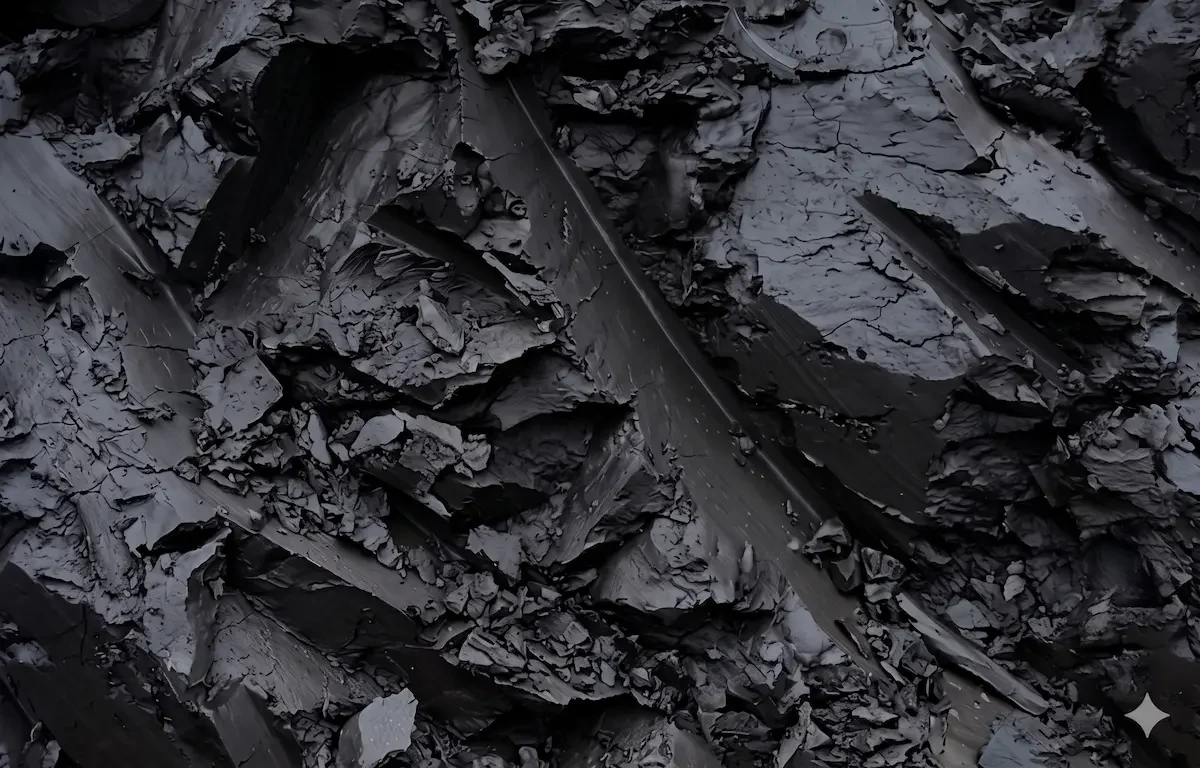
As these massive carbon networks tangle together, carbon fundamentally transforms the earthly material. This was further illuminated by the work of Carl Sagan and Bishun Khare, who investigated how these carbon chains, known as "tholins," interact with light. They discovered that the chemical chaos changes the earth from light, loose dust into a heavy, thick, chemically active matrix. Furthermore, these sprawling, chaotic bonds act like a microscopic sponge, absorbing almost every wavelength of visible light. As a result, the material universally darkens. It physically transforms from pale dust into a profoundly dark, sticky organic sludge. Science recognizes this dark, altered mud as the biological-ready incubator—the absolute prerequisite for life.
Yet, the irony of carbon is that the chaos is only temporary. Once it has fundamentally transformed the dead dust into a biologically viable state, carbon loops back to its original nature. From that dark, chaotic mud, it takes those newly formed organic building blocks and reverts to being an agent of order—but this time, it is a dynamic, living order. It harnesses its chemical hands to build the perfectly sequenced backbone of the DNA double helix. It folds into the meticulous architecture of your muscle fibers. It lines up like precise bricks to build the walls of your cells. It becomes the literal scaffolding upon which the entire human body is built.
Islamic Context
وَلَقَدْ خَلَقْنَا الْإِنسَانَ مِن صَلْصَالٍ مِّنْ حَمَإٍ مَّسْنُونٍ
And We have truly created the human from clay of black earth, transformed.
— Quran 15:26
The Quran outlines the origin of the human being through a progression of material states, emphasizing a transition from raw, elemental earth to a highly refined and structured form. A key passage detailing this process is found in Surah Al-Hijr (15:26): "And We have truly created the human from clay of black earth, transformed." Classical scholars did not view this verse in isolation; rather, they analyzed it as a highly specific phase within a chronological sequence of physical transformations. They understood the creation of the human form not as a singular, instantaneous event, but as a deliberate, staged material process where earthly elements underwent profound physical changes over a period of time.
According to Al-Razi’s (d. 1210) comprehensive analysis of the Quranic descriptions of human creation, the physical process initiates at the basic level of Turāb (raw dust or earth). When water is introduced, it becomes ṭīn (clay). However, the verse in Surah Al-Hijr focuses on the critical, transformative phases that occur after this initial mixture is left to age.
This verse uses the phrase ḥama’in masnūn "clay of black earth, transformed" Al-Tabari (d. 923) traces the linguistic root of ḥama’in to ḥam’ah, which specifically denotes dark, black mud. The greatest analytical focus among the scholars, however, centers on the word masnūn. Their interpretations differ slightly, but all point to a profound physical and chemical alteration. Ibn Abbas (d. 687), and later Al-Baghawi, interpreted masnūn as "altered" or "fermented." They noted that the original earthly mixture was left for a designated period until its core properties changed—specifically noting a shift in its scent and a darkening of its color. It had evolved entirely beyond its original, static mineral state.
Other scholars expanded on the physical properties of this altered state. Al-Qurtubi (d. 1273) noted that masnūn can also mean "poured" or "shaped." He suggested this describes a substance that had become thick, viscous, and active enough to be poured into a specific mold. Therefore, in the consensus of classical thought, ḥama’in masnūn represents a material that has been physically transformed into a dark, highly active, and malleable substance—an earth that has entered a state of dark, active incubation.
Following this fermentation, the scholars note a final physical transition described in the verse: the material becomes ṣalṣāl. Ibn Kathir and Al-Shawkani describe ṣalṣāl as clay that has dried to the point of becoming rigid and "sounding"—meaning if one were to strike it, it would produce an acoustic ring similar to baked pottery. Al-Razi emphasizes that this phase represents the solidification of the previously fluid, altered mud into a defined, stable, and highly structured framework. While ḥama’in masnūn points to the chaotic, malleable, and transformative mud, ṣalṣāl signifies the transition of that matter into a rigid structural state, ready to hold its final form.
What emerges from these classical commentaries is a striking consensus regarding the nature of material creation. The scholars understood the Quranic text to be detailing a systematic taxonomy of earthly refinement. By explicitly charting these states—from raw dust, through a necessary period of dark, active alteration, and concluding with a rigid, structured framework—the classical scholars recognized that the physical vessel of humanity was prepared through a deliberate, sequential evolution of matter, establishing the precise order required for life.
Prev Post
Next Post
The Connection
Carbon’s physical transition as described by science (from a rigid crystal lattice to a chemically active, dark organic matrix, and finally to complex biological structures), mirrors the sequential development described in the Quranic account of turāb, ḥama’in masnūn, and ṣalṣāl. Both frameworks describe an evolution of matter from static earth to a highly organized, functional form. This convergence illustrates that the human physical vessel is the result of a deliberate, staged progression that translates raw material into sophisticated, structured machinery of life.
Related Connections