Geoscience
Springs from the Earth
Scientific Context
Spring Water, Soil Enrichment, and the Diversity of Arid-Land Agriculture
Until the late sixteenth century, the physical mechanism driving groundwater emergence was fundamentally misunderstood. Following the models of Aristotle and Plato, early naturalists assumed that surface rainfall was insufficient to sustain the continuous flow of rivers and oases. They hypothesized that massive subterranean oceans pushed seawater upward through the mountains, somehow filtering out the salt before it reached the surface. It was not until 1580 that French scholar Bernard Palissy accurately proposed that springs were fed entirely by surface precipitation seeping downward. In 1674, Pierre Perrault mathematically proved this meteoric origin by measuring rainfall in the Seine River basin, demonstrating that precipitation volume far exceeded the output of local springs.
Modern hydrogeology shows that water emerging from a spring is chemically distinct from the rain that sourced it. Because water is a near-universal solvent, its subterranean journey fundamentally alters its chemistry. The mechanics of this transit were decoded in 1856 when engineer Henry Darcy formulated a mathematical equation that calculates the rate at which fluid threads downward through porous geological media. As water moves through rock and sediment, it leaches minerals from the surrounding layers. A spring emerging from a limestone aquifer delivers calcium carbonate; one traversing volcanic fissures yields silica and sulfur; one surfacing from sandstone carries iron oxides. Consequently, the water that ultimately breaches the surface is not just accumulated rain; it is a chemical record of the geological pathways it has traversed.
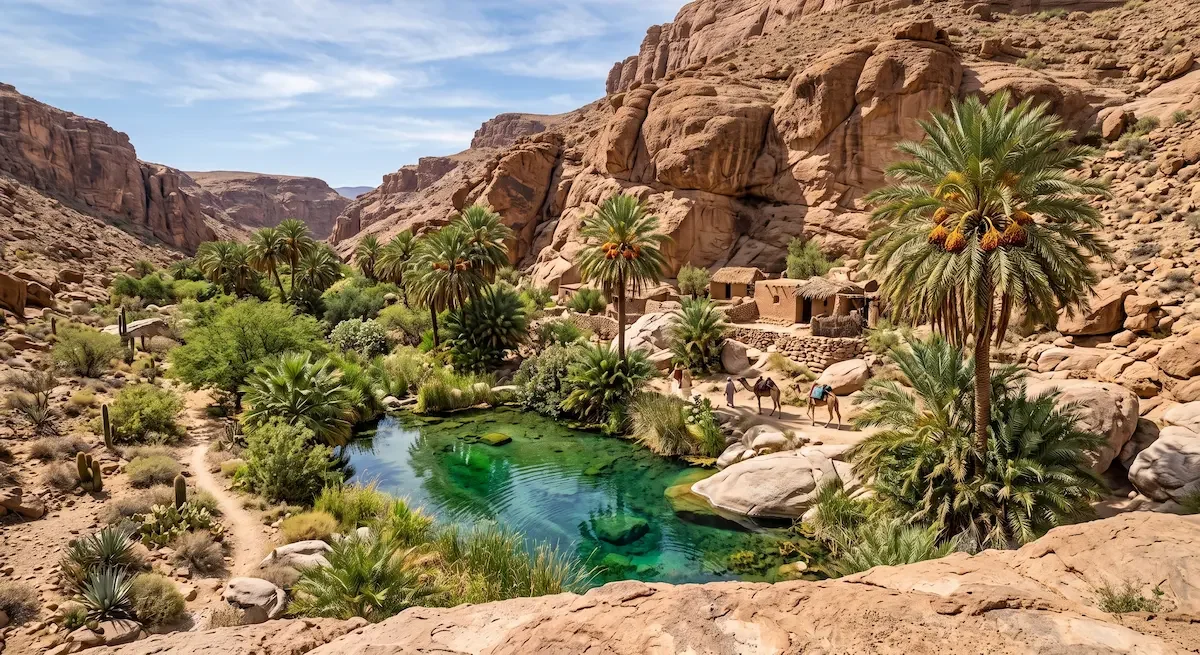
The biological result of this chemistry is directly observable. A 2001 ecological survey by the Arid Land Research Center documented that the mineral content of natural springs supports localized life up to five times denser than the surrounding desert. By providing a steady flow of water and delivering dissolved minerals that pure rain lacks, springs establish soil conditions that seasonal rainfall cannot match. In barren environments, these water sources function as critical hubs for life. They enable the specific plant diversity required to convert empty landscapes into self-sustaining ecosystems.
Islamic Context
أَلَمْ تَرَ أَنَّ اللَّهَ أَنزَلَ مِنَ السَّمَاءِ مَاءً فَسَلَكَهُ يَنَابِيعَ فِي الْأَرْضِ ثُمَّ يُخْرِجُ بِهِ زَرْعًا مُّخْتَلِفًا أَلْوَانُهُ
Do you not see that Allah sent down water from the sky and made it flow as springs in the earth, and then produces thereby crops of varying colours?
— Quran 39:21
The verb that anchors this verse is salaka — “He caused it to thread through.” The word is precise. It does not mean to pour, to bury, or to store. Salaka implies that the water follows a defined course, threading through the earth the way a thread passes through fabric. Al-Rāzī (d. 1210) noted that the choice of salaka over alternatives emphasises route and passage rather than accumulation. In fact, the verbiage is so precise that Ibn ʿAbbās (d. 687) was able to identify the source of the water, the underground path it traverses, and the change that occurs along its journey, stating: "There is no water in the earth except that it descended from the sky, but subterranean veins in the earth alter it."
The plural noun that follows — yanābīʾa (a place where water bubbles forth) is in the same word family as nabb, meaning to flow out or spring up. The verse does not say the water emerges at a single point. It says it emerges as springs — distributed, multiple, scattered. Al-Ṭabarī (d. 923) observed that the plural form captures the actual structure of groundwater emergence: water does not rise at one location and stop, but surfaces wherever the geological pathways allow it to. The verse language mirrors the system: many routes in, many outlets out.
The grammatical sequence is equally precise. The verse moves from salaka (He caused it to thread through) to thumma yukhriju (then He brings forth). The word thumma — “then” — marks sequence, not simultaneity. The water is not emerging while it descends; it descends first, then emerges. Al-Rāzī noted that this ordering captures something the verse treats as essential: an internal phase, then an external one. The spring is the midpoint of a chain, not the beginning. What comes before the spring (the underground journey) determines what comes after it (the vegetation that depends on the water).
The final phrase "crops varying in their colours" uses the plural alwān (colours), but the root carries a meaning in classical Arabic broader than visible pigment. Early authorities like Mujāhid ibn Jabr (d. 722) clarified that the classical meaning of alwān goes beyond visual color to include different kinds, categories, and forms. Mujāhid explained that this refers to the wide diversity of plants (such as wheat, barley, dates, and olives) that all emerge from the exact same water, yet each grows into its own distinct shape and kind.
Prev Post
Next Post
Reference Timeline
600 CE
1000 CE
1500 CE
2000 CE
Quran verse 39:21
615 CE–632 CE
Quran verse identifies the source of spring water as originating as rain and going through an underground journey before emerging again to feed diverse crops
687 CE
Ibn ʿAbbās identifies the source, underground path, and chemical alteration of water, stating that all terrestrial water descends from the sky and is altered by subterranean veins
Ibn ʿAbbās (d. 687)
722 CE
Mujāhid ibn Jabr establishes that the classical Quranic term alwān (colours) refers to structural and botanical diversity (kinds, species, and forms) rather than just chromatic pigment.
Mujāhid ibn Jabr, Tafsir Mujahid (widely preserved via transmission in Al-Ṭabarī's Jāmiʿ al-bayān)
923 CE
Al-Ṭabarī observes that the plural form 'yanābīʾa' captures the distributed nature of groundwater emergence across multiple geological pathways
Al-Ṭabarī, Jāmiʿ al-bayān ʿan taʾwīl āy al-Qurʾān (c. 923)
1210 CE
Al-Rāzī notes that the verb 'salaka' emphasizes a structured underground path rather than random accumulation, establishing a sequential link between descent and emergence
Fakhr al-Din al-Rāzī, Mafātīḥ al-Ghayb (c. 1210)
1580 CE
French scholar Bernard Palissy accurately proposes that natural springs are fed entirely by surface precipitation seeping downward rather than subterranean oceans
Bernard Palissy, Discours admirables, de la nature des eaux et fontaines (1580)
1674 CE
Pierre Perrault mathematically proves the meteoric origin of springs by measuring the Seine River basin, showing precipitation volume far exceeds spring output
Pierre Perrault, De l'origine des fontaines (1674)
1856 CE
Henry Darcy formulates Darcy’s Law, defining the physical equation for how fluid threads downward and flows through porous geological media
Henry Darcy, Les fontaines publiques de la ville de Dijon (1856)
2001 CE
An ecological survey by the Arid Land Research Center documents that spring-fed mineral content supports localized life up to five times denser than the surrounding desert
Arid Land Research Center, Arid Land Research and Management Survey (2001)
The Connection
The Quranic description of water threading through the earth to emerge as scattered springs perfectly mirrors the hydrological mechanics of arid-land oases. By using salaka to emphasize the subterranean journey and thumma to mark the delay before emergence, the verse structurally aligns with the geological process: the water's path through the rock is exactly what allows it to surface with the mineral capacity to produce such sweeping botanical diversity.
Related Connections