Springs from the Earth
Spring Water, Soil Enrichment, and the Diversity of Arid-Land Agriculture
Geoscience
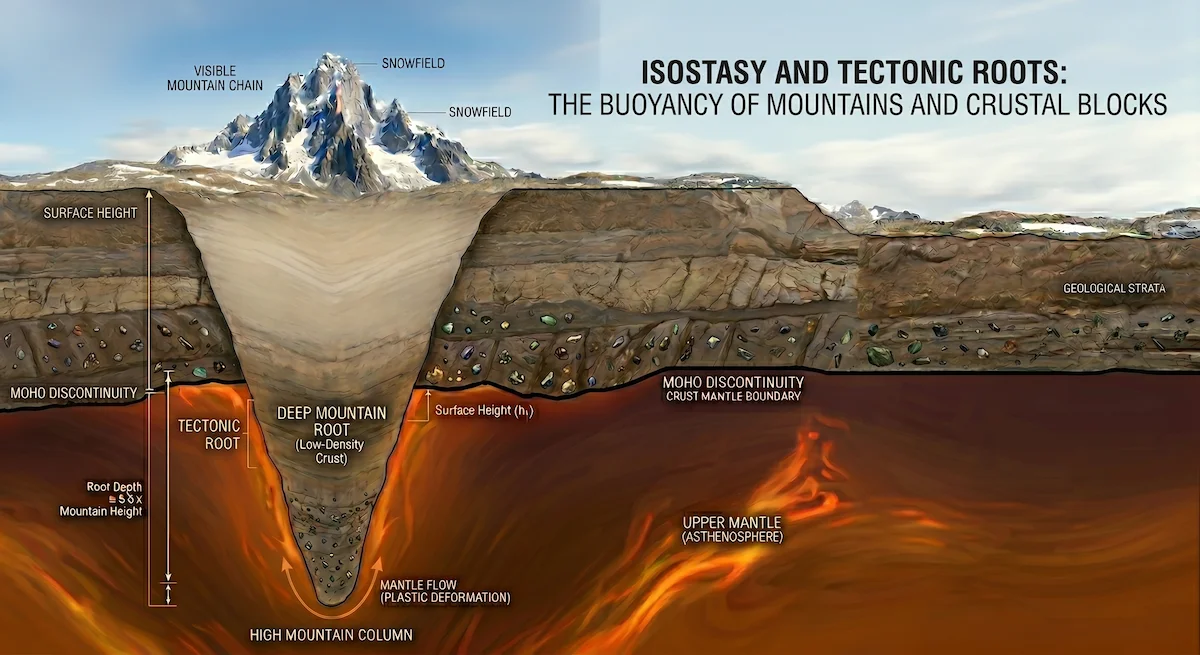
A mountain is, structurally speaking, an iceberg. The visible peak rising above the surface is only a fraction of the whole; the great majority of its mass extends downward, deep into the Earth. This principle, known as isostasy (meaning "equal standstill"), originated from gravitational anomalies discovered during the Great Trigonometric Survey of India. In 1855, mathematician John Henry Pratt noticed that the Himalayas exerted far less gravitational pull on plumb lines than their massive size suggested. Responding to Pratt's anomaly that same year, George Airy, the Astronomer Royal of England, deduced that the mountains could not be supported by a rigid crust alone. If they were merely sitting on the surface, their immense weight would cause the rock beneath them to collapse. Instead, he concluded that mountains must possess deep roots, displacing denser mantle material beneath them, just as a wooden block floats higher in water when a heavier block is fixed to its base.
The explanation for how these massive subterranean structures form arrived in the 1960s with the revolution of plate tectonics. When two continental plates collide, the crust does not merely buckle upward. It is compressed, folded, and thrust simultaneously into the sky to form a range, and driven downward in equal measure to form a deep keel. Scientists map these deep keels by tracing the Mohorovičić discontinuity (or Moho), the physical boundary separating the Earth's crust from the denser underlying mantle. While the Moho sits relatively shallow under the oceans, it plunges to extreme depths under mountain ranges. The Himalayas, geophysicists now observe, push the Moho roughly 80 kilometers downward, about five times the height of Everest above sea level.
These roots are essential for the mountain's existence. They do not lock the tectonic plates in place (orogenic belts remain highly dynamic regions) but they provide the vital buoyant support required to hold the landscape steady. Through isostatic equilibrium, the downward gravitational force of the peak is perfectly balanced by the upward buoyancy of the displaced mantle. The hidden root is what anchors the tremendous mass, stabilizing the crust so it does not fracture under the crushing weight of the summit.
The verse employs the term awtād (stakes) to describe the mountains. In classical Arabic, this word carries a highly specific physical morphology. A stake is an object driven into the ground where the bulk of its mass is buried beneath the surface, leaving only a smaller portion visible above. The text could have utilized a variety of terms, such as 'imād (pillar), burj (tower), or ṣarḥ (lofty structure), any of which would prioritize height and upward prominence. It deliberately chose the language of downward anchoring.
When traditional interpreters approached this verse strictly on its own terms, they focused on the mechanical reality of the word. The lexicographer Ibn Manzur (d. 1312) in Lisan al-Arab defines the root strictly around the action of driving something deep into a surface to secure it. Early Arab linguists understood from their physical environment that a watad (the singular form of stake) requires a specific ratio to function. A tent stake must have the majority of its length driven deep beneath the soil to hold tension. If a stake merely sits on the surface, it provides no structural support and fails. The verse applies this exact structural definition to geological formations.
Classical commentators drew attention to the tight grammatical pairing in the text. Al-Razi (d. 1210) noted that the mountains are described as awtād immediately after the earth is described as a mihād (a level resting place or spread-out surface). Al-Razi explicitly argued that this pairing is intentional. He explained that just as a physical resting place like a tent requires deeply driven stakes to secure it, the earth requires these mountains to act as stakes anchoring the crust. Al-Tabari (d. 923) also isolated this verse's specific wording, stating that the mountains function as stakes driven into the earth to pin it and hold it together.
By applying the word awtād, the verse strips away the visual illusion of the mountain. It directs the observer's attention away from the towering peak, pointing instead to the massive, subterranean root that executes the actual mechanical work of stabilization.
The Quranic description of mountains as stakes perfectly parallels the modern geophysical principle of isostasy. By bypassing the obvious visual trait of height in favor of downward anchoring, the verse's specific morphology aligns directly with the tectonic mechanics of mountain roots. The 80-kilometer subterranean keel of the Himalayas demonstrates that watad is not a loose metaphor for a towering peak, but a literal, structural blueprint of a deeply anchored mass.
Spring Water, Soil Enrichment, and the Diversity of Arid-Land Agriculture