Embryology
A Drop Emitted
Scientific Context
The Chromosomal Basis of Sex
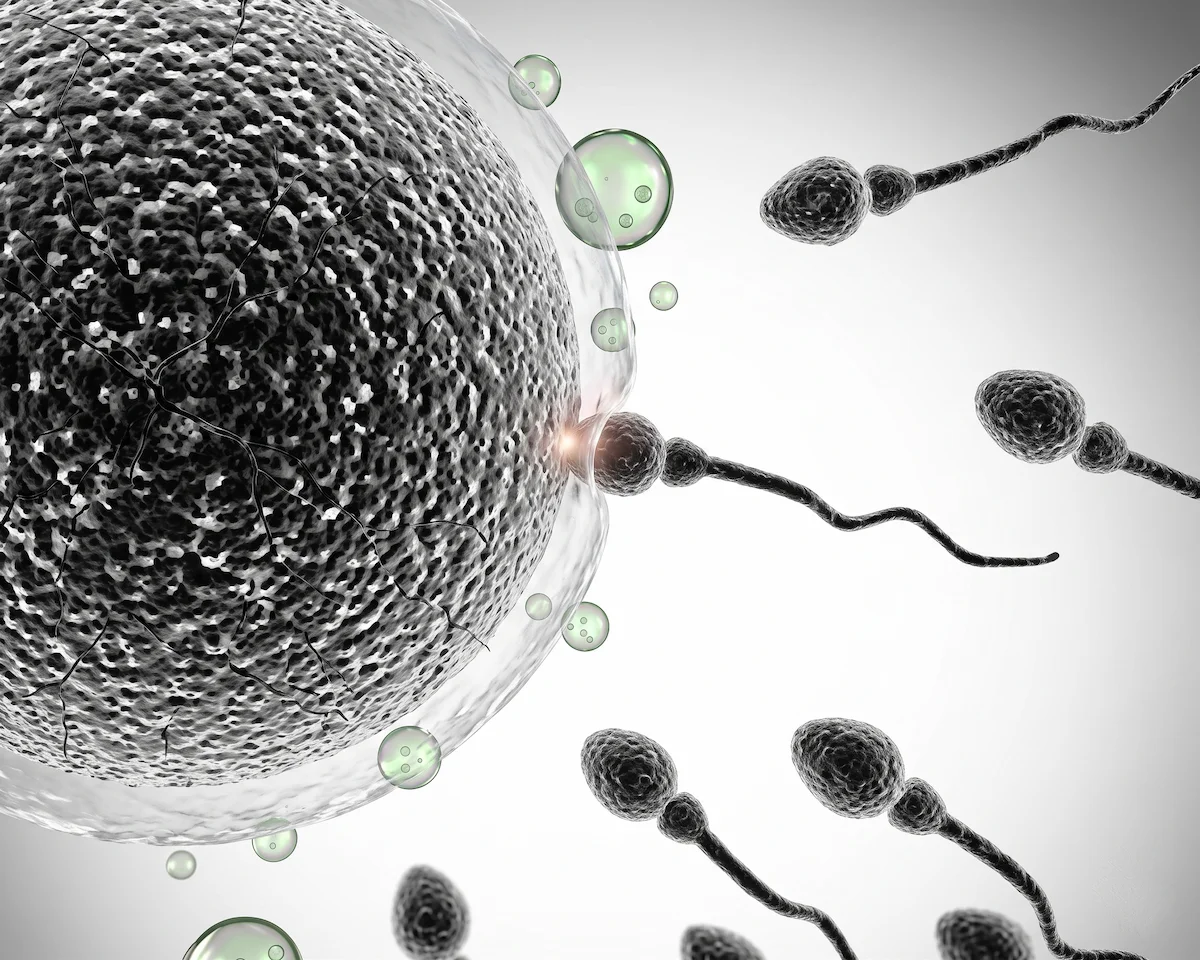
Human cells carry 23 pairs of chromosomes, one pair of which determines biological sex. Females typically carry two X chromosomes; males carry one X and one Y. The ovum always contributes an X. The sperm, however, carries either an X or a Y — and it is therefore the sperm, and the sperm alone, that determines the sex of the resulting embryo. Before the chromosomal basis of heredity was understood, beliefs about sex determination were largely guesswork. Hippocrates and Galen proposed that the sex of a child resulted from the relative strength of "male" and "female" seeds from each parent. Aristotle suggested that environmental heat and the position of the embryo could tilt the outcome. Across cultures, the mother was widely believed to play the decisive role.
The mechanism began to come into view in the late nineteenth century. In 1891, German biologist Hermann Henking identified an unusual structure in the cells of male insects. A few years later, Clarence McClung at the University of Kansas proposed that this element — what we now call a chromosome — was involved in sex determination. Thomas Hunt Morgan and his students at Columbia University confirmed the link in 1910 through experiments with fruit flies, tracing a single chromosome through generations and correlating it with male offspring. By 1923, Theophilus Painter established that human males carried one X and one Y chromosome, while females carried two X chromosomes. The chromosomes had been seen before; their role had not.
The decisive piece fell into place in 1990, when Andrew Sinclair and his team identified a single gene on the short arm of the Y chromosome — SRY (Sex-determining Region Y). The finding was remarkable in its simplicity. In the absence of SRY, the undifferentiated gonadal tissue of a six-week-old embryo develops into ovaries; in its presence, the same tissue develops into testes, which then produce the hormones that drive male anatomy. One gene, present or absent, tilts the entire developmental trajectory. The variable that carries this gene — the Y chromosome — is delivered exclusively by the sperm.
Islamic Context
وَأَنَّهُ خَلَقَ الزَّوْجَيْنِ الذَّكَرَ وَالْأُنثَىٰ٤٥ مِن نُّطْفَةٍ إِذَا تُمْنَىٰ٤٦
And that He created the two mates, the male and the female — from a drop when it is emitted.
— Quran 53:45-46
The first verse employs the term al-zawjayni — "the two mates" — placing male and female side by side, paired and complementary, each a counterpart of the other. The pairing is not merely biological; it is part of a rhetorical pattern that recurs throughout the Qur'an, where creation is repeatedly presented in twos, in polarities whose unity reveals a deeper order. Al-Qurṭubī (d. 1273) observed that the use of the dual form here emphasizes the completeness of the pair: not a spectrum, not a hierarchy, but two distinct yet interdependent categories brought into being from a single source.
That source is named as nuṭfa — a small drop of fluid, and in the Qur'anic vocabulary, the term refers with consistency to the male gamete. Classical commentators, including Ibn ʿAbbās (d. 687), understood nuṭfa as the fluid that is emitted by the man, a reading confirmed by the very grammar of the verse. The phrase that follows — idhā tumnā, "when it is emitted" — leaves no ambiguity: the fluid being described is that which is cast forth, the male contribution, not the mother's.
Al-Rāzī (d. 1210) drew attention to a subtle point in the phrasing. The verse does not say that the male is created from the nuṭfa and the female from something else. It says both — the male and the female — are created from it. The singularity of origin, a single fluid producing two distinct sexes, is embedded in the grammar itself. Ibn Kathir (d. 1373), in his commentary, noted that the verse thus establishes a principle: diversity in outcome does not require diversity in source. Two different ends can emerge from a single beginning, and the determination of which end emerges lies, the verse implies, within the nature of the nuṭfa itself.
Al-Qurṭubī further observed that the choice of idhā tumnā — "when it is emitted" — draws attention to the moment of expulsion, a moment in which the human observer would have had no means of seeing anything at all. The verse directs attention to a process whose mechanism lies entirely outside human observation and identifies with precision one element — the male drop — as the source of both the male and the female.
Prev Post
Next Post
Reference Timeline
600 CE
1000 CE
1500 CE
2000 CE
Quran verses 53:45-46
615 CE–632 CE
And that He created the two mates, the male and the female — from a drop when it is emitted
687 CE
Ibn ʿAbbās understands the Quranic term 'nuṭfa' strictly as the fluid emitted by the man, confirming through the verse's grammar that the male contribution is the definitive source
Ibn ʿAbbās (d. 687)
1210 CE
Al-Rāzī highlights the grammatical singularity of origin in the verse, noting that both the male and female sexes are explicitly created from the exact same single male fluid
Fakhr al-Din al-Rāzī (d. 1210)
1273 CE
Al-Qurṭubī observes that the phrase 'when it is emitted' pinpoints a process outside human observation, precision-identifying the male drop as the exclusive source of both sexes
Al-Qurṭubī (d. 1273)
1373 CE
Ibn Kathīr notes the verse establishes a biological principle: diversity in outcome does not require diversity in source, implying the determination of sex lies within the nuṭfa itself
Ibn Kathīr (d. 1373)
1891 CE
German biologist Hermann Henking identifies an unusual, distinct structure in the cells of male insects, taking the first step toward identifying the chromosomal basis of heredity
Hermann Henking (1891)
1901 CE
Building on Henking's work, Clarence McClung at the University of Kansas formally proposes that this distinct cellular element (chromosome) is directly involved in sex determination
Clarence McClung (c. 1901)
1910 CE
Thomas Hunt Morgan and his students at Columbia University confirm the chromosomal link to sex determination through experiments with fruit flies, tracing a single chromosome across generations
Thomas Hunt Morgan (1910)
1923 CE
Theophilus Painter firmly establishes that human males carry one X and one Y chromosome, while females carry two X chromosomes, bridging the gap between observable chromosomes and their role
Theophilus Painter (1923)
1990 CE
Andrew Sinclair and his team discover the SRY gene on the Y chromosome, proving that a single gene delivered exclusively by the sperm tilts the entire developmental trajectory of the embryo
Andrew Sinclair (1990)
The Connection
The Quranic statement that both the male and the female are created from a single emitted drop points to a biological mechanism modern genetics has only recently uncovered. Both sexes emerge from one fluid, and the variable that determines which sex develops is carried exclusively by the male gamete. The 1990 identification of the SRY gene perfectly parallels the linguistic framing of the verse: a single factor, present or absent, tips the balance between two distinct outcomes.
Related Connections