Geoscience
Passing Like Clouds
Scientific Context

Plate Tectonics and the Movement of Continents
In traditional geological thinking, mountains were understood as fixed anchors—the ultimate structural baselines of an immovable planet. When Flemish cartographer Abraham Ortelius noticed in 1596 that the coastlines of South America and Africa fitted together like severed edges of a single landmass, his map-based observation was set aside as a geometric anomaly. Three centuries later, in 1912, German meteorologist Alfred Wegener formally introduced the concept of continental drift, gathering matched fossil bands and continuous mountain strata across the Atlantic Ocean. Yet geophysicists rejected Wegener’s framework because he could offer no physical mechanism capable of dragging massive continents across a solid ocean floor.
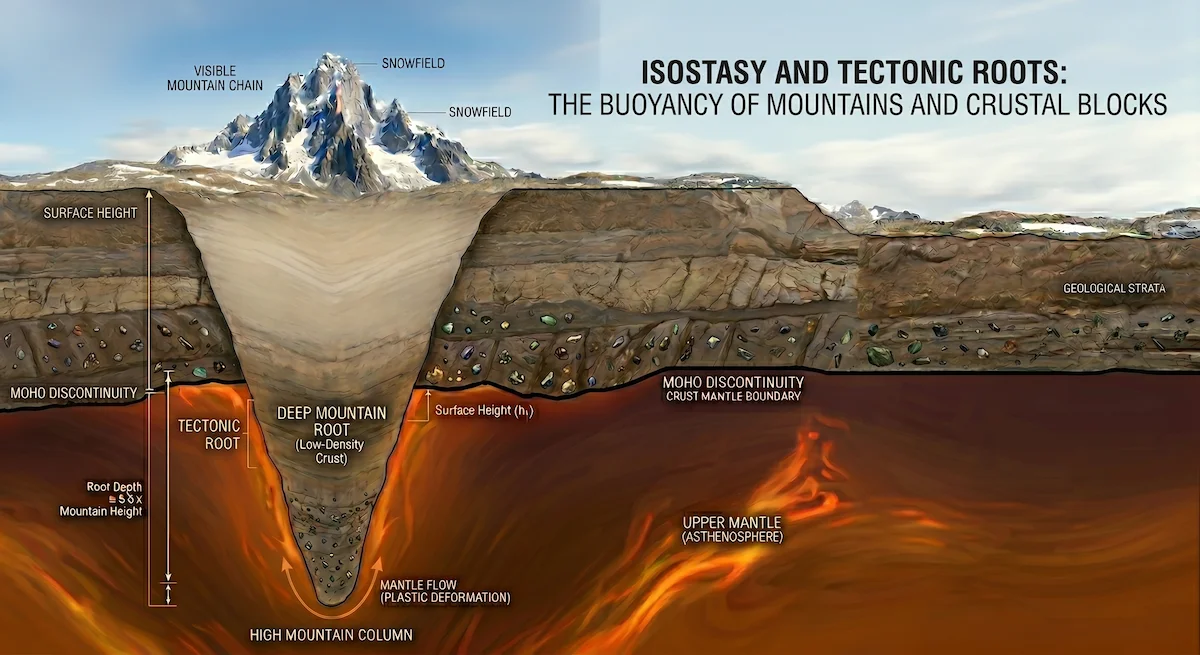
In 1929, British geologist Arthur Holmes identified the missing mechanism deep within the planet's interior: mantle convection. Holmes proposed that although the Earth’s mantle consists of solid rock, intense thermal energy from the core causes subterranean rock to behave over vast ages like an extraordinarily dense, slow-moving fluid. As deep rock heats up, it slowly ascends toward the crust, spreads horizontally, cools, and sinks back toward the interior. This continuous circular flow created a massive subterranean conveyor belt capable of carrying the landmasses above it.
Decades later, oceanographic surveys provided empirical proof for this fluid subsurface movement. During the mid-1960s, researchers Harry Hess, Frederick Vine, and Drummond Matthews mapped symmetrical magnetic striping across the ocean floor. As upwelling basaltic rock erupted along mid-ocean ridges and cooled, it locked in periodic reversals of Earth's magnetic field, confirming that new ocean basins were actively generating and expanding outward.
These breakthroughs established the modern framework of plate tectonics. Continents do not plow through the ocean floor on their own; rather, they sit atop rigid surface plates that ride upon the slowly churning mantle layer below. Driven by these deep heat currents, continental plates drift between two and ten centimeters every year—roughly the speed at which human fingernails grow. Completely invisible on a human timescale, this slow, fluid churn constantly redistributes the world's landmasses across planetary time.
Islamic Context
وَتَرَى الْجِبَالَ تَحْسَبُهَا جَامِدَةً وَهِيَ تَمُرُّ مَرَّ السَّحَابِ ۚ صُنْعَ اللَّهِ الَّذِي أَتْقَنَ كُلَّ شَيْءٍ
And you see the mountains, supposing them fixed, yet they pass as the passing of clouds - the artisanship of Allah, the One who perfected all things.
— Quran 27:88
Because this verse comes between verses talking about the blowing of the Horn and the Last Day, many commentators, including Ibn Abbas (d. 687) and Ibn Kathir (d. 1373) understood the movement of the mountains here as an event of the Last Day.
Yet, the precise vocabulary of the verse establishes a description of an active, present-day reality within the natural world. The passage opens by highlighting a gap between human perception and actuality: "you see the mountains, thinking them rigid". Fakhr al-Dīn al-Rāzī (d. 1210), pointed out that on the Day of Resurrection, the cataclysm will be absolute and undeniable. Human perception will be stripped of all illusion, leaving no room for an observer to mistakenly "think" or "suppose" (ḥasiba) that the mountains are perfectly still.
Muhammad al-Shaʿrāwī (d. 1998) expanded on this by noting that the Qur'an uses entirely different vocabulary for mountains on the Last Day, describing them as crumbling into "scattered dust" (habāʾan munbathā) or unraveling like "carded wool" (al-ʿihn). Here, however, the text chooses jāmidah, meaning solid, fixed, or structurally intact. If the verse referred solely to their destruction, they would not be solid, nor would anyone perceive them to be. The optical illusion of rigidity belongs to the present world, where their immense mass tricks the eye into assuming they are completely motionless.
The metaphor of motion supports this distinction. The verse does not use violent verbs of upheaval, such as those found in passages describing the earth being violently shaken (zulzilat). Instead, it compares the mountains to clouds. Clouds glide silently, steadily, driven by unseen forces. To pass "as the passing of clouds" (marra al-saḥāb) implies a smooth, continuous drift across a vast space. Furthermore, the phrase wa-hiya tamurru ("while they pass") utilizes a grammatical structure known as wāw al-ḥāl (the circumstantial wāw), which directly links the observer's present-tense illusion to the mountain's continuous, ongoing motion.
The verse concludes by defining this passing as "the artisanship of Allah who perfected all things." The word atqana implies profound mastery, operational balance, and flawless execution. Because the Qur'an characterizes apocalyptic dissolution as the unmaking and dismantling of creation rather than an act of precision engineering, the language frames this silent movement not as cataclysmic destruction, but as an ongoing masterpiece of structural precision operating beneath an impression of absolute stillness.
Prev Post
Next Post
Reference Timeline
600 CE
1000 CE
1500 CE
2000 CE
Quran verse 27:88
615 CE–632 CE
The Quran describes the mountains as in a state of constant gentle movement "..they pass as the passing of clouds" despite their fixed appearance.
687 CE
Ibn Abbas interprets the verse within the context of eschatological events, linking the motion of mountains to the cataclysm of the Last Day
Ibn Abbas (d. 687)
1210 CE
Fakhr al-Din al-Razi points out that on the Day of Resurrection, human perception will have no illusion of stillness, distinguishing current earthly observation from future cataclysm
Fakhr al-Din al-Razi, Mafātīḥ al-Ghayb (c. 1210)
1373 CE
Ibn Kathir analyzes the verse alongside other passages describing the Day of Judgment, reinforcing the early interpretive consensus on eschatological motion
Ismail ibn Kathir, Tafsīr al-Qurʾān al-ʿAẓīm (c. 1373)
1596 CE
Abraham Ortelius publishes his cartographic observation that the coastlines of South America and Africa fit together geometrically, though it is set aside as an anomaly
Abraham Ortelius, Thesaurus Geographicus (1596)
1912 CE
Alfred Wegener formally introduces the concept of continental drift, assembling fossil bands and mountain strata across oceans, though lacking a moving mechanism
Alfred Wegener, Die Entstehung der Kontinente und Ozeane (1912)
1929 CE
Arthur Holmes identifies mantle convection as the subterranean thermal conveyor belt driving continental movement through slow fluid-like rock behavior
Arthur Holmes, 'Radioactivity and Earth Movements' (1929)
1963 CE
Harry Hess, Frederick Vine, and Drummond Matthews map symmetrical magnetic striping on the ocean floor, proving seafloor spreading and active ocean basin expansion
Frederick Vine and Drummond Matthews, Nature (1963)
1998 CE
Muhammad al-Shaʿrāwī expands on the linguistic distinction, noting that the choice of 'jāmidah' indicates structural integrity and present-day optical illusion rather than apocalyptic unravelling
Muhammad al-Shaʿrāwī, Tafsīr al-Shaʿrāwī (c. 1998)
The Connection
The Quranic description of mountains passing like clouds while appearing completely still aligns flawlessly with the mechanics of tectonic convection. Whether read strictly as a vivid glimpse of the world’s end or as a multi-layered text revealing the Earth's hidden present, the specific syntax of the verse captures a profound geophysical principle. What the human eye perceives as the ultimate symbol of rigid permanence is structurally capable of continuous, fluid motion—carried across the surface of the globe on currents that no observer can see.
Related Connections
Springs from the Earth
Spring Water, Soil Enrichment, and the Diversity of Arid-Land Agriculture
Geoscience