Geoscience
An Unfathomable Sea
Scientific Context
Internal Waves and the Abyssal Zone
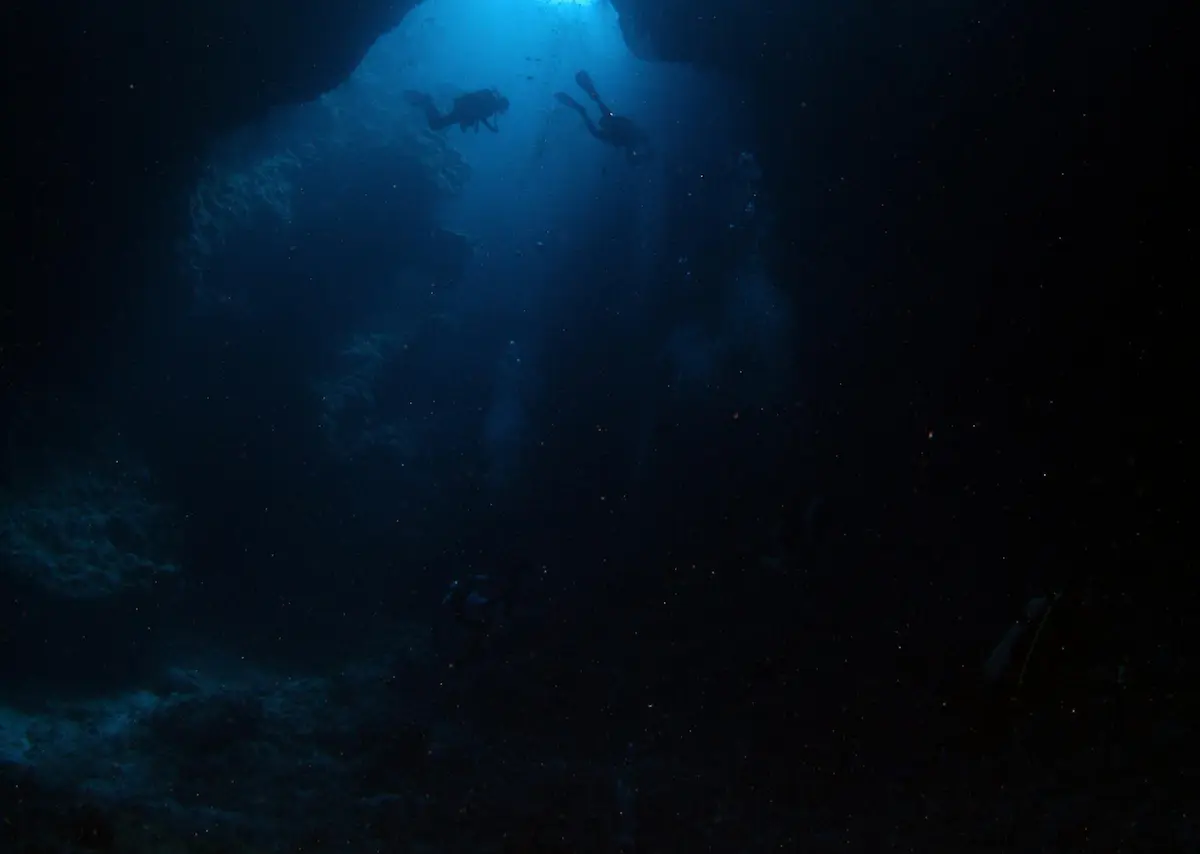
Sunlight does not simply stop when it hits the ocean; it is systematically dismantled. Pure seawater acts as a profound optical filter, stripping away the visual spectrum piece by piece. Within the first ten meters, the water completely absorbs red and orange wavelengths. By the time an observer descends through the twilight zone—stretching down to a thousand meters—the yellows and greens have faded out, leaving only the faintest blue. Beyond that lies the midnight zone, a domain of absolute, permanent black.
In 1934, naturalist William Beebe physically observed this sequential erasure of color during his record-setting bathysphere dives, documenting the gradual loss of spectrum in his landmark work Half Mile Down. Decades later, Nils Jerlov formalized these measurements, demonstrating mathematically how distinct water layers systematically absorb specific optical frequencies. The deep ocean is not a single uniform shadow; it is an optical stack of dimming layers, each one stripping away whatever light survived the layer above it.
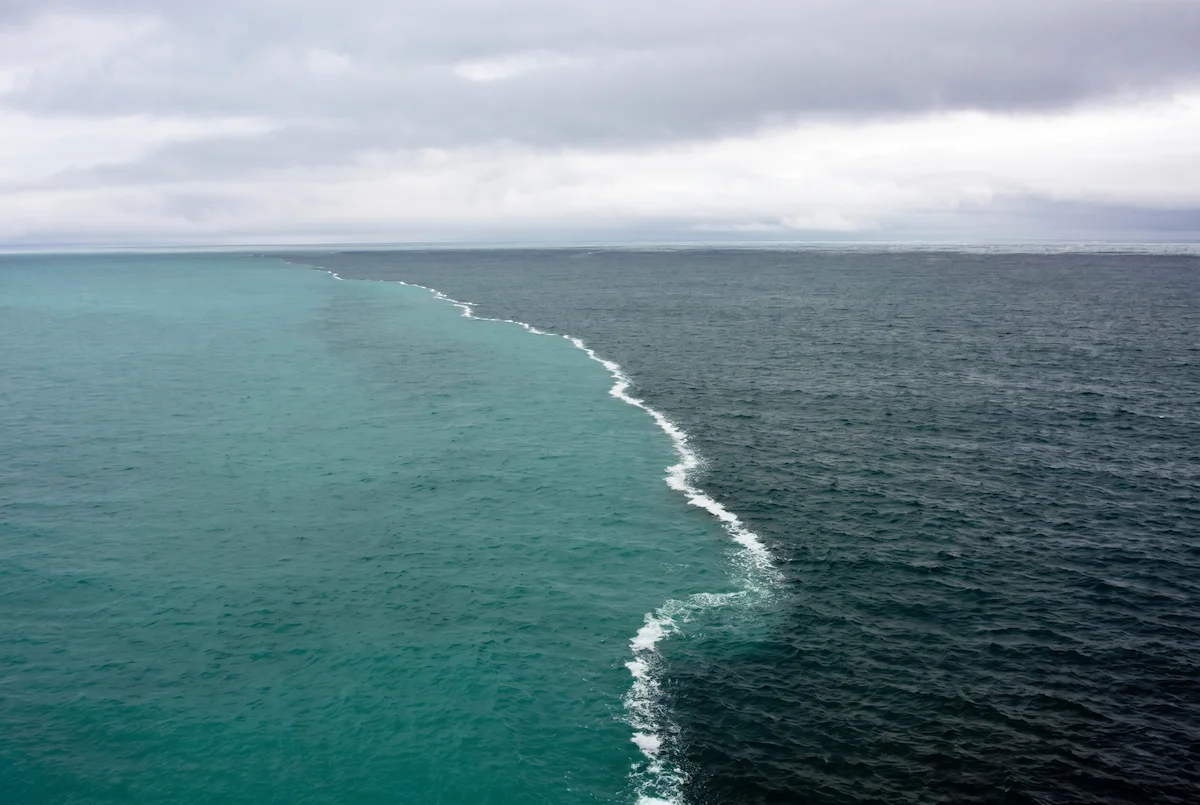
This optical stacking is mirrored by an equally profound physical stratification. In the past, mariners believed the turbulent surface of the sea gave way to a static, motionless deep. But building on work by oceanographer Harald Sverdrup, marine physics now treats the water column as heavily divided into distinct structural layers separated by sharp density boundaries. These interfaces, known as pycnoclines, occur where warmer, lighter surface water meets the freezing, highly saline water of the abyss. The density difference is so severe that the layers resist mixing, resting on top of one another like oil and water, creating a physical barrier almost as distinct as the boundary between the ocean and the air.
Because these fluid boundaries exist, the ocean experiences a phenomenon completely invisible from the surface: internal waves. Walter Munk mapped these dynamics revealing how massive waves propagate slowly along these deep density lines. Today, researchers track these dynamics directly using modern deep-water sensors. During the Internal Waves in Straits Experiment (IWISE), a team led by physical oceanographer Matthew Alford published findings recording internal waves towering over 170 meters in height. Modern marine physics reveals an architecture no surface observer could have predicted: a dark abyss, capped by a density boundary carrying massive internal waves, which is in turn covered by the surface layer and its own breaking waves.
Islamic Context
أَوْ كَظُلُمَاتٍ فِي بَحْرٍ لُّجِّيٍّ يَغْشَاهُ مَوْجٌ مِّن فَوْقِهِ مَوْجٌ مِّن فَوْقِهِ سَحَابٌ ظُلُمَاتٌ بَعْضُهَا فَوْقَ بَعْضٍ إِذَا أَخْرَجَ يَدَهُ لَمْ يَكَدْ يَرَاهَا وَمَن لَّمْ يَجْعَلِ اللَّهُ لَهُ نُورًا فَمَا لَهُ مِن نُّورٍ
Or, like darknesses within an unfathomable sea which is covered by waves, upon which are waves, over which are clouds. Darknesses, some of them upon others. When one puts out his hand, he can hardly see it. And he to whom Allah has not granted light — for him there is no light.
— Quran 24:40
The depiction of the ocean in Surah An-Nur is built entirely around vertical architecture. Verse 24:40 begins by describing an environment of profound physical isolation: "Or like darknesses within an unfathomable sea (baḥr lujjiyy)." The Arabic word lujjiyy derives from the root lajja, which denotes a vast, overwhelming depth characterized by restless motion. The classical commentator Al-Tabari (d. 923) noted that the text purposefully fuses depth and darkness into a single, inseparable quality. The verse does not present the darkness as a mere absence of light. It presents the deep ocean as a substantive, enveloping physical environment that operates entirely on its own terms.
The text then constructs a physical stack over this abyss: "which is covered by a wave, upon which is a wave, over which are clouds." The doubled use of mawj (wave) explicitly creates a stratified water column. Al-Razi (d. 1210) observed that this phrasing is not rhetorical repetition. The verse structurally isolates a boundary wave that covers the deep darkness, which is then covered by a second wave at the surface, which is finally capped by the atmosphere. Al-Qurtubi (d. 1273) adds that this phrasing physically divides the sea into distinct upper and lower domains. The language outlines an environment separated into dynamic layers, placing a hidden wave deep within the water column directly beneath the wave visible to the open sky.
This physical layering is immediately tied to the behavior of light. The text calls the environment "darknesses, some of them upon others (ẓulumāt baʿḍuhā fawqa baʿḍ)." The use of the plural ẓulumāt instead of the singular is a deliberate description of strata. Ibn Abbas (d. 687) read this plural as denoting distinct, separate layers of obscuration rather than one uniform shadow. Ibn Kathir (d. 1373) builds on this, detailing how the darkness of the deep water, the darkness of the wave, and the darkness of the clouds sit on top of one another, each acting as a distinct veil.
The verse concludes this physical description with absolute sensory deprivation: "When one puts out his hand, he can hardly see it." The text does not stop at describing dimness; it pushes the description down into the total erasure of sight. It describes an environment where light is systematically dismantled by the structural layers above it, resulting in a structured, progressive descent into absolute black.
Prev Post
Next Post
Reference Timeline
600 CE
1000 CE
1500 CE
2000 CE
Quran verse 24:40
615 CE–631 CE
The Quran describes the depths of the ocean not as static but as multi-layered, active, and unfathomably dark at its lowest point.
687 CE
Ibn Abbas reads the plural 'zulumat' as denoting distinct, separate layers of obscuration rather than one uniform shadow, identifying multiple vertical veils of darkness
Ibn Abbas (d. 687)
923 CE
Al-Tabari notes that the text purposefully fuses depth and darkness into a single, inseparable quality, presenting the deep ocean as a substantive physical environment
Muhammad ibn Jarir al-Tabari, Jami' al-Bayan (c. 923)
1210 CE
Al-Razi observes that the doubled use of 'mawj' is not repetition, structurally isolating a boundary wave covering the deep darkness beneath a surface wave and atmosphere
Fakhr al-Din al-Razi, Mafatih al-Ghayb (c. 1210)
1273 CE
Al-Qurtubi analyzes the verse as physically partitioning the ocean into distinct upper and lower hydrodynamic domains with hidden waves deep within the water column
Al-Qurtubi, Al-Jami' li-Ahkam al-Quran (c. 1273)
1373 CE
Ibn Kathir details how stacked environmental barriers—deep water, internal boundary, surface wave, and clouds—sequentially veil light in progressive layers
Ismail ibn Kathir, Tafsir al-Quran al-Azim (c. 1373)
1934 CE
Naturalist William Beebe physically observes the sequential erasure of color during record-setting bathysphere dives, documenting the gradual spectrum loss
William Beebe, Half Mile Down (1934)
1942 CE
Harald Sverdrup establishes the physics of density stratification and pycnocline boundaries in ocean physics, modeling the divided structural layers of the water column
Harald Sverdrup, The Oceans: Their Physics, Chemistry, and General Biology (1942)
1966 CE
Walter Munk maps the mathematical dynamics of deep internal waves propagating slowly along deep density interfaces
Walter Munk, 'Abyssal Recipes' (1966)
1968 CE
Nils Jerlov formalizes optical oceanography measurements, demonstrating mathematically how distinct water layers systematically absorb specific optical frequencies
Nils Jerlov, Optical Oceanography (1968)
2013 CE
Matthew Alford and team publish findings from the Internal Waves in Straits Experiment (IWISE), recording internal waves towering over 170 meters in height
Matthew Alford et al., Nature (2013)
The Connection
The Quranic depiction of stacked waves and layered darknesses captures the precise architecture of the abyssal zone. Rather than treating the deep ocean as a simple, uniform void, the text constructs a highly stratified environment. It aligns perfectly with the discoveries of modern marine physics, framing the water column as a compounding barrier: a physical structure divided by hidden density waves, and an optical filter that systematically extinguishes sight. The absolute blindness described at the bottom of this sea is not merely poetic; it is the direct, physical consequence of the structural layers resting above it.
Related Connections

Springs from the Earth
Spring Water, Soil Enrichment, and the Diversity of Arid-Land Agriculture
Geoscience