Physics
One Sweet, One Salty
Scientific Context
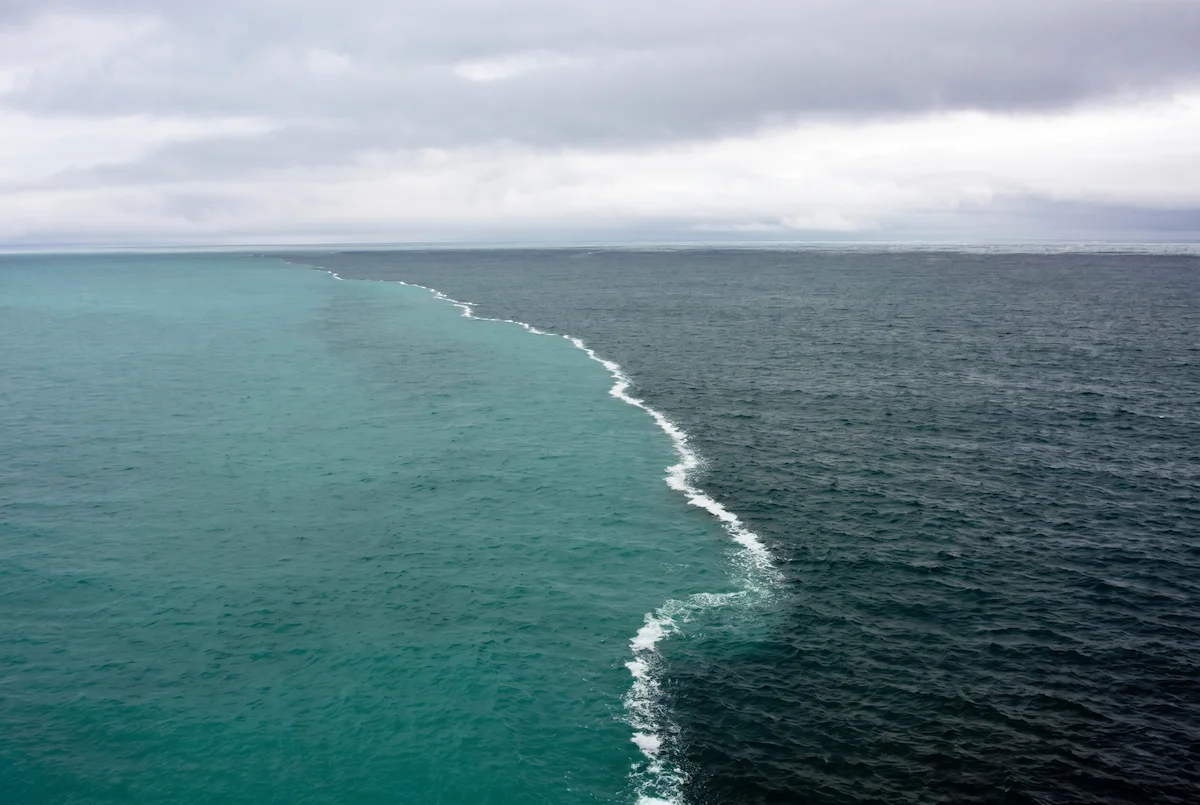
The Halocline: A Barrier Between Two Seas
Modern ocean physics tells us a surprising story about how water interacts. When adjacent bodies of water have distinctly different concentrations of dissolved salt, they actively resist blending. Between 1872 and 1876, the HMS Challenger expedition conducted the first global survey of oceanic salinity, demonstrating that the world's seas are not uniform tubs of water, but stratified into distinct, density-driven layers.
Dissolved salt adds mass to water without expanding its volume, so salty water is heavier and denser than fresh water at the same temperature. When these two water masses meet, gravity pulls the heavier, salt-laden water downward while the lighter water glides across the top. The contact zone between them forms a halocline, a sharp transition layer where salinity and density change dramatically over a short vertical distance. In 1904, Swedish oceanographer Vagn Walfrid Ekman published the fluid dynamics behind this phenomenon, proving how a lighter freshwater layer rides smoothly over dense seawater with minimal mixing at the interface. The steeper this density gradient, the stronger the barrier resists disruption. Without external turbulence from heavy storms or strong tides, the stratified layers hold their positions.
This dynamic produces striking boundaries across the globe. At the Skagerrak strait, where the brackish Baltic Sea meets the salty North Sea, the lighter Baltic runoff rides directly over the heavier oceanic water. In the 1920s, German oceanographer Albert Defant mapped this layered structure, showing that the two seas stack rather than mix, a boundary that persists across tens of kilometers. The same principle governs the deep ocean. In the 1950s, American oceanographer Henry Stommel tracked circulation at the Strait of Gibraltar, demonstrating how dense Mediterranean water plunges over an undersea ridge and travels thousands of kilometers into the Atlantic as an intact subsurface current.
Islamic Context
وَهُوَ الَّذِي مَرَجَ الْبَحْرَيْنِ هَٰذَا عَذْبٌ فُرَاتٌ وَهَٰذَا مِلْحٌ أُجَاجٌ وَجَعَلَ بَيْنَهُمَا بَرْزَخًا وَحِجْرًا مَّحْجُورًا
And it is He who released the two seas — this one fresh and sweet, and that one salty and bitter — and He placed between them a barrier and a prohibiting boundary.
— Quran 25:53
This verse begins with the verb maraja, which means to set something free into open motion. Ibn ʿAbbās (d. 687) compared the root to pasturing livestock let loose to graze freely without tether or enclosure. Al-Ṭabarī (d. 923) explained that the word conveys active, continuous movement where two streams flow directly toward one another. The text is not describing two stagnant lakes separated by an earthen barrier, but two dynamic currents released into open, unconstrained flow.
One body of water is described as ʿadhb furāt, water that is pleasant, sweet, and deeply thirst-quenching. The other is milḥ ujāj, water that is heavily salted, bitter, and burning to the throat. Early linguist Ibn Qutaybah (d. 889) noted that ujāj refers to a brine rendered harsh and undrinkable by intense salinity. Casual observation suggests that bringing two such bodies of water into contact would cause the salty body to immediately swallow, dilute, and spoil the drinkable fresh water. Instead, the passage tells us of a barzakh (barrier) between them. Ibn ʿAbbās explained that this barzakh is an unseen dividing boundary where the two currents touch in full motion without either one prevailing over, overtaking, or corrupting the other.
The closing phrase, ḥijran maḥjūrā, defines the unyielding character of this separation. In classical Arabic, maḥjūr carries the grammatical force of a binding prohibition. Qatādah (d. 736) noted that this restraint is placed upon the waters themselves: the salty current cannot ruin the sweet, and the fresh stream cannot dilute the sea. As Fakhr al-Dīn al-Rāzī (d. 1210) pointed out, the two bodies encounter each other openly in perpetual motion, but an intrinsic limit keeps them apart, preventing the two from collapsing into a single, uniform solution. The result is a sustained coexistence where direct fluid contact does not erase the distinct nature of either sea.
Prev Post
Next Post
Reference Timeline
600 CE
1000 CE
1500 CE
2000 CE
Quran verse 25:53
625 CE
Describes two seas, one fresh and sweet, one salty and bitter held apart by a barrier that prevents either from transgressing the boundary
687 CE
Ibn ʿAbbās defines barzakh as a non-solid, fluid dividing interface between meeting waters
Tanwīr al-Miqbās min Tafsīr Ibn ʿAbbās
736 CE
Qatādah explains ḥijran maḥjūrā as an inviolable prohibition preventing waters from spoiling each other
Tafsīr al-Ṭabarī (citing Qatādah ibn Diʿāmah)
889 CE
Ibn Qutaybah establishes the linguistic definition of ujāj as intensely harsh, burning salinity
Gharīb al-Qurʾān
923 CE
Al-Ṭabarī analyzes maraja as dynamic, continuous movement between two encountering streams
Jāmiʿ al-Bayān ʿan Taʾwīl Āy al-Qurʾān
1210 CE
Fakhr al-Dīn al-Rāzī documents the boundary condition that preserves distinct fluid properties
Mafātīḥ al-Ghayb (Tafsīr al-Kabīr)
1273 CE
Al-Qurṭubī defines the barzakh as an interposing fluid layer (ḥā'il)
Al-Jāmiʿ li-Aḥkām al-Qurʾān
1876 CE
HMS Challenger expedition proves global oceanic density and salinity stratification
Report on the Scientific Results of the Voyage of H.M.S. Challenger (1885)
1904 CE
Vagn Walfrid Ekman publishes fluid mechanics of stratified waters and freshwater layering
Ekman, V. W., On Dead-Water (1904)
1929 CE
Albert Defant maps halocline layering and persistent fluid stacking at the Skagerrak strait
Defant, A., Dynamische Ozeanographie (1929)
1958 CE
Henry Stommel establishes thermohaline circulation models tracking subsurface Mediterranean flow into the Atlantic
Stommel, H., The Gulf Stream: A Physical and Dynamical Description (1958)
The Connection
The Qur’anic text depicts two opposing waters released into open motion, meeting yet held distinct by an invisible barrier and an unyielding limit. In modern oceanography, this fluid stability is governed by haloclines, where steep salinity and density gradients allow adjacent currents to stack and glide past each other across vast distances. Both descriptions show that direct physical contact does not result in immediate homogenization, preserving the distinct identity of each body.
Related Connections