Astroscience
A Protected Ceiling
Scientific Context
The Atmospheric Shield
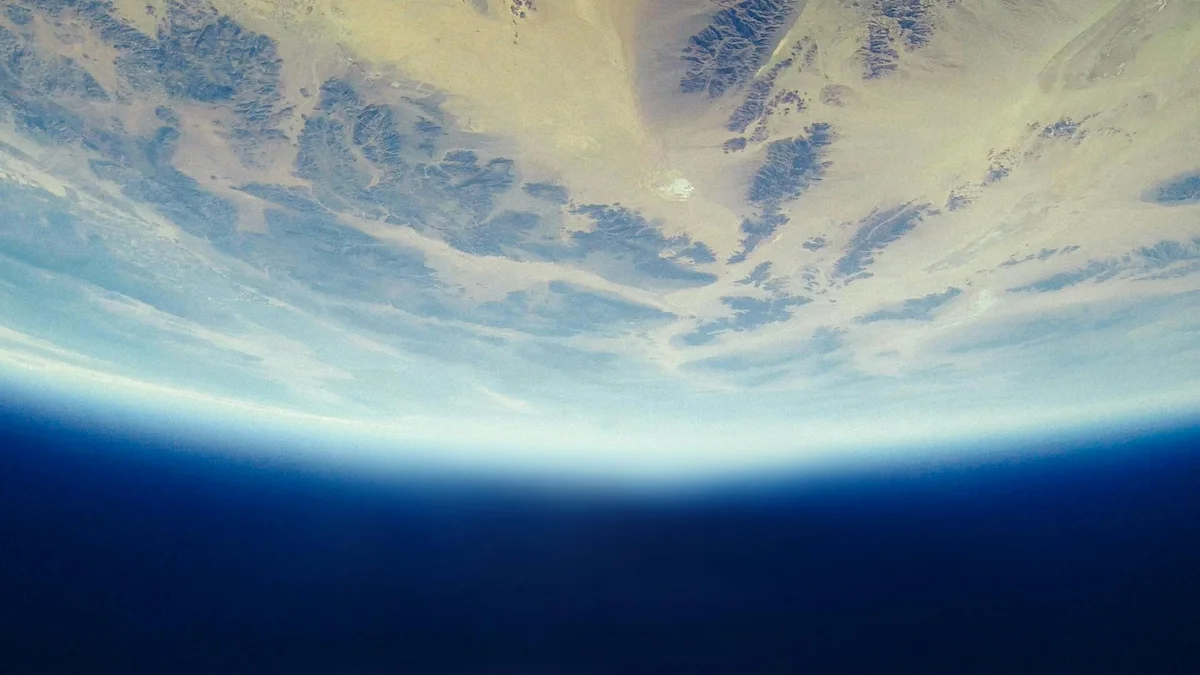
The atmosphere is a layered system in which each altitude band performs a different protective function. The ozone layer in the stratosphere, between roughly 15 and 35 kilometres up, absorbs most of the harmful ultraviolet radiation from the Sun, preventing the cellular damage that would otherwise make surface life impossible. Above it, the mesosphere — the layer between about 50 and 85 kilometres — is dense enough that incoming meteoroids burn up through friction before reaching the ground. Lower down, the atmosphere traps enough heat to keep the surface habitable, while the combination of the magnetic field and the upper air deflects the solar wind. The understanding of these layers came in stages. Ozone was first measured by the British chemist W.N. Hartley in 1881, and the layer itself was confirmed by French physicists Charles Fabry and Henri Buisson in 1913. But it was in 1985, when Joe Farman and his team at the British Antarctic Survey discovered the ozone hole, that humanity realized how vulnerable this shield could be.
What makes the atmosphere a shield rather than just a layer of gas is that it is sustained. The protective functions depend on ongoing processes that have to be kept in balance. Oxygen, the basis of the ozone layer and of breathing, is replenished by photosynthesis at a rate of roughly 130 billion tonnes a year. The ozone layer itself is continuously created and destroyed by a set of reactions described by the geophysicist Sydney Chapman in 1930. Another high-altitude current, the Brewer-Dobson circulation identified in 1949, transports ozone from the tropics toward the poles. Without these maintenance processes, the protective functions would degrade over time. The atmosphere is not a static barrier. It is a structure whose shielding role is being continuously produced.
That the atmosphere is, in fact, a shield became fully visible only after the middle of the twentieth century. Photographs of Earth from space reframed the atmosphere as a boundary layer — a thin, blue, fragile film separating the planet from the vacuum beyond. Successive generations of satellite instruments, beginning with the Nimbus series in 1964, made this protective function measurable from above. The image of Earth as a blue marble, defined by its atmosphere, is itself a 20th-century reframing of what the air above us is.
Islamic Context
وَجَعَلْنَا السَّمَاءَ سَقْفًا مَّحْفُوظًا وَهُمْ عَنْ آيَاتِهَا مُعْرِضُونَ
And We made the sky a protected ceiling, but they turn away from its signs.
— Quran 21:32
The verse opens with the noun al-samāʾ, which classical Arabic uses for what is overhead. The early commentators, including al-Ṭabarī (d. 923) and al-Qurṭubī (d. 1273), understood al-samāʾ in this verse to refer to the entire upper realm — not just the visible blue dome, but the whole overhead system. The verse is not making a claim about how the sky looks. It is making a claim about what the sky is in relation to what lies below it.
The phrase that anchors the verse is saqfan maḥfūẓan — a protected ceiling. The word saqf is architectural. It denotes a roof, a covering, something that shelters what is beneath it. Al-Rāzī (d. 1210) noted that the choice of saqf over alternatives such as jidár (wall) or ghīṣán (cover) is deliberate: a roof shelters from above, a wall only encloses from the side. The verse is naming a function — sheltering from above — not just a position. The qualifier maḥfūẓ carries the sense of an ongoing, preserved state rather than a one-time past act. Al-Rāzī and al-Qurṭubī both made this observation. The sky is a ceiling that is being kept as a shield.
The pairing of the two words is the verse’s structural claim. Mujāhid and al-Ṭabarī noted that the construction places saqf (the structure) and maḥfūẓ (the maintained state) together as a single concept. The sky is not described as a finished object. It is described as a structure whose protective function is being sustained. The two Arabic words together do not name a thing; they name a process of being kept.
The verse closes with a turn: wa hum ʿan āyātihā muʿriḑūn — “yet they turn away from its signs.” The word āyāt (signs) is significant. Ibn Kathīr (d. 1373) recorded that the early commentators read the word here as referring to observable features of the sky — its visible structure, the alternation of day and night, what it provides and what it withholds. The reproach is directed at those who perceive the ceiling overhead but do not recognise what it indicates. The closing line recasts the entire verse from a description into a challenge: the sky as a preserved structure is itself a sign that points beyond itself.
Prev Post
Next Post
The Connection
The Quranic description of the sky as saqfan maḥfūẓan—a protected ceiling—perfectly captures the dynamic nature of Earth's atmosphere. Rather than a static, passive dome, both the verse and modern geophysics define the sky as an actively maintained system of defense. By pairing the architectural shelter of saqf with the continuous preservation of maḥfūẓ, the text linguistically mirrors a planetary shield that must be constantly regenerated to survive. In this light, the verse's closing challenge becomes clear: the sky is not just a canopy to be looked at, but a profoundly engineered system that points directly to its designer.