Bioscience
Proportioned Fingertips
Scientific Context
The Science of Dermatoglyphics
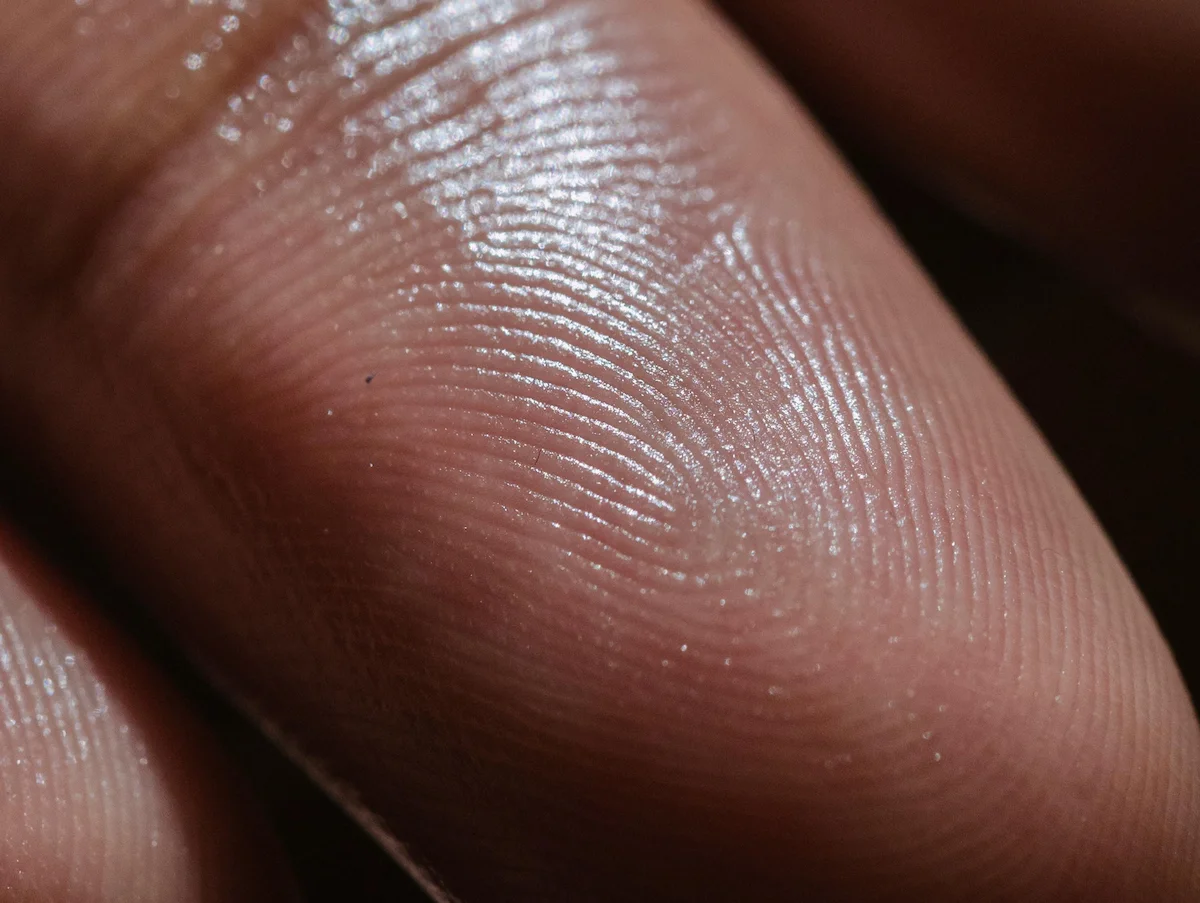
Fingerprints form during a narrow window of fetal development, between the tenth and twenty-fourth weeks of gestation. The American anatomist Harold Cummins and his colleague Charles Midlo coined the term dermatoglyphics in 1926 to name the systematic study of skin ridge patterns, but the precise developmental mechanism remained unclear until the late 1970s. It was then that anatomist William Babler published his foundational research on human fetal development, demonstrating that the patterns are determined by small mounds of tissue on the developing fingertips called volar pads. The timing and rate at which these pads regress dictate the final shape of the print. When a volar pad remains high and round, a whorl forms. When it regresses asymmetrically, a loop forms. When it stays low, an arch forms. Because identical twins experience slightly different microscopic pressures in the womb, their volar pads develop differently, ensuring their fingerprints diverge from the very beginning.
What this produces is combinatorial uniqueness at an extreme scale. A single fingerprint contains dozens of minutiae points — ridge endings, bifurcations, dots — each with a type, a position, and an orientation. The probability of two prints sharing all their minutiae in the same configuration is on the order of 1 in 10³⁰, a number so large that no two prints have ever been found to match in more than a century of forensic comparison. The scientific study of this uniqueness was established by Francis Galton in his 1892 book Finger Prints, and the operational classification system that made fingerprint identification usable by police forces worldwide was published by Sir Edward Henry four years later. Galton's statistical work established the principle. Henry's system made it possible to apply it.
That system has expanded in scale, but its basis is the same. The FBI's automated fingerprint database, brought online in 1999, holds hundreds of millions of records and can search them in minutes. The matching math depends on the configuration of minutiae points — the same features Galton was cataloguing by hand a century earlier. The operational reach of fingerprint identification rests on the biological fact that the human body grows a unique enough pattern on every fingertip that no two are alike.
Islamic Context
أَيَحْسَبُ الْإِنسَانُ أَلَّن نَجْمَعَ عِظَامَهُ بَلَىٰ قَادِرِينَ عَلَىٰ أَن نُّسَوِّيَ بَنَانَهُ
Does man think that We will not assemble his bones? Assuredly, We are able to level his fingertips.
— Quran 75:3-4
These verses address a human doubt about resurrection. The first verse poses the question: does man think that We will not reassemble his bones? The second verse responds with a more specific claim, not a more general one. The answer is not simply — yes, we will reassemble him. It is — yes, we are able to proportion his fingertips. Al-Rāzī (d. 1210) and al-Ṭabarī (d. 923) both noted the structure of the response as a kind of escalation. The first verse names the bones — the largest structural unit of the body. The second names a smaller and more particular part. The argument is not that the reassembly is broad; the argument is that it is exact. If the body is restored with precision, the precision will be visible even in the smallest unit.
The Arabic word that anchors the second verse is banān. In classical Arabic, banān is not the fingers as a whole, but specifically the tips of the fingers. Mujāhid and Ibn ʿAbbās (d. 687) both recorded the precision of this term. The Qur’an could have said aṣābiʾ (fingers), or yadayni (hands), or kafīn (palms). It chose the word that names the very tip — the smallest unit that still carries the feature in question. The choice narrows the scope deliberately.
The verb that follows is nusawwiy — to proportion, to bring to exact form, to give a specific configuration. Al-Qurtubi (d. 1273) and al-Rāzī observed that the verb is not khalaqna (created) or jaʿalna (made). The verb sawwā names a kind of forming that involves precise configuration. The object being formed is not just brought into existence but shaped to a specific pattern. The verse is naming the exactness of the re-creation, not merely the fact of it.
The grammatical structure reinforces this. The phrase is qādirīn ʿalā an nusawwiya banānahu — “able to proportion his fingertips.” Al-Ṭabarī noted that the response is framed as an ongoing capability, not a future event. The active participle qādirīn names a present and continuous ability; the verb nusawwiya is in the present tense. The verse is not saying that exactness will be achieved at a specific future time. It is saying that exactness is a present attribute of the capacity being named. The precision required is already available to the One who is being addressed.
Prev Post
Next Post
The Connection
The Quranic shift from the reassembly of the largest skeletal bones to the precise configuration of the fingertips highlights the absolute limit of biological identity. By pairing banān—the extreme tip of the finger—with the verb nusawwiya (to proportion and perfectly configure), the text bypasses the mere restoration of a human body to focus on the ultimate biometric signature of the individual. Modern dermatoglyphics reveals that these ridges are not just generic skin, but an infinitely unique, combinatorially staggering record of fetal development. The verse confronts the skeptic not by claiming a general resurrection, but by pointing to the exact anatomical feature where human biology gives way to absolute, singular identity.