Neuroscience
Other Skins
Scientific Context
Nociceptors and the Neuroscience of Pain
Pain is the output of a specialized biological system. Long before the microscopic mapping of nerves, early modern surgical pioneers like Wilhelm Fabry (1607), Lorenz Heister (1724), and August Richter (1788) began categorizing burn depths based on progressive tissue destruction. Building on this foundation, the French surgeon Baron Guillaume Dupuytren formalized a comprehensive classification in 1839, documenting a counterintuitive clinical reality: while superficial burns caused intense agony, deep burns that destroyed the full thickness of the skin left the central wound entirely insensate. The flesh was destroyed, and with it, the capacity to feel.
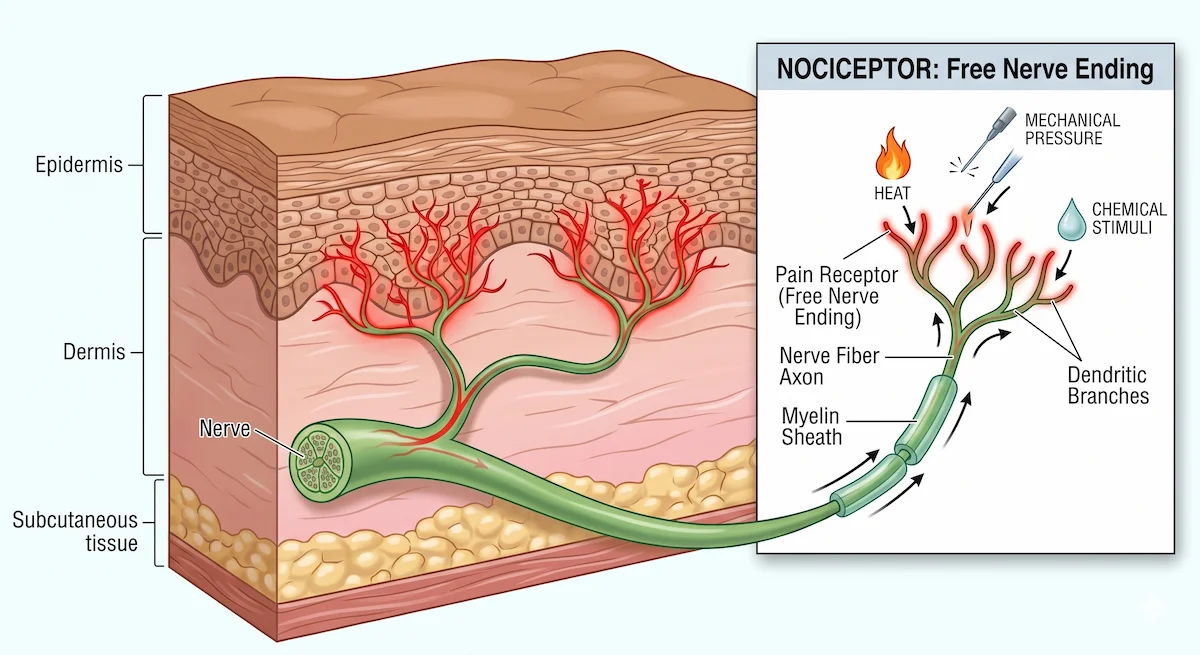
The biological mechanism behind this observation was mapped decades later. In 1906, the British neurophysiologist Charles Scott Sherrington coined the term "nociceptors" to describe the specialized peripheral sensors that detect harmful mechanical, thermal, and chemical stimuli. Concentrated heavily in the skin, these receptors serve as the body’s first line of contact with the external environment. Upon activation, they send electrical signals through nerve fibers to the spinal cord and brain, where the raw signals are processed and perceived as pain. In 1944 the Nobel Prize was given to Joseph Erlanger and Herbert Gasser for work they did throughout the 1920s and 30s to differentiate nerve fibers (myelinated A-delta fibers and unmyelinated C fibers) and their function.
Today, the clinical significance of these discoveries remains profound. First-degree burns, affecting only the outermost layer, activate nociceptors and cause intense pain. Second-degree burns can be even more excruciating because more receptors in the dermis are exposed. A third-degree burn, however, destroys the full thickness of the skin and with it, the nociceptors themselves. The patient feels no pain at the exact site of destruction because the biological equipment for feeling pain is gone. When a skin graft is applied, the area must slowly develop a new population of nociceptors to restore the ability to feel. The skin is not a passive cover; it is the interface through which the body encounters the world, and that interface has to be intact for pain to be felt.
Islamic Context
إِنَّ الَّذِينَ كَفَرُوا بِآيَاتِنَا سَوْفَ نُصْلِيهِمْ نَارًا كُلَّمَا نَضِجَتْ جُلُودُهُمْ بَدَّلْنَاهُمْ جُلُودًا غَيْرَهَا لِيَذُوقُوا الْعَذَابَ
Indeed, those who repudiate Our verses — We will drive them into a fire. Every time their skins are roasted through, We will replace them with other skins so they may taste the punishment.
— Quran 4:56
This verse names a recurring process. "Every time their skins are roasted through, We will replace them with other skins."ʿAbdullāh ibn ʿAbbās (d. 687 CE) addressed the specific detail of "other skins" noting that the new skin is structurally fresh and uncompromised by the previous fire. However, he stressed that while the skin is physically new, the person inhabiting it remains the same. This early understanding isolates the skin as a consumable resource that must be restocked in a ceaseless succession for the punishment to remain effective.
Building on this foundational understanding, later scholars expanded on the verse's structural architecture. Al-Rāzī (d. 1210) noted that the construction places a single destruction and a single replacement inside a repeating cycle. The verse is not describing one event that happens once. It is naming a sequence: a skin is consumed, a new skin takes its place, that skin is consumed, another takes its place. The cycle has no stated end.
The plural form julūd (skins) appears in both halves of the verse, mirroring the cyclical structure. Al-Qurtubi (d. 1273) observed that the plural in the first half and the plural in the second half are not separate; they are paired. Each consumption and each replacement is one instance of a process that is itself plural. The verse is naming a category of events rather than a single event.
The verb naḑija names a particular kind of burning. In classical Arabic, the root conveys a fire that goes all the way through, not a surface singeing. Al-Rāzī observed that the verse describes a destruction that ends the skin as a structure, not a partial injury. The choice of verb locates the consumption at the level where the skin has been entirely consumed, which is also the level where the physical capacity for feeling no longer exists.
The verse closes with the reason: "...so that they may taste the punishment." Al-Ṭabarī (d. 923) noted that this is what gives the replacement its meaning. The skin is not replaced for restoration, the skin must be renewed structurally so that it carries the capacity to feel, and the punishment is tasted again.
Prev Post
Next Post
Reference Timeline
600 CE
1000 CE
1500 CE
2000 CE
Quran verse 4:56
615 CE–632 CE
Describes a continuous cycle where consumed skins are replaced with fresh ones so they may continually taste the punishment
687 CE
Ibn ʿAbbās addresses the linguistic detail of replacing skins, noting the new skin remains structurally fresh to maintain the capacity for feeling while preserving identity
Ibn ʿAbbās (d. 687)
923 CE
Al-Ṭabarī notes that the purpose clause in the verse dictates why the skin is replaced: renewal ensures the punishment can continue to be experienced
Muḥammad ibn Jarīr al-Ṭabarī, Jāmiʿ al-Bayān (c. 923)
1210 CE
Al-Rāzī analyzes the verse's repeating cycle and explains that the root 'naḑija' signifies a fire that consumes the skin entirely down to the level where sensation ceases
Fakhr al-Dīn al-Rāzī, Mafātīḥ al-Ghayb (c. 1210)
1273 CE
Al-Qurṭubī observes that the plural framing of skins across both halves of the verse establishes a recurring category of continuous renewal rather than a single event
Al-Qurṭubī, Al-Jāmiʿ li-Aḥkām al-Qurʾān (c. 1273)
1607 CE
Surgical pioneer Wilhelm Fabry begins categorizing burn depths based on progressive tissue involvement and appearance
Wilhelm Fabry, Curtarum Chirurgica (1607)
1724 CE
German surgeon Lorenz Heister categorizes burn injuries into distinct degrees based on clinical severity
Lorenz Heister, Chirurgie (1724)
1788 CE
August Richter contributes to early modern surgical classifications of skin burn depth
August Richter, Anfangsgründe der Wundarzneykunst (1788)
1839 CE
Baron Guillaume Dupuytren publishes a comprehensive review establishing a six-degree classification of burn depth, explicitly mapping how deep tissue destruction compromises sensation
Guillaume Dupuytren, Leçons Orales de Clinique Chirurgicale (1839)
1906 CE
Charles Scott Sherrington coins the term 'nociceptors' to describe specialized peripheral sensors that detect harmful mechanical, thermal, and chemical stimuli
Charles Scott Sherrington, The Integrative Action of the Nervous System (1906)
1944 CE
Joseph Erlanger and Herbert Gasser share the Nobel Prize for their foundational work distinguishing nerve fiber types (A-delta and C fibers) and their functions
Joseph Erlanger and Herbert Gasser, Nobel Prize in Physiology or Medicine (1944)
The Connection
The Quranic description of skin being continually destroyed and replaced captures a precise biological threshold. Once a fire burns through the full thickness of the tissue, it incinerates the nociceptors, permanently severing the body's ability to feel the burn site. The verse directly addresses this physiological limit: the tissue must be entirely reconstituted because the neurological equipment required to process agony has been completely erased. A destroyed skin is a silent skin, and only a new one can feel the punishment again.
Related Connections