Physics
The Laden Ship
Scientific Context
The Load-Bearing Capacity of Water and Air
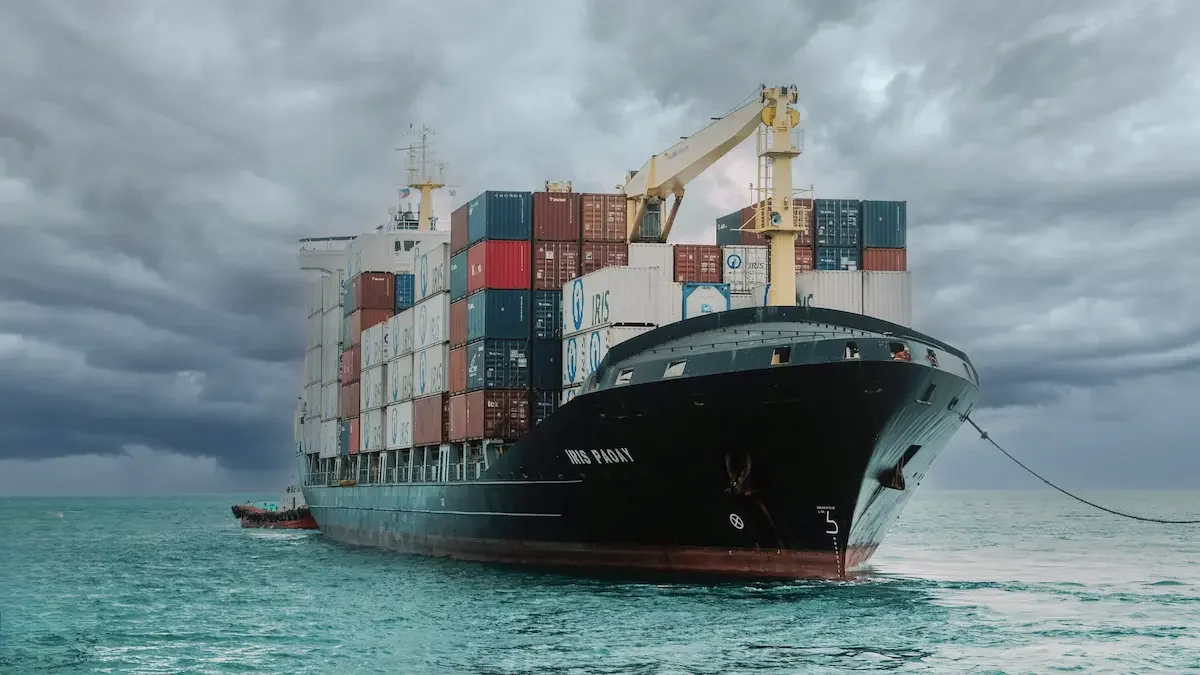
A fully loaded cargo ship can weigh over 200,000 tonnes and is constructed primarily of steel, a material nearly eight times denser than water. It remains afloat by exploiting the inherent physical properties of the water itself. According to Archimedes' principle, the water displaced by the submerged hull generates a reactive upward force. Because water is practically incompressible, this buoyant force pushes back against the hull with a force exactly equal to the mass of the displaced fluid. By maintaining a massive internal volume of air, the ship keeps its average density below that of the water, allowing the ocean to bear its crushing weight.
An aircraft operates on similar principles of fluid dynamics, but in a gaseous medium. A commercial airliner weighing up to 400 tonnes at takeoff climbs into an atmosphere hundreds of times less dense than water. It achieves this by leveraging the physical properties of air pressure and velocity. As the aircraft moves forward, the airfoil shape of its wings forces air to travel faster over the upper surface than the lower surface. This velocity differential creates a region of lower pressure above the wing and higher pressure beneath it. The wing manipulates the atmospheric pressure, generating an upward aerodynamic force known as lift that overcomes the aircraft's mass.
In both cases, the massive weight of these vessels is supported by the immutable characteristics of the mediums they occupy. Fluid dynamics dictate that both water and air will predictably exert massive reactive forces when displaced or accelerated. Naval architecture and aerospace engineering are entirely dependent on these pre-existing physical constraints; a vessel is simply a geometric shape designed to trigger the latent load-bearing capacity of the environment.
Islamic Context
وَءَايَةٌۭ لَّهُمْ أَنَّا حَمَلْنَا ذُرِّيَّتَهُمْ فِى ٱلْفُلْكِ ٱلْمَشْحُونِ وَخَلَقْنَا لَهُم مِّن مِّثْلِهِۦ مَا يَرْكَبُونَ
And a sign for them is that We carried their offspring in the loaded ship. And We have created for them of the like thereof that they ride.
— Quran 36:41-42
The Quran designates the ship as an ayah—a sign—but qualifies it with a specific adjective: al-mashhun (heavily laden or filled to capacity). Al-Tabari (d. 923) emphasized that this word defines the core of the sign. The point of reflection is not simply that an empty wooden hull floats, but that an overwhelming, concentrated mass is safely suspended rather than pulling the vessel to the bottom.
Crucially, to explain how this massive weight is supported, the verse uses the active verb hamalnā ("We carried"). The text does not say the ship carries the passengers; it says they are carried in the ship. Classical interpreter al-Razi (d. 1210) noted that this shifts the focus from the vehicle to the medium. Through the concept of taskhir (subjugation), he observed that a fluid, yielding element like water was endowed with the specific physical capacity to push back and bear crushing weight. The true sign is the inherent load-bearing nature of the environment.
The subsequent verse expands this from a single instance to a broader category of transport: "And We have created for them of the like thereof what they ride." Al-Zamakhshari understood the phrase min mithlihi ("of the like of it") to establish a functional category: any vehicle that operates on this exact same principle of environmental interaction.
By pairing hamalnā ("We carried") with khalaqnā ("We created"), the text directs attention away from human engineering. Humans may shape the wood or metal to construct the vessel, but the capacity of the elements to support that burden is a pre-existing creation. The ship is merely an assembled structure; it is the ordained nature of the surrounding environment that actually does the carrying.
Prev Post
Next Post
The Connection
The Quran points past the construction of the vessel to highlight the mechanism actually doing the work: an environment created with the capacity to bear massive weight. Modern fluid dynamics operates on the exact same premise, locating the physics of buoyancy and lift entirely in the immutable, reactive properties of the water and air. The overlap is direct. A 200,000-tonne ship and a 400-tonne airliner do not defy gravity through their own power; they overcome it only because they are shaped to trigger the pre-existing, load-bearing laws of the medium they occupy.
Related Connections