Geoscience
Water From Above and Below
Scientific Context
Catastrophic Flooding and Alluvial Silt Deposits
The alluvial plains of southern Mesopotamia, where the Tigris and Euphrates rivers meet before emptying into the Persian Gulf, are among the flattest landscapes on Earth. Over a distance of roughly 100 kilometres, the elevation drops by only about one to two meters. In such terrain, even modest flooding can inundate vast areas; a severe flood becomes a civilisation-ending event.
Archaeological excavations have proven that the region is uniquely susceptible to catastrophic inundations. The most striking evidence was uncovered at the ancient city of Ur in the 1920s, where Sir Leonard Woolley's team excavated an 11-foot (3.3-metre) layer of clean, water-lain silt. A deposit of this magnitude implies not merely a river overflow, but a prolonged, high-volume inundation carrying an extraordinary sediment load. It buried the existing settlement metres deep in new alluvium.
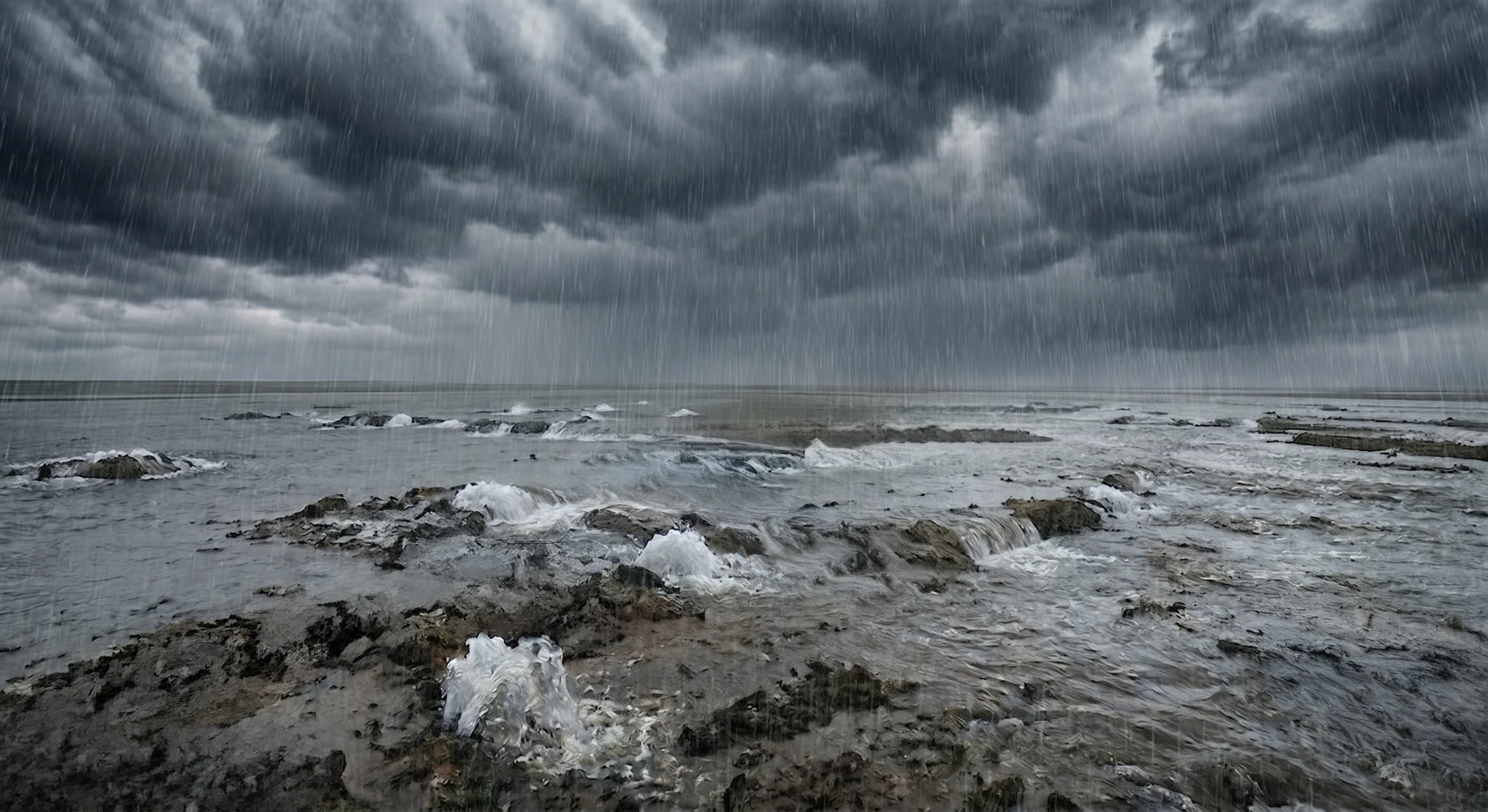
In this region, the water table is already high. When rivers surge beyond their banks and heavy rainfall saturates the soil, the ground itself begins to pour forth water. Springs and seepages emerge across the plain as the water table breaches the surface. The rivers can rupture both natural and artificial barriers, spreading horizontally across a landscape with virtually no gradient to carry the water away. What results is not a passing flood but a prolonged submersion: water sits for weeks or months, reshaping the inhabited surface beneath metres of new sediment.
Modern hydrology and sedimentology confirm that floods of this magnitude, while rare, are physically proven in the Mesopotamian basin. The combination of riverine surge, torrential rainfall, and groundwater extrusion creates precisely the kind of multi-source inundation capable of depositing several metres of silt across a broad, flat region—effectively erasing an entire civilisation's surface infrastructure and agricultural base.
Islamic Context
فَفَتَحْنَا أَبْوَابَ السَّمَاءِ بِمَاءٍ مُّنْهَمِرٍ ١١ وَفَجَّرْنَا الْأَرْضَ عُيُونًا فَالْتَقَى الْمَاءُ عَلَىٰ أَمْرٍ قَدْ قُدِرَ ١٢
So We opened the gates of heaven with water pouring forth. And We caused the earth to gush forth with springs, so the waters met for a matter decreed.
— Quran 54:11-12
Surah Al-Qamar presents the flood not as a vague disaster but as a precise, divinely orchestrated event. The verse uses two active, forceful verbs: fataḥnā (We opened) and fajjarnā (We caused to gush/burst forth). The gates of heaven are opened—not merely as rain, but as māʾin munhamirin. Al-Tabari (d. 923) emphasizes that munhamir signifies a severe, unyielding outpouring far beyond normal precipitation. The earth, in response, is made to burst forth with springs—ʿuyūnan—so that the waters from above and the waters from below iltaqā (met, converged, collided) ʿalā amrin qad qudira—for a matter already decreed.
The grammatical structure of this convergence is highly specific. The verse employs the verb iltaqā (to meet or join), depicting the waters originating from different domains and uniting at the surface. Analyzing this wording, Abdullah ibn Abbas (d. 687) observed that the phrasing indicates the water was brought forth in two equal, corresponding parts—one descending from heaven and the other welling up from the earth. Furthermore, the Quran refers to this combined force using the singular noun al-mā' (the water) rather than a dual form such as al-mā'ān (the two waters). This deliberate linguistic choice indicates that once the torrential outpouring from above and the gushing springs from below collided, they ceased to be separate phenomena.
The phrase ʿalā amrin qad qudira—"for a matter decreed"—frames the entire event within this divine justice. The exact scope of this decree has been a subject of scholarly discussion. While classical scholars like Ibn Kathir (d. 1373) traditionally interpreted the flood as a global event, later interpreters such as Tahir ibn 'Ashur (d. 1973) and Rashid Rida argued for a localized inundation, noting that Quranic retributions are consistently restricted to the specific community that rejected its messenger. In either case, the text makes clear that the inundation was a measured recompense. The Quranic emphasis falls not on geographical breadth, but on ultimate purpose: an overwhelming catastrophe that fulfilled a precise decree of destruction against a targeted, disbelieving community.
Prev Post
Next Post
The Connection
The Quranic description in Surah Al-Qamar (54:11-12) of water pouring from the sky and bursting forth from the ground aligns with the geological record of catastrophic flooding in the Mesopotamian alluvial plain. Archaeological evidence of multi-metre silt deposits at ancient sites such as Ur confirms that floods of sufficient magnitude to bury entire settlements and erase regional civilisation were not only possible but occurred. In Islamic theology, the flood's significance lies not in debated questions of global versus local scope, but in its function: a disbelieving people were overwhelmed by waters from above and below leaving no survivors from those who rejected.
Related Connections
Springs from the Earth
Spring Water, Soil Enrichment, and the Diversity of Arid-Land Agriculture
Geoscience