Bioscience
The Weakest of Homes
Scientific Context
Orb Web Architecture and Function
Spider silk is among the most impressive and over-engineered materials in all of biology. Measurements from the Oxford Silk Group have proven that dragline silk—the structural anchor of the web—possesses a tensile strength comparable to high-grade steel and a toughness per unit of weight that exceeds Kevlar roughly threefold.
However, an engineering paradox exists at the center of the spider's existence: it takes a material stronger than steel and weaves it into one of the most precarious, fragile structures in nature.
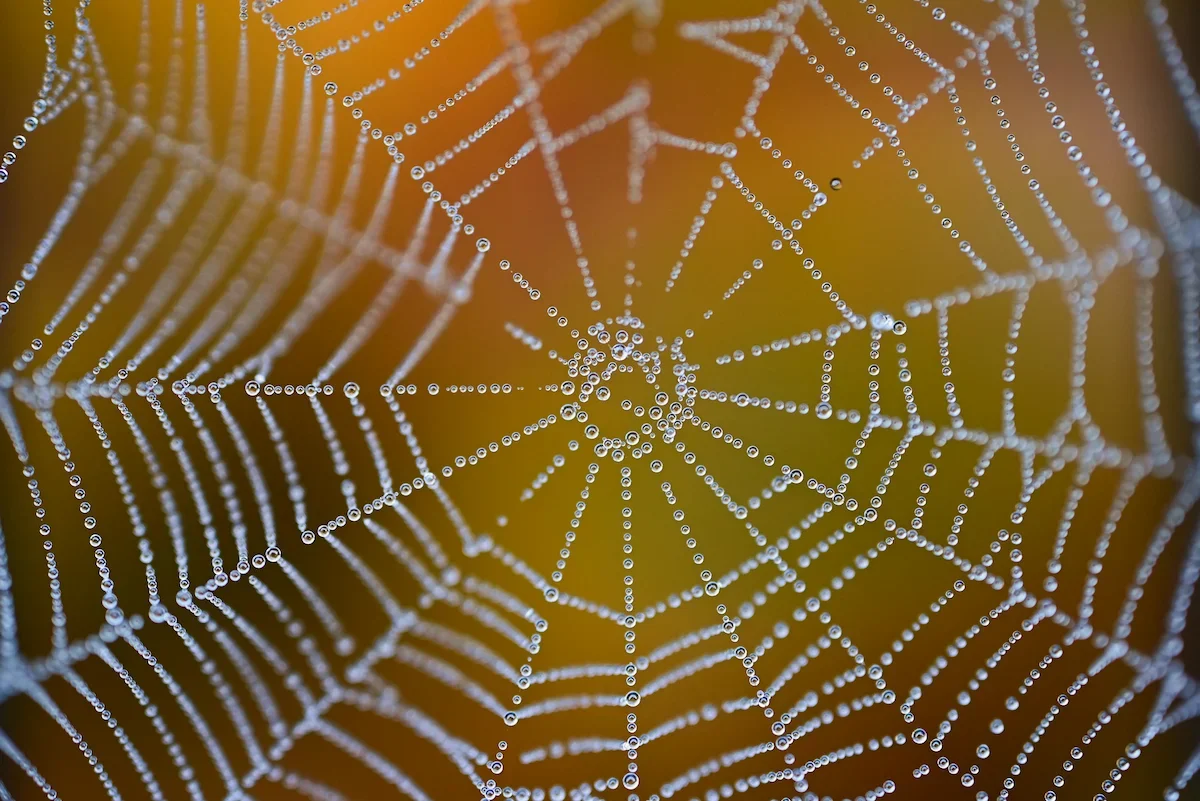
The architecture of an orb web is minimal: a simple frame of anchor lines, a set of radii extending from a central hub, and a spiral of sticky catching silk coated in microscopic glue droplets. Because it is designed to be nearly invisible, the design is highly vulnerable. A single human finger can break dozens of structural junctions, and a stray falling leaf can shear away a quarter of the radii in an instant. An adult garden spider's web can be reduced to a ragged, useless frame in less than a second.
In a biological sense, it is barely a "home" at all. A home shelters what is inside from what is outside; the web does the exact opposite. It is a working surface extended out into the open air specifically to be run into. It offers absolutely no protection from rain, wind, or predators. The spider takes the strongest biological fiber on earth and constructs a dwelling that provides zero shelter—a structure that must be constantly rebuilt because it is continuously undone by the slightest environmental pressure.
Islamic Context
مَثَلُ الَّذِينَ اتَّخَذُوا مِن دُونِ اللَّهِ أَوْلِيَاءَ كَمَثَلِ الْعَنكَبُوتِ اتَّخَذَتْ بَيْتًا وَإِنَّ أَوْهَنَ الْبُيُوتِ لَبَيْتُ الْعَنكَبُوتِ لَوْ كَانُوا يَعْلَمُونَ
The simile of those who take protectors other than Allah is like that of the spider who takes a home. And indeed, the weakest of homes is the home of the spider, if only they knew.
— Quran 29:41
The Quran introduces this comparison using the word mathal (example or parable), signaling that the text is not merely observing nature, but constructing a precise analogy for the human condition.
The linguistic precision of the Arabic is striking. The verse does not claim that the spider is the weakest of creatures, nor does it claim that the spider's physical material is weak. Instead, it explicitly states awhan al-buyūt—the weakest of homes. The choice of the word bayt (home or dwelling) is the load-bearing pillar of the verse. Classical scholars like al-Qurtubi (d. 1273) and Ibn Kathir (d. 1373) noted that the divine comparison focuses entirely on the architecture the animal constructs, not on the animal itself.
This focus is locked into place by the verb ittakhadha (to take or adopt). The verse employs this exact verb twice: first to describe humans who "take" false protectors, and second to describe the spider who "takes" a home. This deliberate grammatical parallel frames both the spider and the human as agents actively choosing a structure for shelter. The crushing weight of the analogy rests on this act of choosing. The text applies the label awhan (weakest) to both the physical web and the misplaced human reliance.
The verse closes with a conditional phrase: law kānū yaʿlamūn ("if they only knew"). This is not a wish, but a profound observation on the illusion of security. The spider weaves a structure of incredible tensile strength, believing it is secure, completely unaware that a passing breeze can destroy it. The classical commentators noted that the verse asks the human listener to recognize this exact same blindness in themselves: relying on worldly powers that appear incredibly strong, but provide absolutely no real shelter when tested.
Prev Post
All Posts
The Connection
The Quranic parable is built on a precise distinction: it does not say the spider's thread is weak, but rather that the home constructed from it is the weakest of dwellings. Modern material science notes this same biological paradox. The spider produces a fiber stronger than steel and tougher than Kevlar, yet weaves it into an exposed, fragile structure that provides zero shelter and is destroyed by a passing breeze. The text uses this precise structural vulnerability as the ultimate metaphor for the illusion of worldly security.
Related Connections