Astroscience
When the Stars Are Scattered
Scientific Context
Cosmic Expansion and Stellar Dispersal
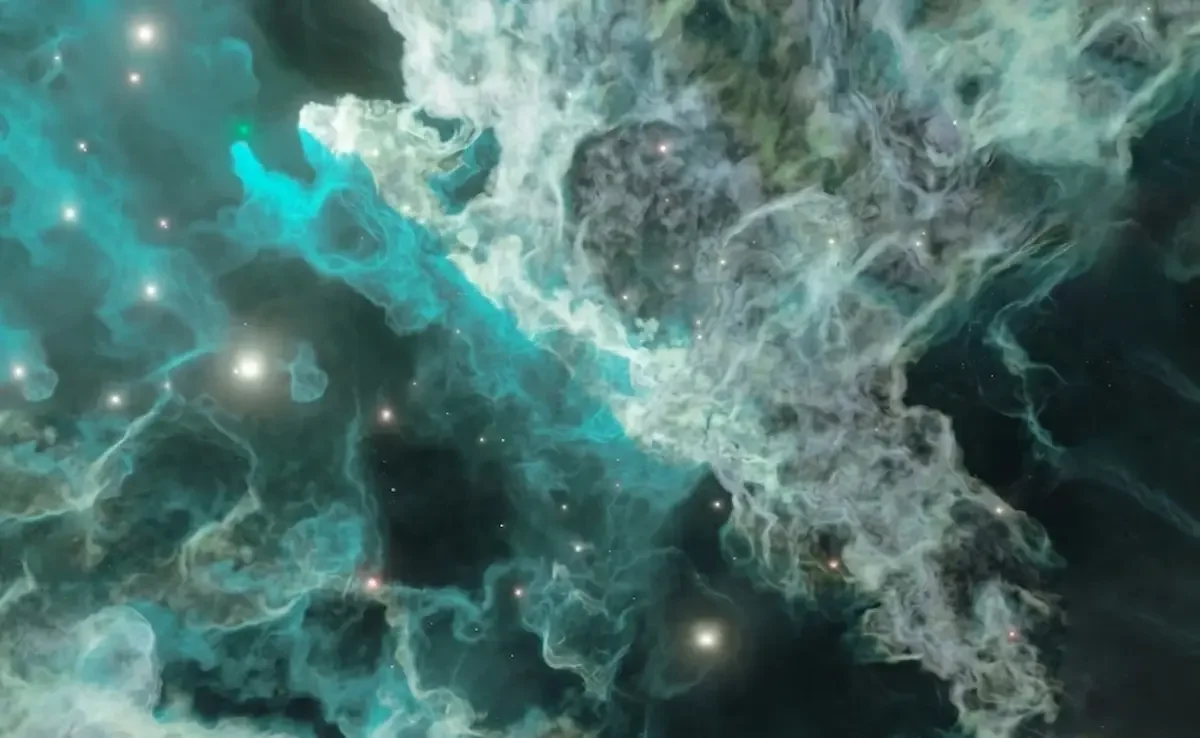
In 1998, two independent teams of astronomers —the Supernova Cosmology Project and the High-Z Supernova Search Team— reached the same startling conclusion: the universe is not just expanding, it is expanding faster and faster. Gravity pulls matter together, so physicists had long assumed that cosmic expansion must be gradually slowing. Instead, they found that an unknown force, now called dark energy (not to be confused with dark matter which acts as a kind of celestial glue), is driving galaxies apart at an increasing rate. This is not galaxies moving through space but space itself stretching, creating cosmic event horizons. Beyond these horizons, galaxies recede faster than light can cross the growing gap. They are permanently severed from causal contact with our region of the universe. The connected cosmos is being cleft into isolated fragments.
Planck satellite observations indicate that roughly 68% of the universe's energy content is dark energy, and its influence grows as space expands. Galaxies beyond our Local Group will eventually disappear behind these horizons. The vast web of galaxy clusters and superclusters is being pulled apart from within, the fabric binding cosmic structure stretched beyond its capacity to hold.
As this structure fails, stars are scattered from their positions. When massive stars die in supernova explosions, they scatter their elements — carbon, oxygen, iron, gold — across thousands of light-years. The Crab Nebula visible today is an expanding debris cloud from a supernova observed in 1054 CE. But scattering extends beyond material dispersal. Astronomers have discovered hypervelocity stars ejected from their galaxies entirely, traveling over 1,000 kilometers per second through intergalactic space. The Milky Way may contain hundreds of millions of these rogue stars, stripped from smaller galaxies it has consumed.
Together, the macroscopic stretching of space and the physical ejection of stars act in concert to dismantle the ordered universe. While expanding space isolates entire galactic clusters by pulling the foundational fabric apart, explosive forces and gravitational collisions scatter the individual luminous bodies from within. According to research published in the Monthly Notices of the Royal Astronomical Society, our own Milky Way galaxy alone has shed hundreds of millions of these rogue stars into the surrounding intergalactic emptiness. Ultimately, these combined forces of dispersal are steadily overwhelming the gravitational bonds that hold celestial structures together. The ordered arrangement of stars in fixed patterns is being dismantled.
Islamic Context
إِذَا السَّمَاءُ انفَطَرَتْ وَإِذَا الْكَوَاكِبُ انتَثَرَتْ
When the heaven is ruptured, and when the stars are scattered.
— Quran 82:1-2
Surah Al-Infitar opens with a striking, sequential declaration: "When the heaven is ruptured, and when the stars are scattered." The verses employ a precise grammatical structure using conditional clauses introduced by the Arabic particle idha (when), which points to an absolute future certainty. This syntax intimately links two distinct verbs—infaṭarat and intatharat—establishing a definitive cause-and-effect relationship where the structural failure of the sky directly precipitates the dispersal of the celestial bodies.
The verse specifically selects the word al-kawākib rather than the more general an-nujūm for the stars. In classical Arabic, kawākib (singular kawkab) designates prominent luminous bodies characterized by their established positions, steady light, or perceived orbits. The scattering of kawākib implies the active disruption of an intricately ordered system, emphasizing that it is the precise geometric arrangement of these bodies—not just their existence—that is being dismantled.
Classical commentators universally recognized the physical severity of these descriptions. Ibn Kathir (d. 1373) explained that these verses describe the actual unmaking of the known cosmos, where the sky loses its cohesion. Al-Qurtubi (d. 1273) noted that the Quran presents heaven not as a passive, empty backdrop, but as an active, bound structure that maintains celestial order. When that foundational structure fails, the arrangement it sustains inevitably collapses.
The specific semantic choices reinforce this concept of structural ruin. The first verb, infaṭarat, derives from the root faṭara, meaning to split, cleave, or rupture from within. It conveys the forceful breaking apart of something originally intact and functional. The subsequent verb, intatharat, originates from nathara, meaning to scatter or disperse. In classical Arabic, nathara is the exact verb famously used to describe pearls scattering across a floor when the underlying string of a necklace snaps. The shift from a verb of structural cleaving to this specific imagery of uncontrolled scattering perfectly captures the loss of a cosmic binding force.
Prev Post
Next Post
The Connection
The Quranic description of heaven splitting and stars scattering employs verbs conveying structural rupture followed by dispersal — a sequence mirroring the astrophysical forecast of dark energy tearing cosmic structure apart and stars being ejected from fixed positions. Accelerating expansion creates horizons permanently severing regions of the universe, while supernovae and galactic collisions scatter stellar material and entire stars across intergalactic space. The verse treats this dissolution as future certainty, inviting reflection on the impermanence of celestial arrangements that appear eternal but were always destined to end.
Related Connections