Physics
Day of a Thousand Years
Scientific Context
The Variable Nature of Cosmic Time
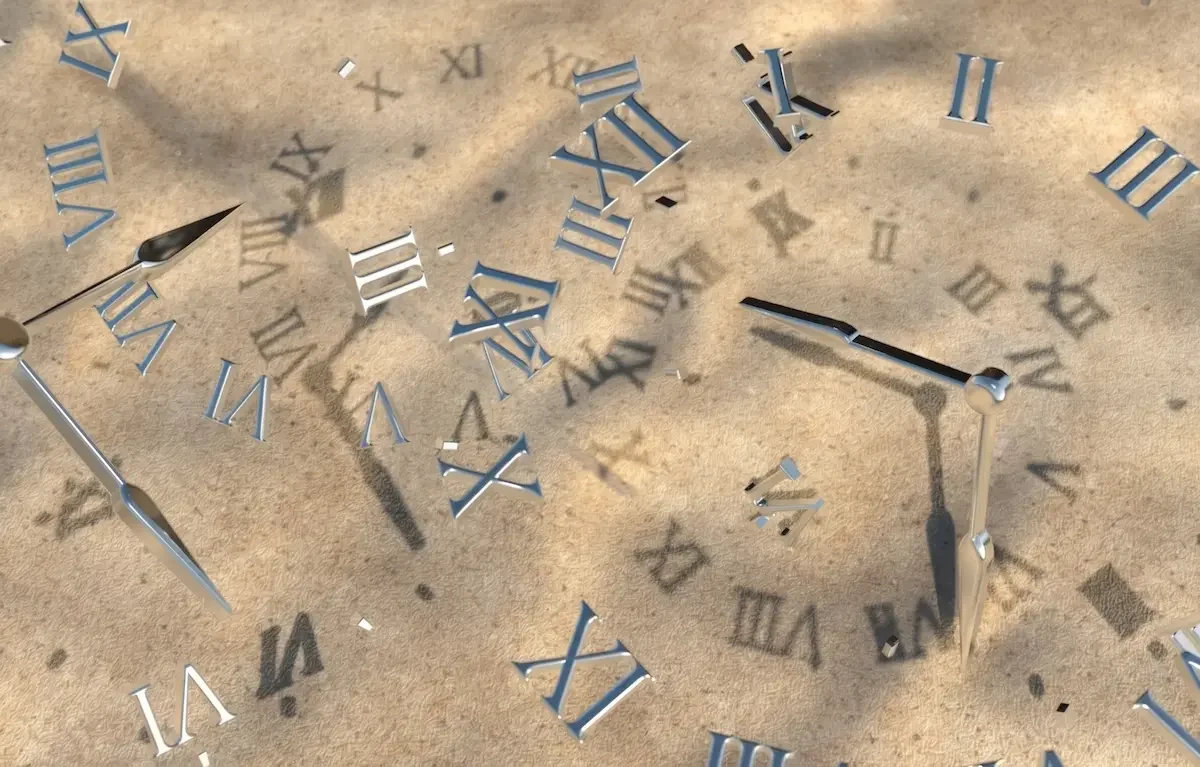
Our historical experience suggests that time is a fixed, universal backdrop—a steady, unyielding metronome ticking uniformly across the cosmos. However, modern astrophysics has entirely dismantled the concept of absolute time on the grandest possible scales. Building on Einstein’s General Theory of Relativity, which established that space and time are physically welded into a single, pliable fabric called spacetime, researchers have confirmed that the flow of time is highly variable. As the universe expands, it does not simply push objects further apart; it actively stretches the fabric of time itself.
When astronomers look into the deep past, they can physically measure this stretching. In 2023, astrophysicist Geraint Lewis at the University of Sydney, alongside Brendon Brewer, published a landmark study analyzing 190 quasars—hyper-active supermassive black holes—from the extreme early universe. Because the light from these quasars traveled for roughly twelve billion years through a continuously expanding universe, the space it moved through was massively stretched. According to relativity, stretching space must also stretch the duration of the events occurring within it. The quasar data established this observationally: looking back at the infant universe, time appears to flow five times slower than it does today. To a localized observer standing near that ancient quasar, a second functioned exactly like a second. But when calibrated against our temporal reckoning on Earth today, that same second took five seconds to pass.
Looking forward, the same physical laws project an even more extreme temporal distortion in the deep future. Driven by dark energy, the expansion of the universe is actively accelerating. Because of this acceleration, distant galaxies are being pushed away from us at increasing speeds, eventually approaching the cosmological event horizon—the boundary where the space between us and the galaxy expands faster than the speed of light. General relativity dictates that as an object approaches this horizon, its time, relative to an observer on Earth, dilates toward infinity. A star exploding near this boundary would appear to play out in extreme slow motion, taking millions of years to detonate. Eventually, as the galaxy crosses the horizon, its time would appear to permanently freeze, its light stretching into undetectable wavelengths as it fades from the observable universe entirely.
From the early epochs of cosmic history to the theoretical limits of the universe, the grand scale of astrophysics demonstrates that time is not an independent, eternal framework. It is a localized, physical property that stretches, slows, and eventually unravels. The duration of an event is never a universal constant; it is a highly variable measure entirely dependent on the cosmological frame of the observer.
Islamic Context
يُدَبِّرُ الْأَمْرَ مِنَ السَّمَاءِ إِلَى الْأَرْضِ ثُمَّ يَعْرُجُ إِلَيْهِ فِي يَوْمٍ كَانَ مِقْدَارُهُ أَلْفَ سَنَةٍ مِمَّا تَعُدُّونَ
He conducts every affair from the heavens to the earth, then it all ascends to Him on a Day whose length is a thousand years by your counting.
— Quran 32:5
Surah As-Sajdah (32:5) describes the administration of the cosmos using a striking temporal disruption: "He conducts every affair from the heavens to the earth, then it all ascends to Him on a Day (yawm) whose length is a thousand years by your counting." The verse hinges on the Arabic word yawm. In standard human usage, a yawm is the fixed, familiar cycle of a solar day. Yet the Quran deliberately fractures this assumption within a single sentence. It names a "Day," but immediately detaches the concept from the sun, expanding its duration to a millennium.
The classical tradition understood that the text was breaking the terrestrial clock. Ibn Abbas (d. 687) reads this specific "Day" as the actual duration it takes for the divine command to descend and ascend, operating on a scale utterly detached from human solar days. Al-Razi (d. 1210) observes that the word yawm in classical Arabic does not intrinsically require a sunrise and sunset; it fundamentally signifies an epoch, a distinct phase, or a bound span of events. When the Quran applies yawm to the mechanics of the heavens, the term sheds its earthly limitations entirely.
This decoupling of time from a fixed terrestrial anchor is a consistent structural feature across the text. In Surah Al-Hajj (22:47), the exact same metric is invoked (a day equaling a thousand years) and is explicitly contrasted against human perception to emphasize a completely different experiential reality. Surah Al-Ma'arij (70:4) expands this temporal elasticity by a factor of fifty, describing the ascent of cosmic entities "on a Day whose length is fifty thousand years." By shifting the numerical calibration so drastically depending on the specific event being described, the text reinforces that a yawm is a dynamic, fluid container. Furthermore, Surah Qaf (50:38) states that the creation of the heavens and the earth took place over "six days" (sittati ayyamin). Because this sequence includes the very formation of the celestial bodies that define our 24-hour cycle, Islamic scholars recognize that these "days" signify distinct, successive cosmic phases rather than earthly rotations.
The defining linguistic pivot of Surah As-Sajdah (32:5) lies in its final two words: mimma ta'uddoon ("of what you count" or "by your reckoning"). The verb derives from the root ʿadda, meaning to compute, number, or calculate. The text explicitly isolates human computation. It does not simply say the day is a thousand years long; it says the day equals a thousand years when measured by human mechanics. By anchoring the duration to the observer's specific act of counting, the verse separates the absolute reality of an event from the localized perception of the one measuring it. The Quran does not treat time as an absolute, rigid container. Instead, it presents the structures of the universe as operating on a temporal scale that is fundamentally independent of the terrestrial clock, treating the entire human calendar as a relative, observer-dependent standard.
Prev Post
Next Post
The Connection
The text describes the flow of time not as a universal constant, but as a fluid measure calibrated explicitly against human reckoning. Over a century of astrophysical observation, modern cosmology has detailed a matching architecture of time. Where classical physics once assumed a rigid clockwork universe, the cosmos is now known to operate on a pliable timeline that stretches across the expanse of space. The overlap between a text that makes time dependent on the observer and a physical universe that does the same is notable.
Related Connections