Astroscience
A Preserved Ceiling
Scientific Context
The Atmospheric Shield
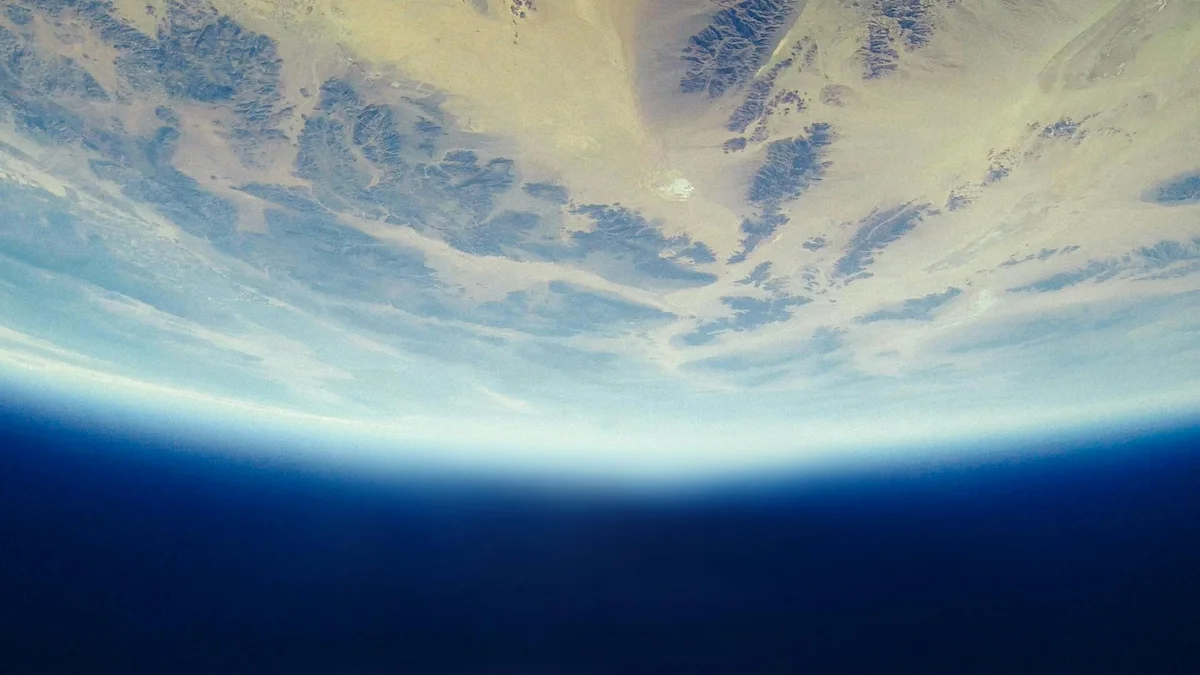
The air above us looks like an empty void, but it is actually a massive, active defense system. The Earth is wrapped in a multi-layered shield, where each specific altitude performs a distinct job to keep the surface safe. High above the clouds, the mesosphere acts as a physical barrier, burning up incoming meteors through pure friction. Just below it, the stratosphere acts as a chemical barrier. Here, the ozone layer absorbs the sun’s lethal ultraviolet radiation, stopping it before it can reach the ground and destroy cellular life.
We did not always know this machinery was there. The discovery of our planetary shield happened piece by piece. The first major breakthrough came in 1881, when British chemist W.N. Hartley detected ozone in the upper atmosphere and realized it was catching specific, harmful wavelengths of sunlight. By 1913, French physicists Charles Fabry and Henri Buisson expanded on this, successfully mapping the actual size and boundaries of the ozone layer.
But the most crucial discovery was not just where the shield was, but how it worked. In 1930, geophysicist Sydney Chapman revealed that this barrier is not a permanent, static roof. It is an active engine. The ozone layer is continuously created and destroyed by solar reactions. This means the sky's defense system relies entirely on a continuous supply of fresh material from the ground. Every year, global plant life pumps approximately 130 billion tonnes of oxygen into the atmosphere, feeding the exact chemical cycle required to keep the overhead shield intact.
This constant need for fuel makes the atmosphere incredibly vulnerable. We learned exactly how fragile this system is in 1985, when Joe Farman and a team of researchers discovered a massive hole in the ozone layer over Antarctica. It provided the final, undeniable proof that our planetary shield is not a permanent fixture. It is an active, fragile process that must be continuously generated to survive.
Islamic Context
وَجَعَلْنَا السَّمَاءَ سَقْفًا مَّحْفُوظًا وَهُمْ عَنْ آيَاتِهَا مُعْرِضُونَ
And We made the sky a preserved ceiling, but they turn away from its signs.
— Quran 21:32
The verse opens with the noun al-samāʾ, a term classical Arabic uses for everything situated overhead. Foundational commentators, including Ibn ʿAbbās (d. 687) and al-Ṭabarī (d. 923), understood this to mean the entire upper realm—not just the visible blue dome, but the complete overhead system. The text does not claim how the sky looks, but rather establishes what it is in relation to the world below it.
This relationship is anchored by the phrase saqfan maḥfūẓan—a preserved ceiling. The word saqf is strictly architectural, denoting a covering designed to shelter whatever lies beneath it. Al-Rāzī (d. 1210) noted that choosing saqf over an alternative like jidār (wall) is highly deliberate: a roof shelters from above, indicating a structural function rather than just a physical position.
Crucially, the qualifier maḥfūẓ is a passive participle. It does not mean the ceiling is doing the guarding; it means the ceiling itself is the object being kept safe from collapse. As al-Rāzī and al-Qurṭubī (d. 1273) observed, it carries the grammatical sense of an ongoing, maintained state. The sky is not an indestructible, abandoned monument. It is a fragile canopy that must be actively and continuously preserved to survive.
The verse closes with a reminder, “...yet they turn away from its signs.” Mujāhid ibn Jabr (d. 722), interpreted these signs (āyāt) as the sky's observable features—its visible structure, its rhythms, and what it physically guards against. The reproach targets those who perceive the ceiling overhead but ignore what its precise architecture indicates. Ultimately, the closing line recasts the entire verse from a description into a challenge: the sky's preserved structure is itself a sign pointing beyond itself.
Prev Post
Next Post
Reference Timeline
600 CE
1000 CE
1500 CE
2000 CE
Quran verse 21:32
615 CE–632 CE
Describes the sky as a 'preserved ceiling' (saqfan maḥfūẓan), emphasizing its function as an actively maintained architectural canopy and pointing to its observable signs
687 CE
Ibn ʿAbbās understands the term 'al-samāʾ' to encompass the entire overhead realm and its relationship to the world below, rather than just the visible blue dome
Ibn ʿAbbās (d. 687)
722 CE
Mujāhid ibn Jabr interprets the sky's 'signs' as its observable physical features, its structural rhythms, and the elements it actively guards against
Mujāhid ibn Jabr (d. 722)
923 CE
Al-Ṭabarī reinforces the understanding of the sky as a complete upper system, establishing its identity through its functional relationship to the earth
Muḥammad ibn Jarīr al-Ṭabarī, Jāmiʿ al-Bayān (c. 923)
1210 CE
Al-Rāzī notes that the deliberate choice of the architectural term 'saqf' (ceiling) denotes a covering specifically designed to shelter whatever lies beneath it
Fakhr al-Dīn al-Rāzī, Mafātīḥ al-Ghayb (c. 1210)
1273 CE
Al-Qurṭubī observes that the passive participle 'maḥfūẓ' dictates an ongoing, maintained state, indicating the sky is a fragile canopy requiring continuous preservation
Al-Qurṭubī, Al-Jāmiʿ li-Aḥkām al-Qurʾān (c. 1273)
1881 CE
British chemist W.N. Hartley detects ozone in the upper atmosphere, realizing this chemical barrier catches specific, harmful wavelengths of sunlight
W.N. Hartley, Journal of the Chemical Society (1881)
1913 CE
French physicists Charles Fabry and Henri Buisson expand upon early atmospheric detections, successfully mapping the actual size and boundaries of the ozone layer
Charles Fabry and Henri Buisson, Journal de Physique (1913)
1930 CE
Geophysicist Sydney Chapman reveals that the ozone barrier is an active engine continuously created and destroyed by solar reactions, requiring constant resupply
Sydney Chapman, Memoirs of the Royal Meteorological Society (1930)
1985 CE
Joe Farman and his research team discover a massive hole in the Antarctic ozone layer, proving the planetary shield is an active, fragile process
Joe Farman et al., Nature (1985)
The Connection
The Quranic description of the sky as a protected ceiling perfectly captures the dynamic nature of Earth's atmosphere. Rather than a static, passive dome, both the verse and modern geophysics define the sky as an actively maintained system of defense. By pairing the architectural shelter of saqf with the continuous preservation of maḥfūẓ, the text linguistically mirrors a planetary shield that must be constantly regenerated to survive.
Related Connections