Bioscience
Shaped Fingertips
Scientific Context
The Science of Dermatoglyphics
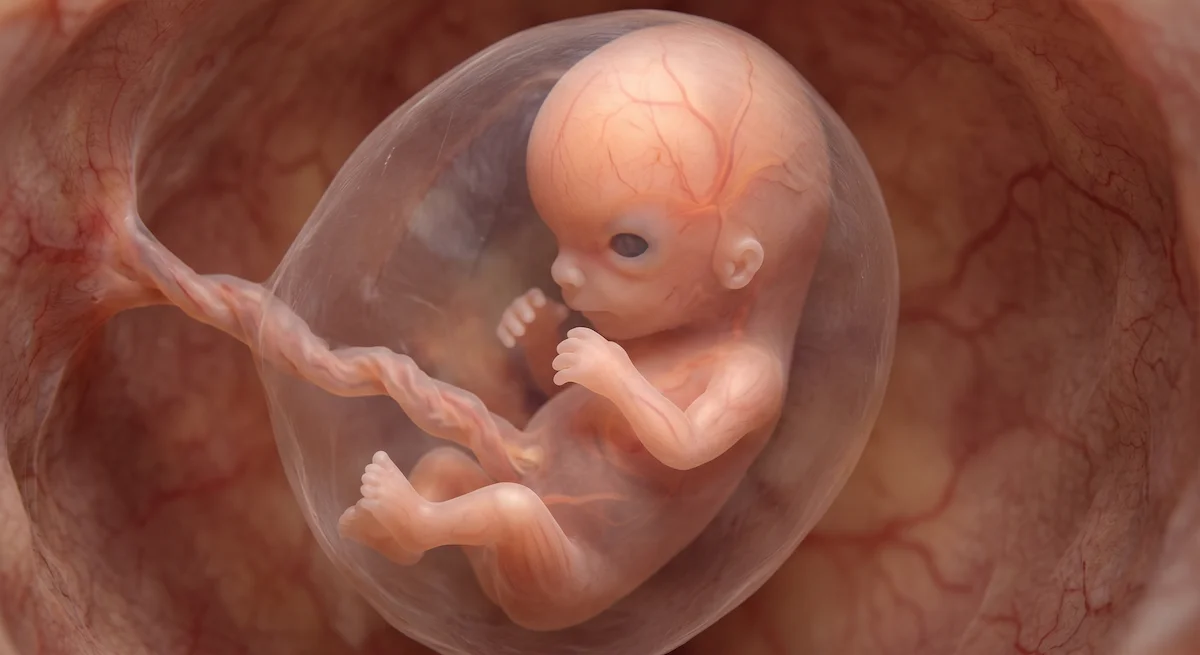
Fingerprints form during a narrow window of fetal development, between the tenth and twenty-fourth weeks of gestation. The American anatomist Harold Cummins and his colleague Charles Midlo coined the term dermatoglyphics in 1926 to name the systematic study of skin ridge patterns, but the precise developmental mechanism remained unclear until the late 1970s. It was then that anatomist William Babler published his foundational research on human fetal development, demonstrating that the patterns are determined by small mounds of tissue on the developing fingertips called volar pads. The timing and rate at which these pads regress dictate the final shape of the print. When a volar pad remains high and round, a whorl forms. When it regresses asymmetrically, a loop forms. When it stays low, an arch forms. Because identical twins experience slightly different microscopic pressures in the womb, their volar pads develop differently, ensuring their fingerprints diverge from the very beginning.
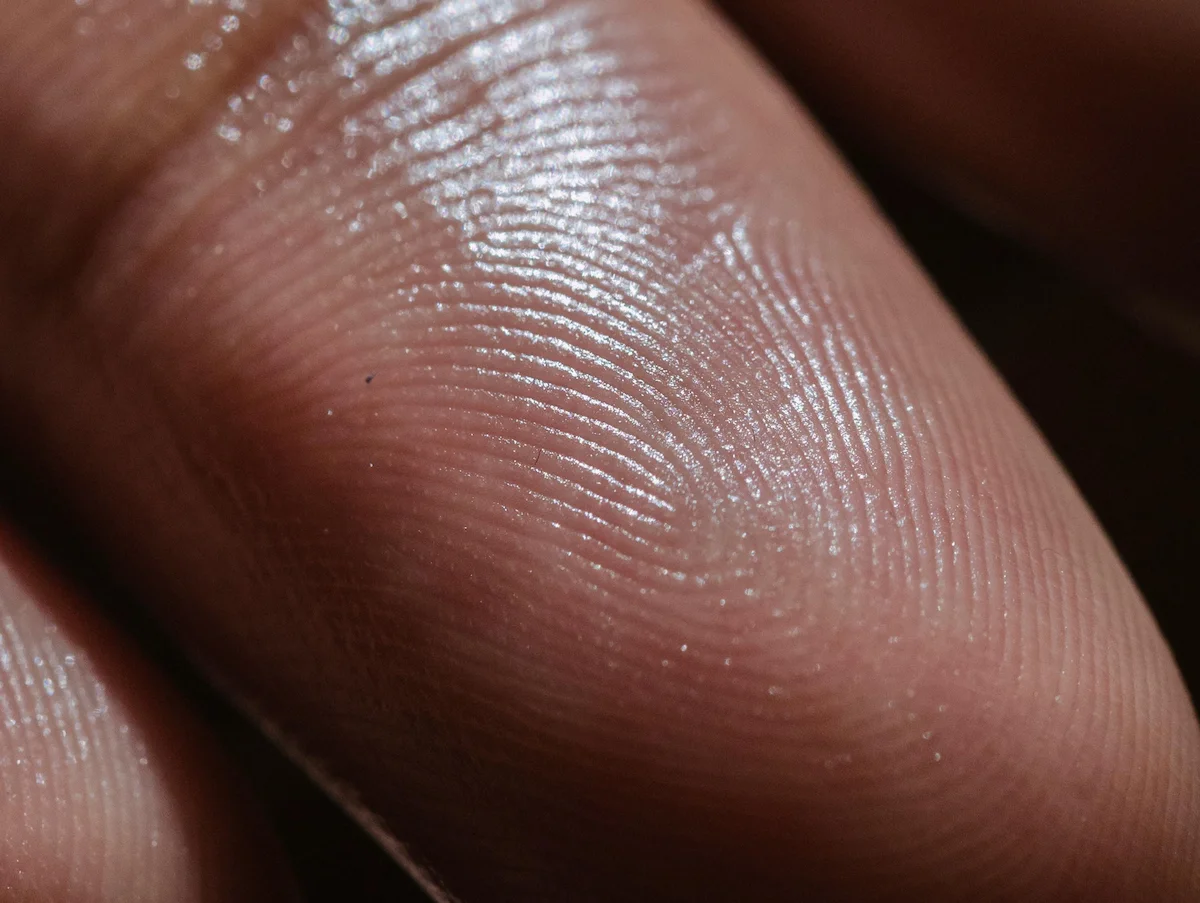
What this produces is combinatorial uniqueness at an extreme scale. A single fingerprint contains dozens of minutiae points — ridge endings, bifurcations, dots — each with a type, a position, and an orientation. The probability of two prints sharing all their minutiae in the same configuration is on the order of 1 in 10³⁰, a number so large that no two prints have ever been found to match in more than a century of forensic comparison. The scientific study of this uniqueness was established by Francis Galton in his 1892 book Finger Prints, and the operational classification system that made fingerprint identification usable by police forces worldwide was published by Sir Edward Henry four years later. Galton's statistical work established the principle. Henry's system made it possible to apply it.
That system has expanded in scale, but its basis is the same. The FBI's automated fingerprint database, brought online in 1999, holds hundreds of millions of records and can search them in minutes. The matching math depends on the configuration of minutiae points — the same features Galton was cataloguing by hand a century earlier. The operational reach of fingerprint identification rests on the biological fact that the human body grows a unique enough pattern on every fingertip that no two are alike.
Islamic Context
أَيَحْسَبُ الْإِنسَانُ أَلَّن نَجْمَعَ عِظَامَهُ بَلَىٰ قَادِرِينَ عَلَىٰ أَن نُّسَوِّيَ بَنَانَهُ
Does man think that We will not assemble his bones? Assuredly, We are able to shape his fingertips.
— Quran 75:3-4
These verses address a foundational human doubt regarding the physical mechanics of resurrection, specifically the reassembly of a decayed body. The Arabic verb anchoring the response is nusawwiya (to shpae, to level, or to bring to an exact configuration). Historically, this term generated two distinct interpretive tracks among classical scholars. A notable early view, championed by figures like Ibn ʿAbbās (d. 687) and al-Ṭabarī (d. 923), interpreted the "shaping" as a divine warning regarding human dexterity: the Creator could have simply fused the digits into a flat, uniform hoof or pad, depriving man of the delicate motor skills required to grasp, build, or write.
However, a parallel tradition held by Ibn Qutaybah (d. 889), one of the earliest authorities in Islamic linguistics, focused on the restoration of the body's smallest parts. He argued that the verse functions as a logical escalation from large-scale structure to minute detail. While the first verse names the large, heavy structural units of the body (the bones), the second focuses specifically on the banān (the fingertips). Ibn Qutaybah explicitly noted that this refers to the capacity to perfectly reconstruct the sulamiyyat—the smallest, most intricate, and delicate phalanges of the human hand. The 10th-century grammarian Al-Zajjaj reinforced this, observing that if the Creator can perfectly reconfigure the body’s most complex and delicate architectural extremity, restoring the broader skeleton is trivial by comparison. This opinion was also held by ar-Razi (d. 1210) and later cemented by Ibn Kathir (d. 1373) as the primary and most apparent meaning of the text.
In the modern era, following the scientific formalization of dermatoglyphics, this structural interpretation has become the overwhelming consensus among Islamic interpreters. Modern scholars recognize that while classical commentators accurately identified the fingertips as the ultimate site of human physical complexity, they lacked the microscopic tools to observe the architecture of the skin itself. Tafsir Al-Muntakhab, compiled by a supreme committee of scholars and scientists at Al-Azhar University, explicitly bridges this historical gap. In their commentary, they state that the banān was deliberately isolated in the text because of the fine lines and microscopic ridges resting on the tips of the fingers, which differ entirely from one person to another. By synthesizing the classical understanding of structural precision with modern biological data, contemporary commentators recognize a shift in the verse's ultimate implication: it is not merely a promise to restore a generic human anatomy, but a guarantee to precisely reconstruct an unrepeatable, absolute individual identity.
Prev Post
Next Post
Reference Timeline
600 CE
1000 CE
1500 CE
2000 CE
Quran verses 75:3-4
615 CE–632 CE
The Quran highlights the precise reassembly of the 'banān' (fingertips) as the ultimate proof of resurrection, escalating from large structural bones to the body's most intricate and delicate extremity
687 CE
Ibn ʿAbbās interprets 'shaping' as a warning regarding the loss of human dexterity, noting the Creator could have fused the digits into a flat, uniform hoof
Ibn ʿAbbās (d. 687)
889 CE
Ibn Qutaybah argues the verse functions as a logical escalation, focusing specifically on the capacity to precisely reconstruct the sulamiyyat—the smallest, most delicate phalanges
Ibn Qutaybah, Ta'wil Mushkil al-Qur'an (c. 889)
923 CE
10th-century grammarian Al-Zajjaj observes that if the Creator can perfectly reconfigure the body’s most complex architectural extremity, restoring the broader skeleton is trivial
Abū Isḥāq al-Zajjāj, Maʿānī al-Qurʾān (c. 923)
923 CE
Al-Ṭabarī reads it with the interpretation of shaping as the fusion of the fingers, which would deprive man of the delicate motor skills required to grasp or write
Muḥammad ibn Jarīr al-Ṭabarī, Jāmiʿ al-Bayān (c. 923)
1210 CE
Fakhr al-Dīn al-Rāzī systematically documents linguistic escalation, verbal precision, and the structural complexity of the fingertips (banān).
Mafātīḥ al-Ghayb, Tafsīr al-Kabīr (c. 1210)
1373 CE
Ibn Kathīr cements the physical restoration of the body's smallest and most complex parts as the primary and most apparent meaning of the text
Ismāʿīl ibn Kathīr, Tafsīr al-Qurʾān al-ʿAẓīm (c. 1373)
1892 CE
Francis Galton establishes the statistical and scientific foundation for combinatorial uniqueness in human skin ridges in his landmark book
Francis Galton, Finger Prints (1892)
1896 CE
Sir Edward Henry establishes the operational classification system that makes microscopic fingerprint identification practically usable by global police forces
Sir Edward Henry, The Classification and Uses of Fingerprints (1896)
1926 CE
Anatomists Harold Cummins and Charles Midlo coin the term 'dermatoglyphics' to formalize the systematic scientific study of skin ridge patterns
Harold Cummins and Charles Midlo (1926)
1968 CE
The scholars of Al-Azhar's Tafsir Al-Muntakhab explicitly bridge classical commentary with modern biology, noting the fingertips' microscopic ridges guarantee absolute individual identity
Al-Azhar University, Tafsīr Al-Muntakhab (c. 1968)
1978 CE
William Babler publishes foundational embryological research demonstrating that fingerprint patterns are determined by the timing and asymmetric regression of fetal volar pads
William Babler (c. 1970s)
1999 CE
The FBI brings the automated fingerprint database (IAFIS) online, operationalizing the matching of microscopic minutiae configurations across hundreds of millions of records
Federal Bureau of Investigation, IAFIS (1999)
The Connection
The Quranic shift from the reassembly of the largest skeletal bones to the precise configuration of the fingertips highlights the absolute limit of biological identity. Modern dermatoglyphics reveals that the ridges on human fingertips are not just generic skin, but an infinitely unique, combinatorially staggering record of fetal development. The verse confronts the skeptic not by claiming a general resurrection, but by pointing to the exact anatomical feature where general human biology gives way to absolute, singular identity.
Related Connections