Neuroscience
Benefit and Wickedness
Scientific Context
The Science of Inebriants and Gambling
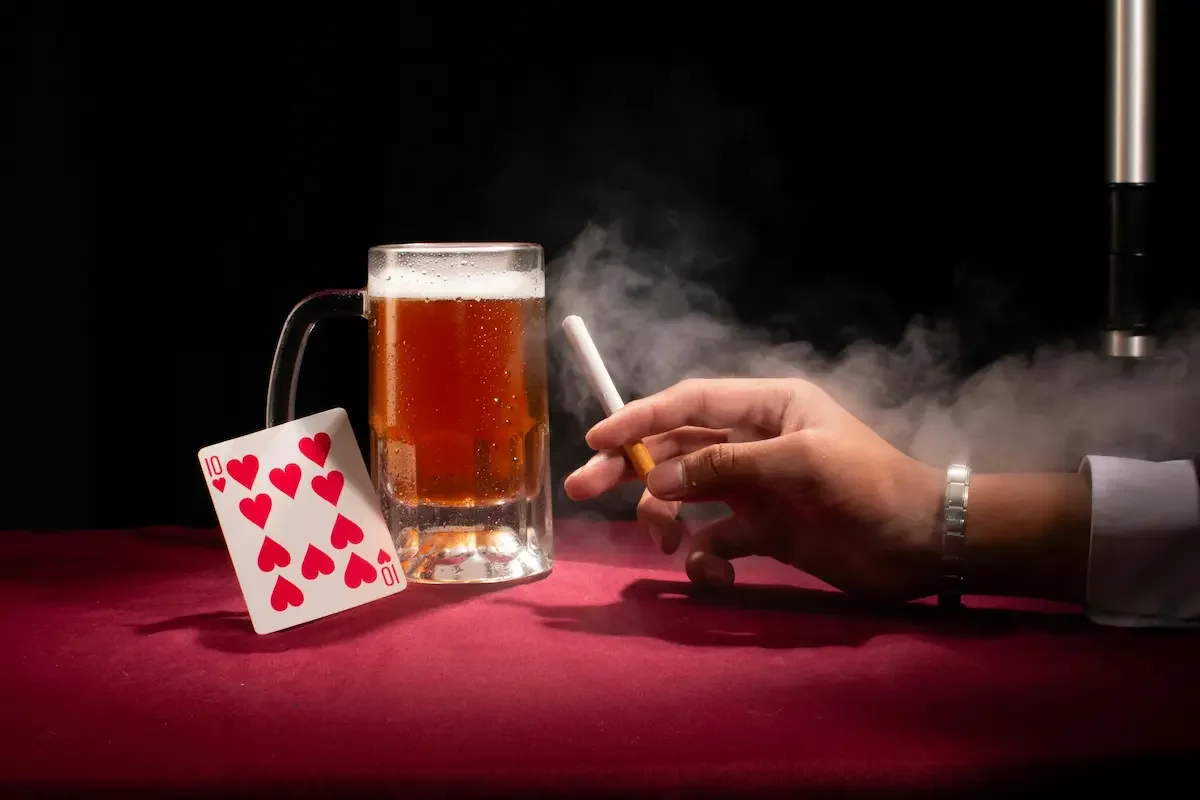
Alcohol is classified as a Group 1 carcinogen by the World Health Organization’s International Agency for Research on Cancer, placing it alongside asbestos and tobacco. When consumed, ethanol is metabolized into acetaldehyde, a toxic compound that damages DNA and impairs the body's ability to repair it. This cellular damage elevates the risk of breast, liver, colorectal, and oral cancers, leading public health authorities at both the CDC and the WHO to explicitly state that no level of alcohol consumption is safe for human health.
Beyond cellular mutation, chronic alcohol use profoundly alters the brain. A massive neuroimaging study using UK Biobank data, led by researchers at the University of Pennsylvania, demonstrated that the physical volume of grey matter measurably shrinks in drinkers. This atrophy is particularly pronounced in regions governing decision-making, impulse control, and emotional regulation. Over time, the dopaminergic reward system is hijacked: tolerance builds, withdrawal becomes physically punishing, and dependency sets in, recognized medically as alcohol use disorder.
Gambling operates on the same neurological circuitry. Building on foundational behavioral science, researchers identify its core mechanism—an intermittent reinforcement schedule of unpredictable wins amid frequent losses—as one of the most powerful drivers of compulsive behavior. Functional MRI studies, such as those directed by neuroscientist Luke Clark at the Centre for Gambling Research, demonstrate that near-misses activate the exact same reward pathways in the brain as actual wins, keeping the individual engaged at the table.
Because this resulting dependency shares so many neurobiological features with substance abuse—including craving, loss of control, and withdrawal symptoms—the American Psychiatric Association began classifying gambling disorder in the DSM-5 as a behavioral addiction in 2013. Epidemiological data tracks the fallout: populations with high gambling participation show statistically elevated rates of financial ruin, family dissolution, and suicide, with societal costs in healthcare and lost productivity that vastly exceed the revenues generated by the industry.
Islamic Context
يَسْأَلُونَكَ عَنِ الْخَمْرِ وَالْمَيْسِرِ قُلْ فِيهِمَا إِثْمٌ كَبِيرٌ وَمَنَافِعُ لِلنَّاسِ وَإِثْمُهُمَا أَكْبَرُ مِن نَّفْعِهِمَا...
They ask you about inebriants and gambling. Say, 'In them (both) are great wickedness and benefit for humanity, and their wickedness is greater than their benefit.' ...
— Quran 2:219
The Quran addresses alcohol and gambling not by immediately outlawing them, but by establishing a method for evaluating their true cost. Ibn Kathir (d. 1373) explains in his Tafsir al-Qur'an al-Azim that this verse was revealed after Umar ibn al-Khattab observed the societal and intellectual degradation caused by alcohol and prayed for a clear, decisive ruling. The revelation responded by weighing both practices on the same scale.
The verse explicitly acknowledges the worldly appeal of the activities. The word manafi' (benefits) recognizes the real financial profit of the wine trade and the sudden wealth gained through gambling. However, the text immediately places this utility against an ithm kabir—a great sin or severe harm.
Classical commentators were precise about what this ithm entails physically and mentally. Al-Qurtubi (d. 1273) notes in al-Jami' li-Ahkam al-Qur'an that the wickedness described here is fundamentally about the destruction of the intellect ('aql) and the stripping away of a person's behavioral control. Fakhr al-Din al-Razi (d. 1210) observes that while the benefit is immediate and tangible, the ithm encompasses the systemic ruin of the user's mind, driving them toward irrationality and communal fracture. The text diagnoses the harm not just as a spiritual demerit, but as the active dismantling of the faculties that allow a person to govern themselves.
The decisive clause uses the comparative form akbar (greater): the destruction is greater than the utility. This comparative reasoning served as a crucial intermediary step. Before the absolute prohibition of both alcohol and gambling was revealed in Surah Al-Ma'idah, this verse forced the early Muslim community to confront the severe imbalance of these practices. It taught that an activity with a localized reward is ultimately destructive if its underlying mechanism degrades the user, preparing the community to accept the complete ban by first laying out the sheer volume of the harm.
Prev Post
Next Post
The Connection
The Quran instructs the community to evaluate inebriants and gambling by recognizing that their systemic destruction massively outweighs their localized utility. Modern psychiatry and neuroscience show the same stark imbalance, identifying both activities as mechanisms driven by the exact same dopaminergic loops and characterized by the exact same erosion of behavioral control.
Related Connections