Physics
The Stars Wiped Out
Scientific Context
Hydrostatic Equilibrium and the Internal Balance of Stars
When we look at a star, we intuitively think of its light as a byproduct. But as British astrophysicist Arthur Eddington first demonstrated in his foundational 1926 work, The Internal Constitution of the Stars, a star’s light is not a byproduct; it is the physical structure holding the massive object together.
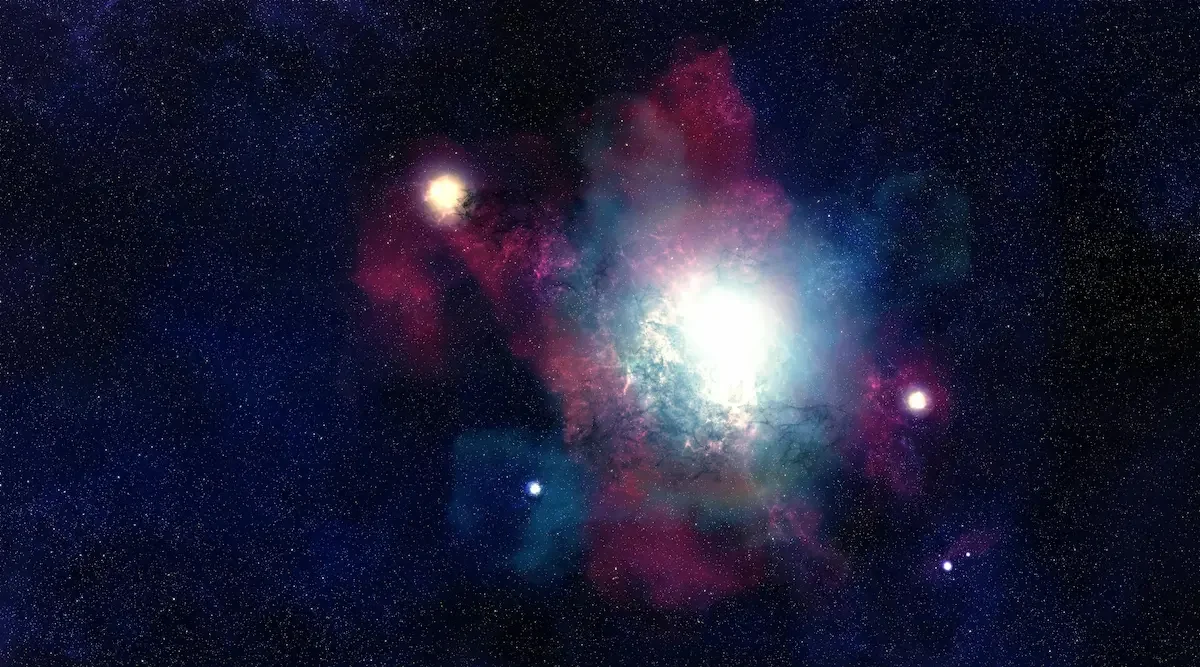
A star exists purely as a standoff between two immense forces. Deep in the core, nuclear fusion generates an incomprehensible amount of outward energy, releasing photons. This outward "radiation pressure" pushes violently against the crushing weight of the star's mass. As long as this pressure perfectly balances gravity, the star maintains what Eddington defined as hydrostatic equilibrium.
Because a star is held up entirely by its internal light, its death is not a slow fade. As documented by astronomers Walter Baade and Fritz Zwicky in 1934 when they first coined the term "supernova," the death of a massive star is a catastrophic, two-step mechanical failure.
The collapse is triggered the moment the star's internal furnace is extinguished. When a massive star burns through its final reserves of nuclear fuel, the fusion process abruptly stops. In an instant, the outward radiation pressure drops to zero, meaning the "light" inside the core literally goes out. Without this crucial outward force, gravity wins instantaneously, crushing the core inward at a fraction of the speed of light.
This immediate inward collapse is instantly followed by a violent outward tearing. As the core crushes into itself, it hits a quantum density limit and violently rebounds. This sudden bounce triggers a massive shockwave that blasts outward from the center, violently ripping the star's outer envelope apart and cleaving through the surrounding interstellar medium.
Islamic Context
فَإِذَا النُّجُومُ طُمِسَتْ ٨ وَإِذَا السَّمَاءُ فُرِجَتْ ٩
So when the stars are wiped out,
And when the heaven is cleft,
— Quran 7:8-9
Classical commentators read these verses in a world dominated by Aristotelian cosmology, which held that celestial bodies were indestructible spheres of an eternal aether. Interpreters actively rejected this premise of celestial permanence precisely because the vocabulary of Surah Al-Mursalat demanded otherwise. By focusing on the explicit verbs of physical destruction in these verses, scholars argued that the stars are not immutable objects, but vulnerable structures bound for a sudden, two-stage failure.
The first stage is an erasure of the star's defining nature. Al-Tabari (d. 923) explains in his Jami' al-Bayan that the verb ṭamasa refers to a complete maḥw—the literal wiping away of a thing's form and signature. Al-Razi (d. 1210) observes that because a star is entirely defined by its emission of light, erasing that light dismantles the nature of the object itself.
Ibn Kathir (d. 1373) grounds this structural failure theologically in his Tafsir al-Qur'an al-Azim. He notes that the continued stability of the cosmos relies entirely on God actively restraining it from collapse, an act he ties to the divine name al-Halīm (the Forbearing). The stars do not possess intrinsic, eternal permanence; they maintain their place only as long as this sustaining power holds.
The second verse names the physical consequence of this erasure: the heaven is cleft (furijat). Al-Qurtubi and Al-Baghawi define this verb as inshiqaq—a sudden, physical tearing. Al-Qurtubi (d. 1273) emphasizes that the word describes the ripping apart of a cohesive mass, leaving a ragged, gaping breach.
The text establishes a strict sequence of cause and effect. The internal existence of the star is wiped out, and this erasure acts as the immediate catalyst for the surrounding heaven to tear. The verses present a cosmology where the sudden loss of a star's internal state directly triggers the structural rupture of its environment.
Prev Post
Next Post
The Connection
The verse describes a sudden, two-stage failure: the core of a star is wiped out, and the surrounding heaven is violently cleft. Ninety years of astrophysics details a sequence that aligns directly with this progression. When a massive star's internal radiation pressure drops to zero, the core-collapse supernova that follows physically tears apart the surrounding interstellar medium. The overlap is hard to miss. Far from the ancient assumption of permanent celestial bodies, the descriptions share a picture of a volatile equilibrium whose sudden erasure rips space open.
Related Connections