Astroscience
Each in an Orbit, Swimming
Scientific Context
Planetary Motion and Orbital Mechanics
For almost two millennia, Western cosmology operated on the geocentric models of Aristotle and Ptolemy, which placed a motionless Earth at the center of the cosmos. In this classical view, the Sun, Moon, and planets were not unanchored bodies moving freely through open space. Instead, astronomers believed celestial objects were embedded within nested, transparent crystalline spheres. As these solid shells turned, they carried the heavenly bodies along in eternal, uniform circular paths, governed by principles assumed to be entirely separate from terrestrial physics.
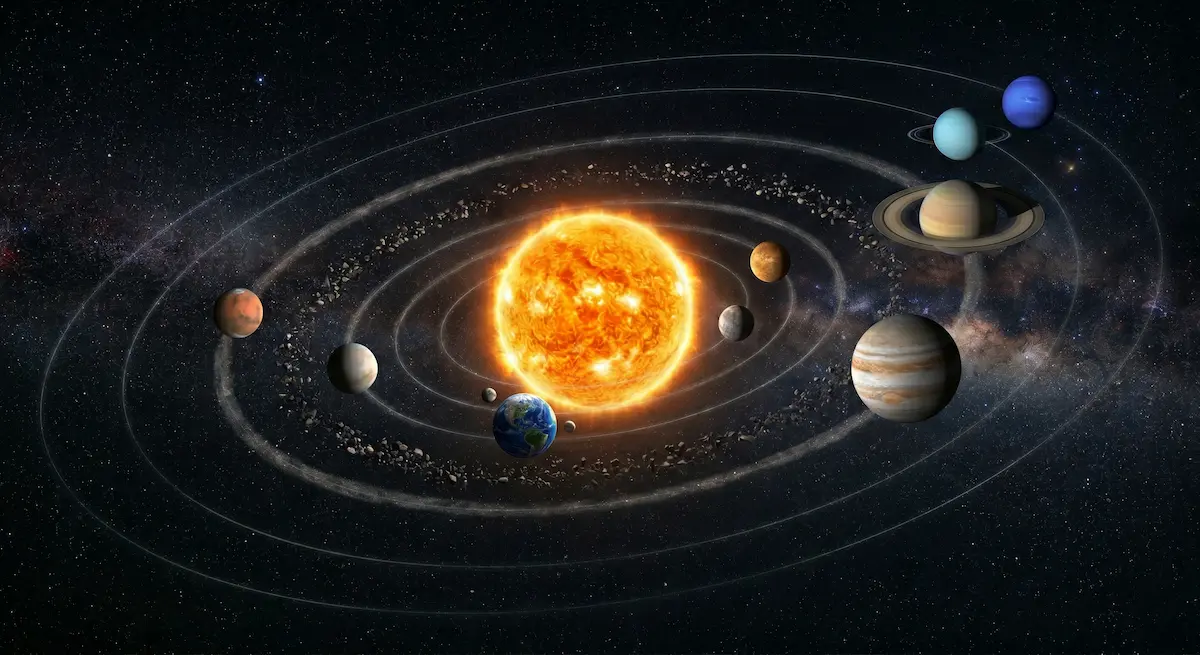
This static architecture began to crumble in the early seventeenth century. Analyzing the meticulous observational records gathered by Tycho Brahe, Johannes Kepler demonstrated that planetary paths are elliptical rather than circular, with planets accelerating near the Sun and decelerating as they move outward. Decades later, in 1687, Isaac Newton uncovered the underlying physics behind these paths in his Philosophiae Naturalis Principia Mathematica. Newton established that universal gravitation provides the continuous centripetal force required to bend a planet's forward momentum into a stable, repeating orbit, proving that the same fundamental laws govern both falling objects on Earth and bodies moving through space.
In 1915, Albert Einstein deepened this picture through general relativity. He reinterpreted gravity not as an invisible force pulling across empty space, but as the physical warping of space and time caused by mass and energy, with celestial bodies simply following the natural curves of this geometry. Over the past century, modern space-based observatories have extended these orbital mechanics far beyond our immediate planetary neighborhood. Missions like the European Space Agency's Hipparcos satellite and the Gaia observatory mapped the precise positions and trajectories of over a billion stars, confirming that the Sun itself is locked in a vast galactic orbit. Traveling at roughly 220 kilometers per second at a distance of 26,000 light-years from the galactic core, the Sun completes one full revolution every 225 to 250 million years, following a defined, calculable path through the Milky Way rather than drifting aimlessly through space.
Islamic Context
وَالشَّمْسُ تَجْرِي لِمُسْتَقَرٍّ لَّهَا ذَٰلِكَ تَقْدِيرُ الْعَزِيزِ الْعَلِيمِ وَالْقَمَرَ قَدَّرْنَاهُ مَنَازِلَ حَتَّىٰ عَادَ كَالْعُرْجُونِ الْقَدِيمِ لَا الشَّمْسُ يَنبَغِي لَهَا أَن تُدْرِكَ الْقَمَرَ وَلَا اللَّيْلُ سَابِقُ النَّهَارِ وَكُلٌّ فِي فَلَكٍ يَسْبَحُونَ
And the sun runs to a settlement of its own - that is the evaluation of The Most Esteemed, The Most Knowledgeable. And the moon — We have determined for it waypoints, until it returns like an old date stalk. It is not for the sun to approach the moon, nor does the night advance upon the day, but each is in an orbit, swimming.
— Quran 36:38-40
The Quranic description of the heavens presents the Sun and Moon not as stationary objects, but as bodies engaged in purposeful, continuous travel. When speaking of the Sun, the text uses the active verb tajrī (runs) to convey a steady, flowing motion along an established route ending in an appointed mustaqarr (settlement). Ibn ʿAbbās (d. 687) explained that this term pointed to an assigned path across the sky from which the Sun never strays, as well as an ultimate boundary set for its lifespan. In compiling the earliest comprehensive commentary, Al-Ṭabarī (d. 923) recorded that early scholars understood mustaqarr in two complementary ways: an unbroken journey through the heavens, and an appointed stopping point marked for the close of time.
This sense of ordered movement governs the lunar cycle as well: qaddarnāhu manāzila ("We appointed for it waypoints"). Early authority Qatādah (d. 735) observed that the verse focuses on a changing journey rather than a static appearance, tracking how the Moon occupies a distinct station each night as its shape gradually transforms across the month. The close of this sequence is captured through a tangible image: kal-ʿurjūn al-qadīm (like the old date stalk). Mujāhid ibn Jabr (d. 722) noted that as a date branch dries and ages on the palm, it withers, pales, and curls into a slender, bowed arc, matching the thin crescent of the waning moon just before the new cycle begins.
The passage brings these paths together with the closing phrase, kullun fī falakin yasbaḥūn (each is in an orbit, swimming). To illustrate falak, early scholars turned to a familiar tool; Ibn ʿAbbās and eighth-century linguist, Al-Khalīl ibn Aḥmad (d. 786), defined falak as a circular course, comparing its motion to the rounded whorl of a hand spindle that turns smoothly and continuously. The accompanying verb, yasbaḥūn (drawn from the language of swimming or gliding smoothly across water), evokes effortless motion across the sky. In Maʿānī al-Qurʾān, early grammarian Al-Farrāʾ (d. 822) explained that the phrasing gives each heavenly body its own assigned route, traveling along separate, non-overlapping paths in complete order without one overtaking or striking the other.
Prev Post
Next Post
Reference Timeline
1 CE
600 CE
1000 CE
1500 CE
2000 CE
Quran verses 36:38-40
615 CE–622 CE
Describes the Sun travelling along a designated course, the Moon progressing through sequential stages, and celestial bodies smoothly traversing their own independent orbits
350 BCE
Aristotle establishes geocentric cosmology, proposing that the Sun, Moon, and planets are embedded within nested crystalline spheres that carry them along circular paths around a motionless Earth
Aristotle, On the Heavens (De Caelo) (c. 350 BCE)
150 CE
Claudius Ptolemy codifies the mathematical geocentric system, utilizing epicycles and deferents to calculate planetary motion within the rigid celestial sphere framework
Claudius Ptolemy, Almagest (c. 150)
687 CE
Ibn ʿAbbās defines mustaqarr as an assigned, preordained path and falak as a rounded circuit analogous to the whorl of a spinning spindle
Ibn ʿAbbās (d. 687)
735 CE
Qatādah ibn Diʿāmah explains manāzil as a calculated, nightly sequence of distinct lunar waypoints spanning the month
Qatādah ibn Diʿāmah (d. 735)
786 CE
Al-Khalīl ibn Aḥmad formally documents falak in classical lexicography (Kitāb al-ʿAyn) as the circular, rounded track traced by celestial bodies
Al-Khalīl ibn Aḥmad al-Farāhīdī, Kitāb al-ʿAyn (c. 786)
822 CE
Al-Farrāʾ analyzes yasbaḥūn in Maʿānī al-Qurʾān as frictionless, continuous gliding along distinct, non-colliding celestial pathways
Al-Farrāʾ, Maʿānī al-Qurʾān (c. 822)
1609 CE
Johannes Kepler establishes that planetary orbits are elliptical rather than circular, with orbital speeds changing systematically relative to distance from the Sun
Johannes Kepler, Astronomia Nova (1609)
1687 CE
Isaac Newton demonstrates that universal gravitation provides the continuous centripetal force governing planetary paths, uniting terrestrial and celestial physics
Isaac Newton, Philosophiae Naturalis Principia Mathematica (1687)
1915 CE
Albert Einstein formulates general relativity, reinterpreting gravity as the physical warping of space and time along which celestial bodies naturally move
Albert Einstein, General Theory of Relativity (1915)
2013 CE
The European Space Agency's Gaia observatory maps over a billion stars, measuring the Sun's calculable 225-to-250-million-year orbit around the Milky Way galactic core
European Space Agency, Gaia Mission (2013)
The Connection
The Quranic description of celestial motion completely bypasses the ancient illusion of a static sky or a rigidly fixed Sun. By defining the cosmos as a system where massive bodies "swim" along independent, non-intersecting courses toward defined destinations, the text captures the precise kinematic nature of orbital mechanics. It rejects the idea of chaotic drift or falling, presenting instead a frictionless, perfectly balanced momentum. The result is a mathematically precise universe where every entity, from the Moon tracing its phased stations to the Sun hurtling along its galactic trajectory, glides through the vacuum exactly as modern astrophysics observes.
Related Connections