Astroscience
Each Swimming in an Orbit
Scientific Context
Planetary Motion and Orbital Mechanics
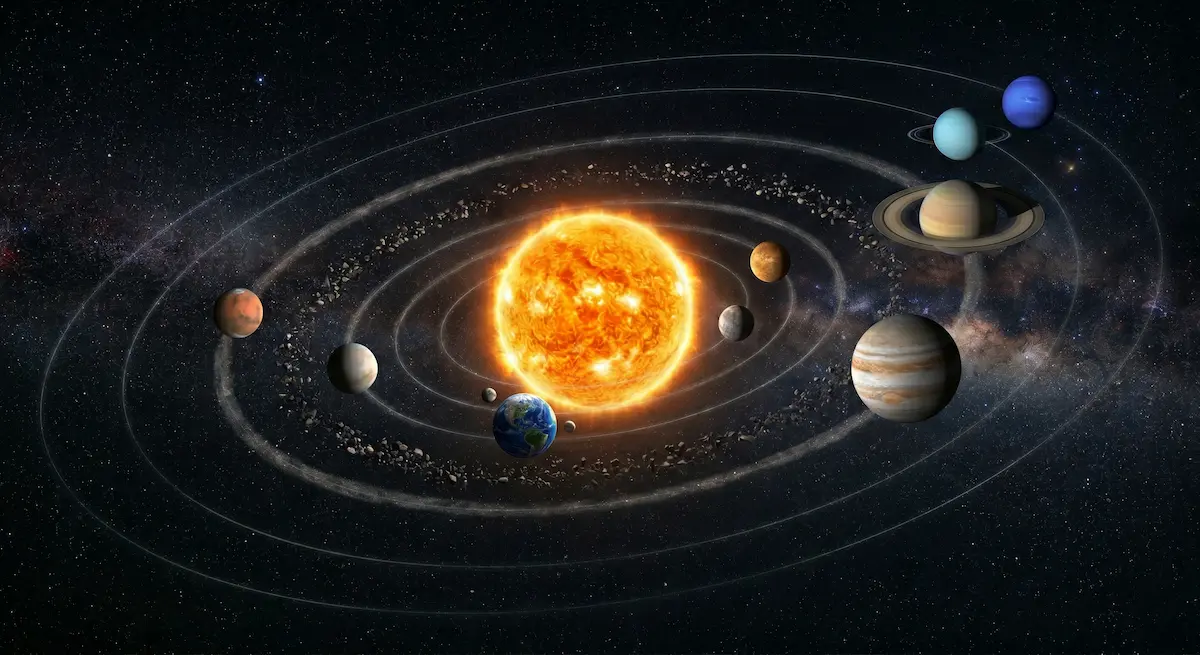
The cosmos is in motion at every scale. The Earth completes one orbit around the Sun every 365.25 days, traveling at an average of about 107,000 kilometres per hour at a mean distance of 150 million kilometres. The Moon circles the Earth every 27.3 days. The Sun itself, together with the entire solar system, orbits the centre of the Milky Way galaxy, completing one revolution roughly every 225 to 250 million years. Nothing in the visible universe is stationary. Everything moves along paths shaped by gravity and by the momentum it carries.
The discovery that celestial bodies follow predictable orbits was one of the great milestones of science. In the early seventeenth century, Johannes Kepler, working from observations collected by the Danish astronomer Tycho Brahe, demonstrated that the planets move in elliptical paths with the Sun at one focus. Kepler’s three laws of planetary motion (the ellipse, the area law, and the harmonic law) gave the geometry of the orbits. A generation later, Isaac Newton supplied the underlying physics: gravity provides the centripetal force that keeps each planet in its path, balancing the planet’s tendency to fly off in a straight line. By the twentieth century, Albert Einstein’s general relativity refined the picture further, replacing the Newtonian gravitational force with the geometry of curved spacetime. The precision of orbital mechanics is what makes spaceflight possible: positions can be calculated centuries in advance, and missions to distant targets can be timed to the second.
The same orbital precision has now been measured outward and inward. Modern astrometry (the science of charting stellar positions with extreme precision) has confirmed that the Sun itself is moving through the galaxy at roughly 220 kilometres per second, on a vast orbit that takes it around the galactic centre. The European Space Agency’s Hipparcos satellite, launched in 1989, refined earlier ground-based measurements of the solar apex — the direction in which the Sun is travelling. ESA’s follow-up mission, Gaia, has been tracking the positions and motions of more than a billion stars since 2014, producing the most precise picture yet of the Sun’s path through the Milky Way. The Sun, by the time this mission is complete, will be known to be on a specific, calculable trajectory — not drifting, not wandering, but following its own orbit within a larger system.
Islamic Context
وَالشَّمْسُ تَجْرِي لِمُسْتَقَرٍّ لَّهَا ۚ ذَٰلِكَ تَقْدِيرُ الْعَزِيزِ الْعَلِيمِ وَالْقَمَرَ قَدَّرْنَاهُ مَنَازِلَ حَتَّىٰ عَادَ كَالْعُرْجُونِ الْقَدِيمِ لَا الشَّمْسُ يَنبَغِي لَهَا أَن تُدْرِكَ الْقَمَرَ وَلَا اللَّيْلُ سَابِقُ النَّهَارِ ۚ وَكُلٌّ فِي فَلَكٍ يَسْبَحُونَ
And the sun runs to a settlement of its own - that is the evaluation of The Most Esteemed, The Most Knowledgeable. And the moon — We have determined for it waypoints, until it returns like an old date stalk. It is not for the sun to approach the moon, nor does the night advance upon the day, but each is in an orbit, swimming.
— Quran 36:38-40
These verses cite a place the Sun is moving toward. The verb tajrī (runs) and the noun mustaqarr (a determined destination or fixed course) describe a journey with a defined endpoint, not random drift. Early authorities read mustaqarr in different ways. Al-Ṭabarī (d. 923) and al-Qurṭubī (d. 1273) both recorded two main readings: mustaqarr as a daily resting point, the place where the Sun sets at the end of its day’s travel, and mustaqarr as a fixed orbit, the determinate path the Sun follows in the larger structure of the heavens. Both readings take the word seriously as an indicator for something defined, not as a general statement about motion.
The verse then turns to the Moon. Qaddarnāhu manāzila "We have determined for it waypoints" describes the lunar cycle as a sequence of defined positions, each one a manzil, a place the Moon passes through. Al-Rāzī (d. 1210) observed that the choice of the plural manāzil rather than a singular form is significant: the verse is not naming a single phase but a sequence of them. The comparison that follows — ka-l-'urjūn al-qadīm, like an old date stalk — is a visual description of the thin curved crescent at the end of the waning month. Al-Qurṭubī noted that the comparison works because the curved profile of a dried date palm stalk closely matches the shape of the slender waning crescent. The verse is being deliberately concrete about how the cycle ends.
The closing clause of the passage is the extremely impactful. Kullun fī falakin yasbaḥūn — "each is in an orbit, swimming." The word falak in classical Arabic names a rounded course, the path of a celestial body. Yasbaḥūn, they swim, denotes a smooth motion through a medium — not falling, not being pushed, but gliding. Mujāhid and Ibn Kathīr (d. 1373) both noted the choice of the verb. The image of swimming captures something other verbs do not: the celestial bodies are not static and nor are they in free fall, but are in a medium, following a path. Each has its own falak, and the orbits do not intersect. The Sun does not catch the Moon; the night does not outrun the day. Each moves in the path assigned to it.
Prev Post
Next Post
The Connection
The Quranic description of celestial motion completely bypasses the ancient illusion of a static sky or a rigidly fixed Sun. By defining the cosmos as a system where massive bodies "swim" along independent, non-intersecting courses toward defined destinations, the text captures the precise kinematic nature of orbital mechanics. It rejects the idea of chaotic drift or falling, presenting instead a frictionless, perfectly balanced momentum. The result is a mathematically precise universe where every entity, from the Moon tracing its phased stations to the Sun hurtling along its galactic trajectory, glides through the vacuum exactly as modern astrophysics observes.