Bioscience
A Cure for Everything but Death
Scientific Context
The Science of Thymoquinone
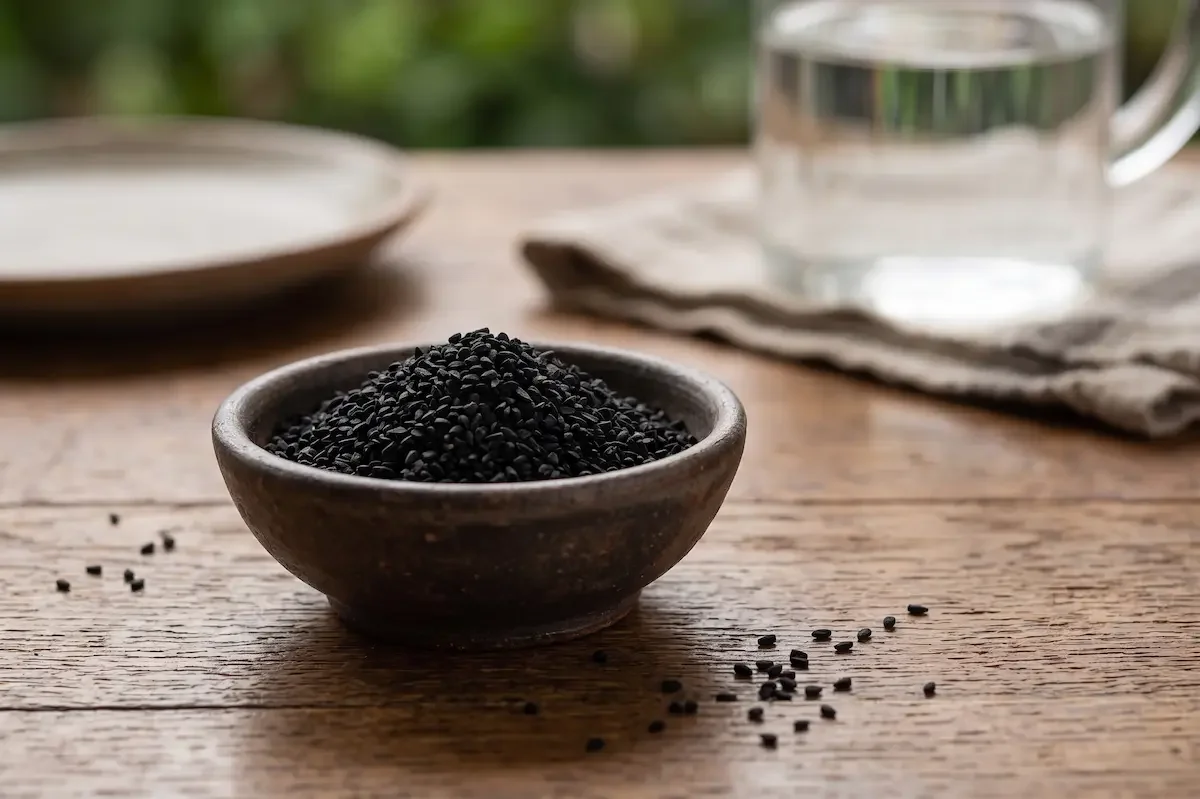
Black seed (Nigella sativa) has been a staple of traditional medicine across the Middle East, South Asia, and North Africa for over two thousand years. Physicians in the Islamic Golden Age heavily relied on it, yet the biological mechanism behind its effectiveness remained a mystery until recently. Modern pharmacology has isolated its primary active compound: thymoquinone. What makes thymoquinone unique is its ability to influence multiple, entirely distinct biological pathways simultaneously—a rare property that explains its unusually broad therapeutic range.
Most compounds target a single system, but thymoquinone acts as a systemic modulator. For pain and swelling, it blocks the exact same inflammatory enzymes targeted by common drugs like ibuprofen, but without damaging the stomach lining or kidneys. Research from King Saud University demonstrated that thymoquinone actively suppresses cytokines—the proteins that trigger tissue damage—while simultaneously forcing the body to boost its own antioxidant production. In animal models, it reduced inflammatory markers by up to 60 percent across multiple organ systems.
This systemic reach extends to metabolic and neurological health. A comprehensive 2016 clinical analysis found that black seed supplementation lowered fasting blood sugar by an average of 17 mg/dL in patients with type 2 diabetes. Researchers identified a three-pronged mechanism: the compound helps regenerate insulin-producing cells, makes existing cells more responsive to insulin, and slows sugar absorption in the gut.
Because thymoquinone successfully crosses the blood-brain barrier, it also operates on cognitive pathways. It blocks the enzyme that breaks down acetylcholine, a chemical messenger essential for memory and learning—mirroring the exact mechanism used by modern Alzheimer's medications. Furthermore, the natural oil present within the seed acts as a built-in lipid carrier, ensuring the compound is efficiently absorbed and distributed throughout the body. It is this unique architecture—a potent systemic modulator paired with a highly bioavailable delivery method—that allows a single plant to actively regulate inflammation, metabolism, and neurology all at once.
Islamic Context
إِنَّ فِي الْحَبَّةِ السَّوْدَاءِ شِفَاءً مِنْ كُلِّ دَاءٍ إِلَّا السَّامَ
Use this black seed, for indeed it contains a cure for every disease except death.
— Hadith Sahih al-Bukhari 5688, Sahih Muslim 2215
The significance of black seed in Islamic tradition rests on a highly authenticated statement from the Prophet Muhammad (peace be upon him). The text employs the command form istaʿmilū ("use"), shifting the statement from a general observation into an active medical prescription. The phrase al-ḥabbat as-sawdāʾ uses the definite article, specifying a particular, known plant rather than generic black seeds, which classical scholars unanimously identified as Nigella sativa.
The word shifāʾ (cure or healing) derives from the verb shafā, which carries the meaning of restoration and the removal of harm. In classical Arabic, shifāʾ implies not merely the temporary suppression of a symptom, but the return of the body to systemic balance and health.
The classical Islamic medical tradition took this prophetic statement and integrated the seed directly into clinical practice. In his foundational medical encyclopedia, The Canon of Medicine, Ibn Sina (Avicenna) recorded that black seed stimulates the body's internal energy and helps overcome systemic exhaustion. Later, the 14th-century physician Ibn al-Qayyim dedicated an extensive section to the seed in his medical treatises. He explained its incredibly broad efficacy by noting that it clears internal blockages, reduces unhealthy inflammation, and restores baseline balance across the entire body. For these classical physicians, the seed was not a targeted drug for a single ailment, but a foundational restorer of overall systemic function.
The phrase "every disease" (kull dāʾ) was the focal point of classical textual commentary. In Arabic rhetoric, the word kull (every/all) frequently functions as a generalization indicating a massive, comprehensive scope rather than strict, literal universality. The foundational scholar Ibn Hajar al-Asqalani explained that the text is pointing to the seed's extraordinarily broad therapeutic range across multiple categories of illness, not claiming it is a magical panacea that cures every possible pathology without exception.
This understanding is locked into place by the immediate qualification: "except death" (illā as-sām). Al-Qurtubi noted that this exclusion strengthens the medical claim rather than weakening it. It acknowledges that healing operates strictly within natural, physiological limits. The seed addresses treatable conditions across the human system, but it does not override the fundamental biological transition from life to death.
Prev Post
Next Post
The Connection
The Prophetic tradition describes black seed not as a magical cure-all, but as a highly comprehensive restorative bounded by natural mortality. Modern pharmacology has isolated exactly why this occurs, identifying a single compound—thymoquinone—that actively crosses distinct physiological barriers to reduce inflammation, regulate metabolism, and protect cognitive function simultaneously. Both the classical textual commentary and modern biochemical analysis isolate the exact same phenomenon: an unusually broad therapeutic agent that operates across the entire human system, the black seed.
Related Connections