Bioscience
Springs of Camphor and Ginger
Scientific Context
The Science of Thermal Perception
Camphor and ginger have been staples of traditional medicine for thousands of years. Ancient physicians applied camphor to relieve muscle pain and prescribed ginger for digestive distress. Modern pharmacology has finally identified the exact mechanism behind their efficacy: both compounds literally hack the human nervous system's temperature-sensing network, creating intense sensations of cooling or warming without actually changing the physical temperature of the tissue.
Understanding how this works was one of the most significant breakthroughs in modern biology. The discovery of how the human nervous system uses specialized neural sensors called TRP channels to perceive temperature and pain was so profound that it earned Dr. David Julius the 2021 Nobel Prize in Physiology or Medicine. His research detailed exactly how molecules like those found in camphor and ginger interface with these specific sensory pathways.
The human body detects cold through a specific neural sensor called TRPM8. This is the exact receptor that fires when your skin is exposed to physically freezing temperatures (below 26°C / 79°F). When camphor binds to this receptor, it chemically triggers the channel. The brain registers a profound cooling sensation, which initiates a neurological trick: it increases local blood flow and actively blocks pain signals from reaching the brain. This mechanism explains why low concentrations of topical camphor provide such highly effective, non-damaging relief for inflamed joints and muscle strain.
Ginger operates through the exact opposite neural pathway. Its active compounds, gingerols, bind to TRPV1—the heat-sensitive receptor that fires in response to physically burning temperatures (above 43°C / 109°F). This chemical activation triggers vasodilation, increasing circulation and generating a wave of subjective warmth throughout the digestive tract. This warming stimulation is highly therapeutic; clinical analyses show it significantly reduces nausea and blocks the exact same inflammatory enzymes targeted by ibuprofen, but without irritating the stomach lining.
By chemically activating these opposing thermal receptors, camphor and ginger act as pharmacological modulators. They deliver the therapeutic benefits of extreme cold (pain relief and reduced inflammation) and extreme heat (increased circulation and muscle relaxation) without subjecting the body's tissues to the actual physical damage of freezing or burning.
Islamic Context
— إِنَّ الْأَبْرَارَ يَشْرَبُونَ مِن كَأْسٍ كَانَ مِزَاجُهَا كَافُورًا
— وَيُسْقَوْنَ فِيهَا كَأْسًا كَانَ مِزَاجُهَا زَنْجَبِيلًا
— وَيُسْقَوْنَ فِيهَا كَأْسًا كَانَ مِزَاجُهَا زَنْجَبِيلًا
— Indeed, the righteous will drink from a cup whose mixture is of camphor.
— And they will be given to drink a cup whose mixture is of ginger.
— And they will be given to drink a cup whose mixture is of ginger.
— Quran 76:5 and 76:17
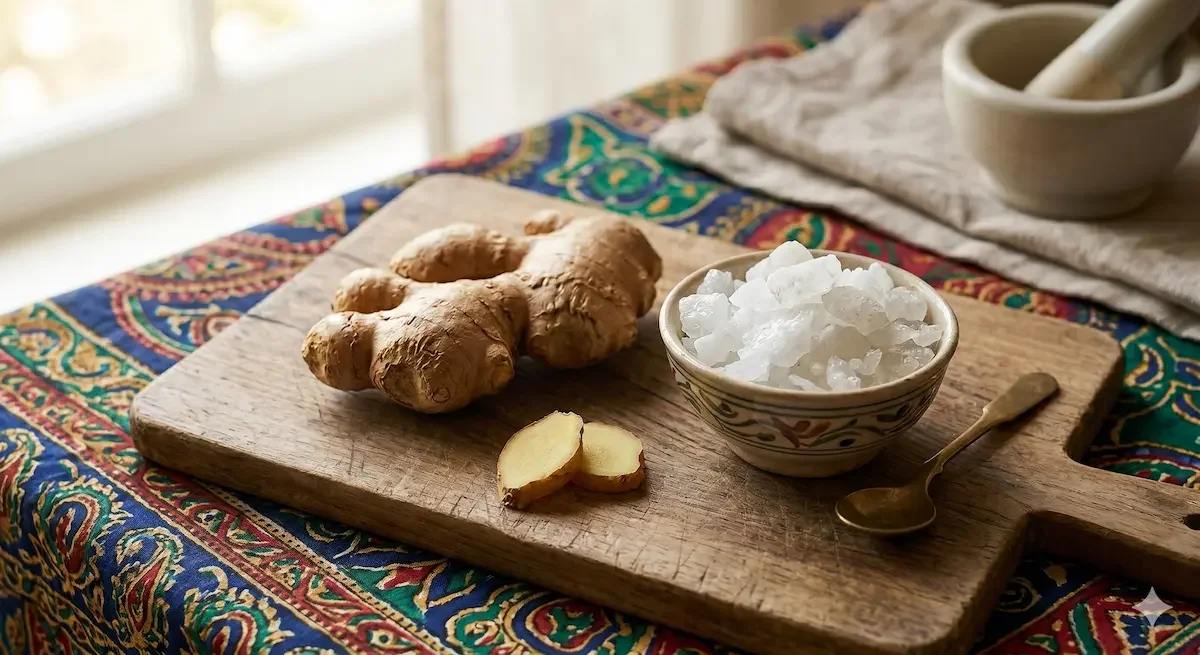
Surah Al-Insan presents two specific beverages prepared for the righteous in paradise. The text explicitly separates them: verse 5 describes a drink mixed with camphor (kāfūr), while twelve verses later, verse 17 describes a separate drink mixed with ginger (zanjabīl).
The verses anchor both descriptions with the word mizāj (mixture), which derives from the verb meaning to blend or temper. In classical Arabic, this word does not simply mean a random assortment of ingredients; it implies a highly intentional composition designed to moderate and balance the effects of the drink.
Quranic interpreters paid close attention to why the text separates these two specific ingredients. Ibn Abbas (d. 687) noted that the camphor provides a profound, soothing coolness, while the ginger provides a stimulating warmth. Al-Qurtubi (d. 1273) emphasized that the verses mention them separately to indicate they represent entirely different experiential states. The pairing reflects a principle of ultimate physiological and sensory balance—providing the righteous with complementary opposites that span the entire spectrum of sensory satisfaction.
Linguistically, the word kāfūr shares its origins with the verb kafara, meaning to conceal, cover, or even soothe. Classical commentators, such as Mujahid, noted that the camphor of paradise transcends its earthly counterpart, offering a pure cooling effect that masks or completely covers any worldly exhaustion or heat. Conversely, ginger (zanjabīl) was highly prized in pre-Islamic trade networks specifically for its sharp, penetrating warmth. The early scholar Qatadah observed that in paradise, this warming root is transformed into a continuously flowing spring. On earth, they are functional medicines used to alter the body's state; in the hereafter, their opposing thermal properties are elevated into pure, perfectly balanced delight.
Prev Post
Next Post
The Connection
The Quranic text explicitly pairs a cooling agent and a warming agent as the ultimate sensory beverages of paradise, describing them as carefully tempered mixtures. Modern neurobiology reveals that these two specific plants represent perfect biological opposites, chemically activating the cold-sensing and heat-sensing neural receptors of the human body. Both the classical textual commentary and modern pharmacology highlight the exact same symmetry: a perfect, complementary balance between cooling relief and warming stimulation that spans the complete spectrum of human thermal perception.
Related Connections